

Home
Clinical
Finishing & Polishing
Polishing Paste
Polishing Pastes
Dental Creations Z-Shine Diamond Polishing Kit
Home
Laboratory
Finishing & Polishing
Polishing Paste
Polishing Pastes
Dental Creations Z-Shine Diamond Polishing Kit
View all 5




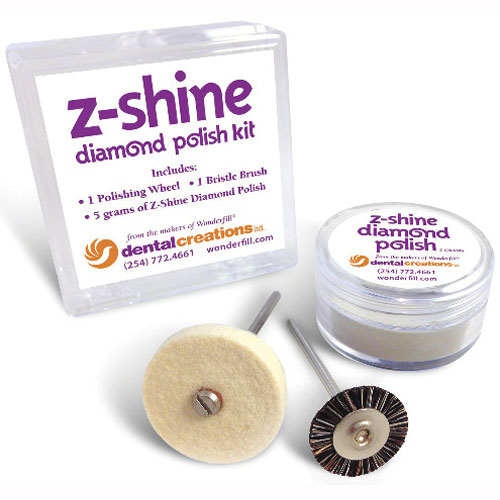
Dental Creations Z-Shine Diamond Polish Kit – 5 g Polish with Wheels (Dental Creations item #800) One-step diamond polish kit for a high gloss finish on dental restorations. • High gloss finish on all restorations with one step in 30 seconds or less (per Dental Creations). • Especially designed for e.max and zirconia crowns (per Dental Creations). • Can be used with any restoration material (per Dental Creations). • Water soluble; cleanup takes about 20 seconds (per Dental Creations). In the package: 5 g of diamond polish, 1 #11 soft brush wheel and 1 felt wheel, 1 in. x 1/8 in. How it's used: For a natural surface luster on e.max or zirconia, use the #11 soft brush wheel with Z-Shine. It rinses off with a toothbrush and water in a few seconds. For use by a dental professional. Manufacturer: Dental Creations, Ltd., Waco, TX, USA.
Product
- Manufacturer
- Dental Creations
- Manufacturer #
- 800
- Item code
- 090-0006
- UPC / Barcode
- 800
Catalog path
- Marketplace
- Clinical · Laboratory
- Category
- Finishing & Polishing
- Subcategory
- Polishing Paste
Ordering
- Status
- In stock
- Weight
- 0.13 lb
More from Polishing Paste
Stocked in the same subcategory.


Questions
What is it used for?
Dental Creations Z-Shine Diamond Polish Kit – 5 g Polish with Wheels (Dental Creations item #800) One-step diamond polish kit for a high gloss finish on dental restorations. • High gloss finish on all restorations with one step in 30 seconds or less (per Dental Creations). • Especially designed for e.max and zirconia crowns (per Dental Creations). • Can be used with any restoration material (per Dental Creations). • Water soluble; cleanup takes about 20 seconds (per Dental Creations).
When does it ship?
In-stock orders placed before 3 PM ET ship the same day. An item we don't keep on the shelf shows its own ship-by date on its page, and you can cancel it for a full refund until it ships.Ground shipping is free over $49.
About polishing pastes
A polishing paste is the loose-abrasive step: published work describes it as the final stage, applied after the sequence of abrasive discs, giving a smooth and glossy surface. A study of diamond pastes found they improved surface roughness, gloss and colour stability, and had no effect on the surface microhardness of the composites. The FDA form of words for the same thing is a device in paste or powder form containing an abrasive material, intended to remove debris from the teeth.
A polishing paste is loose abrasive in a carrier, applied with a cup, brush or wheel rather than mounted on a shank. A glossary defines a polishing agent as any material used to impart lustre to a surface. The FDA regulates the paste or powder form as an oral cavity abrasive polishing agent, a Class I device containing an abrasive material such as silica pumice and intended to remove debris from the teeth (21 CFR 872.6030). The same section says the abrasive polish is applied to the teeth by a handpiece attachment, the prophylaxis cup. That cup has its own FDA listing: a Class I device made of rubber, held by a dental handpiece and used to apply polishing agents during cleaning (21 CFR 872.6290).
Pumice is one of the classical abrasives: a glossary describes it as a type of volcanic glass used as an abrasive, prepared in various grits. Whiting is another, pure white chalk that has been ground and washed, used for polishing dental materials. Modern pastes are more often diamond or aluminium oxide: a review lists diamond polishing pastes among the adjuncts that reached surface roughness below 0.2 microns.
What to look at when choosing a polishing paste
Particle size: a study applied diamond pastes of under one micron, one micron and half a micron and found no statistically significant difference between them. The authors reasoned that no differences were found because all the diamond particle sizes were smaller than one micron.
How it is used: published work reports that the outcome depends on the composition of the paste, how long it is applied, the pressure applied, and whether the procedure is dry or wet.
What carries it: pastes are usually applied with flexible rubber cups, and published work notes that felt polishing brushes and other special abrasives have been suggested to enhance their effect.
What it is used on: a review notes that systems containing diamond particles, or adjuncts such as diamond polishing pastes, reached surface roughness below 0.2 microns.
Sources: Büyükpolat et al. 2025, The effect of polishing pastes on the surface roughness, microhardness, gloss, and color change of resin composites (BMC Oral Health) · The Glossary of Prosthodontic Terms, 9th edition (J Prosthet Dent 2017) · FDA 21 CFR 872.6030, Oral cavity abrasive polishing agent · FDA 21 CFR 872.6290, Prophylaxis cup · Polishing systems for modern aesthetic dental materials: a narrative review, 2024 (Br Dent J)
