

RMH3 DentalIn stock
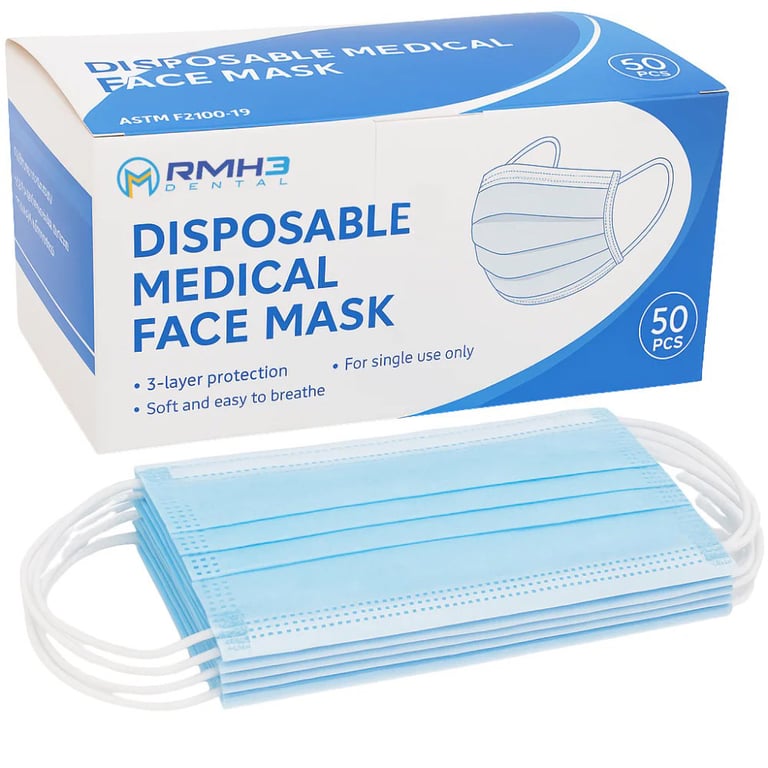
RMH3 Dental Disposable Face Masks, Earloop — 50/Box · Pleated · Blue
SKU 001-0014MFR# FMRB50
Type
Pleated
Pleated$4.99
ASTM Level 3$6.45
Color
Blue
Blue$4.99
BlackPink
The Face Mask, ASTM Level 3, Blue is a disposable 4-ply ear-loop mask designed for infection control and sterilization within a dental setting. It functions as personal protective equipment to provide a barrier against fluid penetration.
This mask is ASTM Level 3 rated, indicating high fluid resistance. It is supplied in blue, with 50 masks per box. This configuration suits dental practices requiring a high level of protection for routine clinical procedures.
Product
- Manufacturer
- RMH3 Dental
- Manufacturer #
- FMRB50
- Item code
- 001-0014
Catalog path
- Marketplace
- Clinical
- Category
- Gloves, Masks & Apparel
- Subcategory
- Masks
Ordering
- Status
- In stock
More from Masks
Stocked in the same subcategory.


RMH3 Dental
Blue Disposable Isolation Gowns, One Size Fits All (Regular/Large) — 50/Case
In stock
127 sold this month$25.58


Questions
What is it used for?
The Face Mask, ASTM Level 3, Blue is a disposable 4-ply ear-loop mask designed for infection control and sterilization within a dental setting.
Which type and color options are on this page?
This page carries 2 type options: Pleated, ASTM Level 3. This page carries 3 color options: Blue, Black, Pink. Pick one to see its price, part number and stock.
How many come in a pack?
50 per pack; the price shown is per pack.
When does it ship?
In-stock orders placed before 3 PM ET ship the same day; anything not on our shelf ships within 3 business days.Ground shipping is free over $10.
About masks
A surgical mask is a loose-fitting, disposable device that creates a physical barrier between the mouth and nose of the wearer and potential contaminants in the immediate environment. The same product may be labelled surgical, isolation, dental or medical procedure mask, and it may come with or without a face shield. Surgical masks are regulated under 21 CFR 878.4040. That section covers surgical apparel and places surgical gowns and surgical masks in Class II with special controls.
Worn properly, a surgical mask is meant to help block large-particle droplets, splashes, sprays or splatter that may contain germs from reaching the mouth and nose, and may also help reduce exposure of the wearer's saliva and respiratory secretions to others. By design it does not filter or block very small particles in the air, and the loose fit between the mask and the face means it does not give complete protection. Surgical masks are not intended to be used more than once, and are removed and replaced if damaged or soiled or if breathing through the mask becomes difficult. A face mask that only covers the nose and mouth is not personal protective equipment, and because it may meet no fluid barrier or filtration level it is not a substitute for a surgical mask or a respirator.
In dental settings the CDC describes a surgical mask as protecting against microorganisms generated by the wearer, with more than 95 percent bacterial filtration efficiency, and as also protecting the wearer from large-particle droplet spatter. When a mask becomes wet from exhaled moist air, resistance to airflow rises and more air passes around the edges of the mask, so a wet mask is changed. The majority of surgical masks are not certified by NIOSH as respirators and do not satisfy the OSHA requirements for respiratory protection, although certain surgical N95 respirators do. An N95 respirator is designed to achieve a very close facial fit and very efficient filtration of airborne particles, with edges made to form a seal around the nose and mouth. Surgical N95 respirators are Class II devices regulated by the FDA under 21 CFR 878.4040 and by CDC NIOSH under 42 CFR Part 84.
What to look at when choosing a mask
Fluid resistance is the ability of the mask's material to resist the penetration of blood and body fluids. The FDA points to a synthetic blood test run on a pass or fail basis at three velocities matching the range of human blood pressure, 80, 120 and 160 mm Hg, and says masks that pass at higher velocities are more fluid resistant.
Bacterial filtration efficiency measures the ability of the mask's material to prevent the passage of aerosolized bacteria, expressed as the percentage of a known quantity that does not pass the mask material at a given aerosol flow rate. Particulate filtration efficiency is measured with a particle challenge of 0.1-micron polystyrene latex spheres, a test of submicron efficiency.
Breathability: differential pressure, or delta-P, is the measured pressure drop across the mask material and shows its resistance to air flowing through the mask. In general a lower delta-P means greater breathability.
Flammability is reported as a class, and the FDA advises that Class 1 and Class 2 flammability materials be used in surgical masks intended for use in the operating room.
Shape and fastening: mask styles include duck bill, flat pleated, cone shaped and pouch, and design features include tie-on or ear loops and an attached face shield. The fabric is commonly polypropylene, with metal used in nose features, elastic in ear loops and foam or other anti-fog material where fitted.
Change-out: the CDC describes changing masks between patients, or during treatment if the mask becomes wet. For a respirator the level of protection depends on the efficiency of the filter material and on how well the facepiece fits or seals to the face, and respirators are used within a complete respiratory protection program that includes training and fit testing.
Sources: FDA: N95 Respirators, Surgical Masks, Face Masks, and Barrier Face Coverings · CDC: Guidelines for Infection Control in Dental Health-Care Settings, 2003 (MMWR 52(RR-17)) · FDA 21 CFR 878.4040, Surgical apparel · FDA guidance: Surgical Masks — Premarket Notification [510(k)] Submissions
