

DentonicsShips in 3 business days
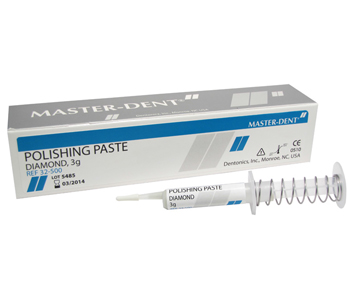
Dentonics Polishing Paste Syringe · Diamond · 3 g
SKU 113-0136MFR# 32-500
Type
Diamond
Diamond$29.70
Non-Diamond
Size
3 g
3 g$29.70
5 g
Dentonics Diamond Polishing Paste in a 3 g syringe. A diamond-particle paste for producing a high-luster final polish on composite, ceramic, and other dental restorations. Catalog code 32-500.
Dentonics Polishing Paste Syringe is a polishing paste from Dentonics.
This page carries 2 type options: Diamond, Non-Diamond. This page carries 2 size options: 3 g, 5 g.
Find it on our Finishing & Polishing shelf, under Polishing Paste.
Orders placed before 3 PM ET ship the same day when the item is on our shelf (otherwise within 3 business days), and ground shipping is free over $10.
Product
- Manufacturer
- Dentonics
- Manufacturer #
- 32-500
- Item code
- 113-0136
Catalog path
- Marketplace
- Clinical
- Category
- Finishing & Polishing
- Subcategory
- Polishing Paste
Ordering
- Status
- Ships in 3 business days
More from Polishing Paste
Stocked in the same subcategory.




Questions
Which type and size options are on this page?
This page carries 2 type options: Diamond, Non-Diamond. This page carries 2 size options: 3 g, 5 g. Pick one to see its price, part number and stock.
When does it ship?
In-stock orders placed before 3 PM ET ship the same day; anything not on our shelf ships within 3 business days.Ground shipping is free over $10.
About polishing pastes
A polishing paste is the loose-abrasive step: published work describes it as the final stage, applied after the sequence of abrasive discs, giving a smooth and glossy surface. A study of diamond pastes found they improved surface roughness, gloss and colour stability, and had no effect on the surface microhardness of the composites. The FDA form of words for the same thing is a device in paste or powder form containing an abrasive material, intended to remove debris from the teeth.
A polishing paste is loose abrasive in a carrier, applied with a cup, brush or wheel rather than mounted on a shank. A glossary defines a polishing agent as any material used to impart lustre to a surface. The FDA regulates the paste or powder form as an oral cavity abrasive polishing agent, a Class I device containing an abrasive material such as silica pumice and intended to remove debris from the teeth (21 CFR 872.6030). The same section says the abrasive polish is applied to the teeth by a handpiece attachment, the prophylaxis cup. That cup has its own FDA listing: a Class I device made of rubber, held by a dental handpiece and used to apply polishing agents during cleaning (21 CFR 872.6290).
Pumice is one of the classical abrasives: a glossary describes it as a type of volcanic glass used as an abrasive, prepared in various grits. Whiting is another, pure white chalk that has been ground and washed, used for polishing dental materials. Modern pastes are more often diamond or aluminium oxide: a review lists diamond polishing pastes among the adjuncts that reached surface roughness below 0.2 microns.
What to look at when choosing a polishing paste
Particle size: a study applied diamond pastes of under one micron, one micron and half a micron and found no statistically significant difference between them. The authors reasoned that no differences were found because all the diamond particle sizes were smaller than one micron.
How it is used: published work reports that the outcome depends on the composition of the paste, how long it is applied, the pressure applied, and whether the procedure is dry or wet.
What carries it: pastes are usually applied with flexible rubber cups, and published work notes that felt polishing brushes and other special abrasives have been suggested to enhance their effect.
What it is used on: a review notes that systems containing diamond particles, or adjuncts such as diamond polishing pastes, reached surface roughness below 0.2 microns.
Sources: Büyükpolat et al. 2025, The effect of polishing pastes on the surface roughness, microhardness, gloss, and color change of resin composites (BMC Oral Health) · The Glossary of Prosthodontic Terms, 9th edition (J Prosthet Dent 2017) · FDA 21 CFR 872.6030, Oral cavity abrasive polishing agent · FDA 21 CFR 872.6290, Prophylaxis cup · Polishing systems for modern aesthetic dental materials: a narrative review, 2024 (Br Dent J)
