

Veratiq DentalIn stock
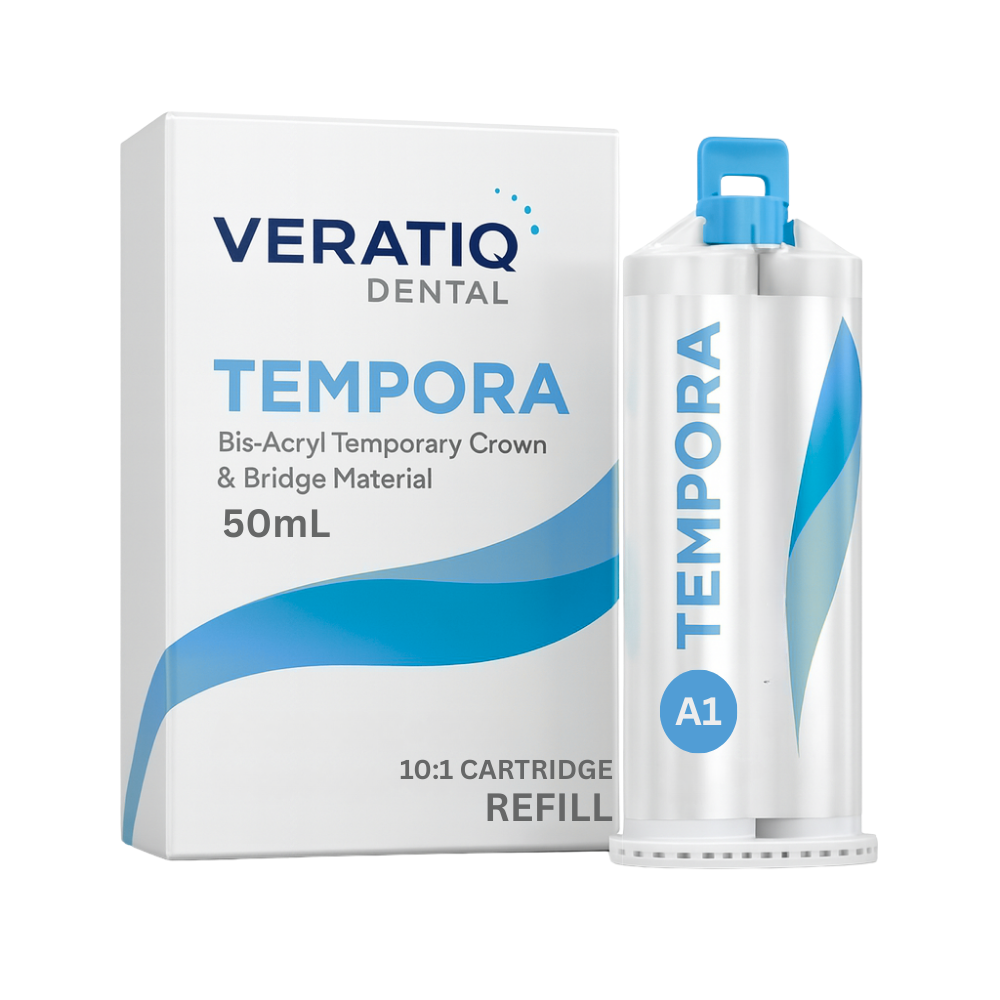
Veratiq Tempora Bis-Acryl Temporary Crown & Bridge Material, 10:1 Cartridge, 50 mL · A1 · Refill
SKU 200-0212MFR# 27000
Shade
A1
Pack
Refill
Refill$56.95
Cartridge & Tips Kit$64.95
Tempora Bis-Acryl Temporary Crown & Bridge Material in a 50 mL 10:1 automix cartridge refill, shade A2. Designed for fabrication of temporary crowns, bridges, inlays and onlays. Provides excellent strength, low shrinkage, natural esthetics and easy polishing. Compatible with standard 10:1 dispensing systems.
Product
- Manufacturer
- Veratiq Dental
- Manufacturer #
- 27000
- Item code
- 200-0212
Catalog path
- Marketplace
- Clinical
- Category
- Restorative & Cosmetic
- Subcategory
- Temporary Crown Material
Ordering
- Status
- In stock
More from Temporary Crown Material
Stocked in the same subcategory.


Zest Dental Solutions
Zest Turbo Temp 2 Provisional Crown & Bridge Material Refill, 76 g
111-0306
$185.31


Vericom
DenFil Light-Cure Micro-Hybrid Composite Capsules, 0.25 g — 20/Pack
In stock
144 sold this month$30.40

RMH3 Dental
MiFlo Delivery Tips, Pre-Bent Needle Tip with Brush Padded End, 19G — 100/Box
In stock
51 sold this month$28.03

RMH3 Dental
Articulating Paper, Blue/Red — 12 Books × 12 Sheets
In stock
23 sold this monthfrom $3.80

Questions
What is Tempora used for?
Tempora Bis-Acryl Temporary Crown & Bridge Material in a 50 mL 10:1 automix cartridge refill, shade A2.
Which shade and pack options are on this page?
This page carries 6 shade options: A1, A2, A3, A3.5, B1, Bleach. This page carries 2 pack options: Refill, Cartridge & Tips Kit. Pick one to see its price, part number and stock.
When does it ship?
In-stock orders placed before 3 PM ET ship the same day; anything not on our shelf ships within 3 business days.Ground shipping is free over $10.
About temporary crown material
A temporary crown and bridge resin is a material such as polymethylmethacrylate used to make a temporary crown or bridge, for use until the permanent restoration is made. The FDA classes it as a Class II device (21 CFR 872.3770). These materials divide into methacrylate resins, supplied as a liquid and powder and mixed by hand, and composite resin materials, supplied as two pastes and mostly automixed. Methacrylate resins set by a chemical reaction, while the composite-based ones are self-curing or dual-curing.
An interim prosthesis is a fixed or removable prosthesis made to improve appearance, stability or function for a limited period, after which a definitive prosthesis replaces it. The shelf holds both kinds of material, with the acrylic powders and liquids, the stain liquids and the glaze used to finish a provisional.
How the two kinds of material differ
A review lists the drawbacks of the acrylic as high polymerisation shrinkage, release of residual monomer and ready staining. The same review notes that its contraction and the heat given off while it sets can interfere with the state of the mouth.
Materials containing no methyl methacrylate were introduced to reduce tissue toxicity and thermal irritation. In one laboratory study the self-curing acrylic gave off significantly more heat than the bis-acrylic composite, and took about twice as long to reach its peak temperature.
What to look at when choosing
Span: in a study of provisional materials, fracture of a long span restoration under considerable chewing force was described as more likely than fracture of a short span. How long it stays in: a review notes that provisionals are usually worn for a short time, but complex rehabilitations can keep them in place for a prolonged period.
What it has to do while it is in: cover exposed dentine, prevent unwanted tooth movement, maintain function, allow oral hygiene and prevent gingival overgrowth. Provisional restorations also allow the appearance, the occlusal vertical dimension and the new occlusal scheme to be tested before the final work.
Sources: The Glossary of Prosthodontic Terms, 9th edition (J Prosthet Dent 2017) · FDA 21 CFR 872.3770, Temporary crown and bridge resin · Jurel et al. 2020, A Review on the Biocompatibility of PMMA-Based Dental Materials for Interim Prosthetic Restorations (Materials) · Mohan et al. 2016, In vitro comparative evaluation of mechanical properties of temporary restorative materials used in fixed partial denture (J Pharm Bioallied Sci) · Sharma et al. 2015, Comparison of temperature rise in pulp chamber during polymerization of materials used for direct fabrication of provisional restorations (Eur J Dent) · Nejatidanesh et al. 2013, In vitro comparison of flexural strength and elastic modulus of three provisional crown materials (J Clin Exp Dent)
