

Veratiq Dental
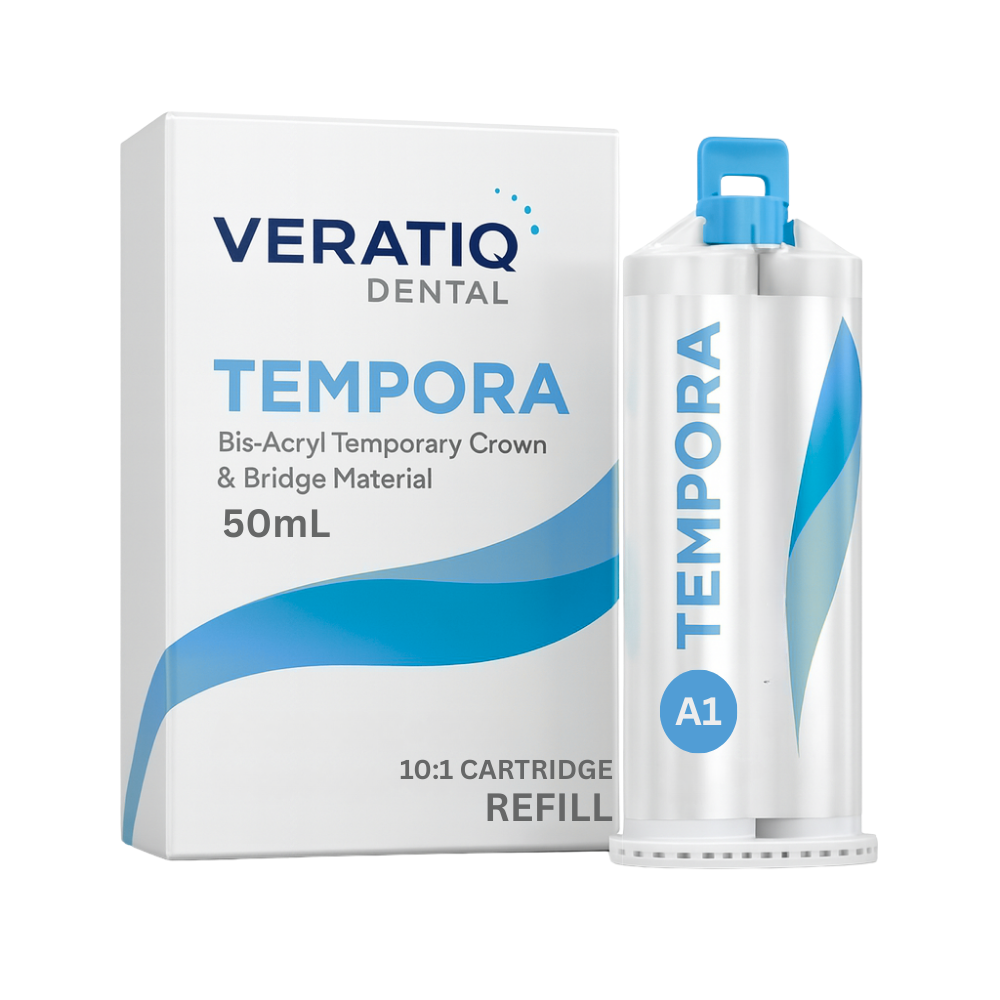
Veratiq Tempora Bis-Acryl Temporary Crown & Bridge Material, 10:1 Cartridge, 50 mL
200-0212
$56.95

Stocked in the same subcategory.




SNAP® Monomer – 4 fl oz (118 mL) Liquid (Parkell item #S441) The liquid for SNAP® self-cure resin, Parkell's ethyl methacrylate material for making temporary crowns and bridges by hand.
In-stock orders placed before 3 PM ET ship the same day. An item we don't keep on the shelf shows its own ship-by date on its page, and you can cancel it for a full refund until it ships.Ground shipping is free over $49.
Temporary crown and bridge accessories are the items filed beside the temporary material: liquids and kits, temporary cement, stain and mixing tips.
An interim prosthesis is a fixed or removable prosthesis made to improve appearance, stability or function for a limited period, after which a definitive prosthesis replaces it. The shelf holds both kinds of material, with the acrylic powders and liquids, the stain liquids and the glaze used to finish a provisional.
A review lists the drawbacks of the acrylic as high polymerisation shrinkage, release of residual monomer and ready staining. The same review notes that its contraction and the heat given off while it sets can interfere with the state of the mouth.
Materials containing no methyl methacrylate were introduced to reduce tissue toxicity and thermal irritation. In one laboratory study the self-curing acrylic gave off significantly more heat than the bis-acrylic composite, and took about twice as long to reach its peak temperature.
Span: in a study of provisional materials, fracture of a long span restoration under considerable chewing force was described as more likely than fracture of a short span. How long it stays in: a review notes that provisionals are usually worn for a short time, but complex rehabilitations can keep them in place for a prolonged period.
What it has to do while it is in: cover exposed dentine, prevent unwanted tooth movement, maintain function, allow oral hygiene and prevent gingival overgrowth. Provisional restorations also allow the appearance, the occlusal vertical dimension and the new occlusal scheme to be tested before the final work.
Sources: The Glossary of Prosthodontic Terms, 9th edition (J Prosthet Dent 2017) · FDA 21 CFR 872.3770, Temporary crown and bridge resin · Jurel et al. 2020, A Review on the Biocompatibility of PMMA-Based Dental Materials for Interim Prosthetic Restorations (Materials) · Mohan et al. 2016, In vitro comparative evaluation of mechanical properties of temporary restorative materials used in fixed partial denture (J Pharm Bioallied Sci) · Sharma et al. 2015, Comparison of temperature rise in pulp chamber during polymerization of materials used for direct fabrication of provisional restorations (Eur J Dent) · Nejatidanesh et al. 2013, In vitro comparison of flexural strength and elastic modulus of three provisional crown materials (J Clin Exp Dent)
Hi. Ask about a product, shipping or returns. For an order, I'll pass you to our team.
Answers are written by AI from our catalog and policies, and can be wrong. It does not give clinical advice.
