


Option
64 oz Bottle
PowerScrub concentrated evacuation line cleaner, by the 64 oz bottle, by the case of four, as an intro kit with the Sidekick dispenser, or the Sidekick dispenser on its own.
- PCS-VLCB — 64 oz Bottle
- PCS-VLCK — Case of 4 × 64 oz Bottles
- PCS-VLIK — Intro Kit (64 oz Bottle + Sidekick Dispenser)
- PCS-VLSK — Sidekick Dispenser Only
Product
- Manufacturer
- Solmetex
- Manufacturer #
- PCS-VLCB
- Item code
- 115-0015
Catalog path
- Marketplace
- Clinical
- Category
- Evacuation
- Subcategory
- Evacuation Cleaners
Ordering
- Status
- In stock
More from Evacuation Cleaners
Stocked in the same subcategory.


Keystone Industries
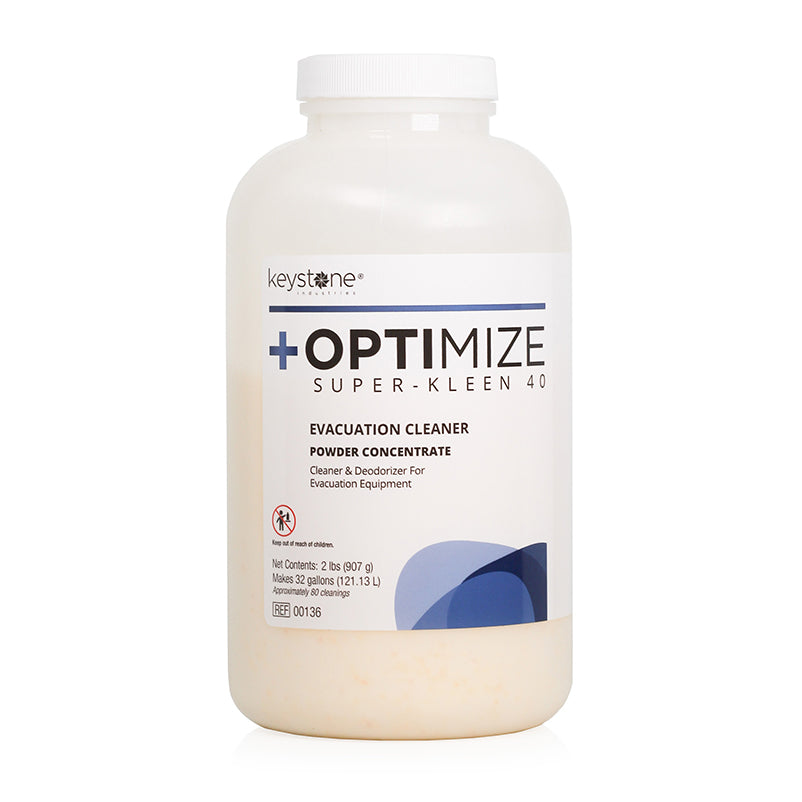
Keystone Super-Vac 40 Plus Concentrated Evacuation Cleaner, 1/2 Gallon
010-3991
$37.25



Questions
What is Solmetex PowerScrub Vacuum Line Cleaner used for?
PowerScrub concentrated evacuation line cleaner, by the 64 oz bottle, by the case of four, as an intro kit with the Sidekick dispenser, or the Sidekick dispenser on its own.
Which option options are on this page?
This page carries 4 option options: 64 oz Bottle, Case of 4 × 64 oz Bottles, Intro Kit (64 oz Bottle + Sidekick Dispenser), Sidekick Dispenser Only. Pick one to see its price, part number and stock.
When does it ship?
In-stock orders placed before 3 PM ET ship the same day; anything not on our shelf ships within 3 business days.Ground shipping is free over $10.
About evacuation system cleaners
Dental offices use disinfectants or line cleaners to reduce odours, remove solid waste particles and biofilms in the lines, and to maintain low microbial counts in dental unit water. Bacteria and biofilms sit steadily in the pipeline connected to the evacuators, which gives them a surface to form, grow and multiply on and shed from. Cleaning and disinfecting the suction pipeline has long been a problem in dental infection control, and a 2024 study reported that no domestic or international standard for it is recommended. The cleaners on this shelf are powders and liquid concentrates diluted before use.
Where a practice discharges amalgam process wastewater to a public treatment works, the EPA rule says dental unit water lines, chair-side traps and vacuum lines must not be cleaned with oxidizing or acidic cleaners, including bleach, chlorine, iodine and peroxide, that have a pH lower than 6 or greater than 8. The EPA says the purpose of that practice is to prohibit cleaners that solubilize mercury from dental amalgam in the wastewater lines of a dental facility. The named chemicals are not an exhaustive list: the EPA says a cleaner that is oxidizing would be prohibited even if its pH is between 6 and 8. The prohibition was not intended to reach dental unit water line cleaning products when those products are used in water supply lines.
The reason is chemical: when oxidizing or acidic line cleaners such as bleach, chlorine, iodine and peroxide are used, mercury can be released from the amalgam waste that has collected in the system. Oxidizing line cleaners can also solubilize elemental mercury bound to the amalgam. The ADA’s management practices for amalgam waste are to use line cleaners that minimize dissolution of amalgam, and not to use bleach or chlorine-containing cleaners to flush wastewater lines.
What to look at when choosing an evacuation cleaner
Chemistry: a study of cleaners for suction pipelines found a double-chain quaternary ammonium salt disinfectant had excellent bactericidal ability and anti-biofilm effect, and was less corrosive to the fittings of the pipelines. In the same study a chlorine disinfectant reduced or inhibited free-floating microorganisms but did nothing to remove or inhibit the biofilm on the pipeline wall, and its long-term use may corrode the pipeline fittings.
Foam: the same study notes that 3% hydrogen peroxide with a multi-enzyme cleaner may produce abundant foam when it meets blood stain, which may block the suction pipelines and the spittoon downpipes and cause gas backflow.
Whether the amalgam rule applies: it does not apply to a practice that exclusively practises oral pathology, oral and maxillofacial radiology, oral and maxillofacial surgery, orthodontics, periodontics or prosthodontics. It also does not apply to a practice that does not discharge any amalgam process wastewater to a public treatment works, such as one on a septic system.
State and local law: the EPA calls its rule a floor, a minimum requirement, not a ceiling, so state or local requirements may go beyond it.
Sources: EPA 40 CFR Part 441, Dental Office Point Source Category · EPA 822-S-17-002, Frequently Asked Questions on the Dental Office Category Rule (Nov 2017) · EPA 821-R-16-005, Technical and Economic Development Document for the Dental Office Category (Dec 2016) · ADA Oral Health Topics: Amalgam Separators and Waste Best Management Practices · Effective disinfecting of negative pressure pipelines of dental chair units reduces the risk of cross infection, 2024 (PMC10773641)
