

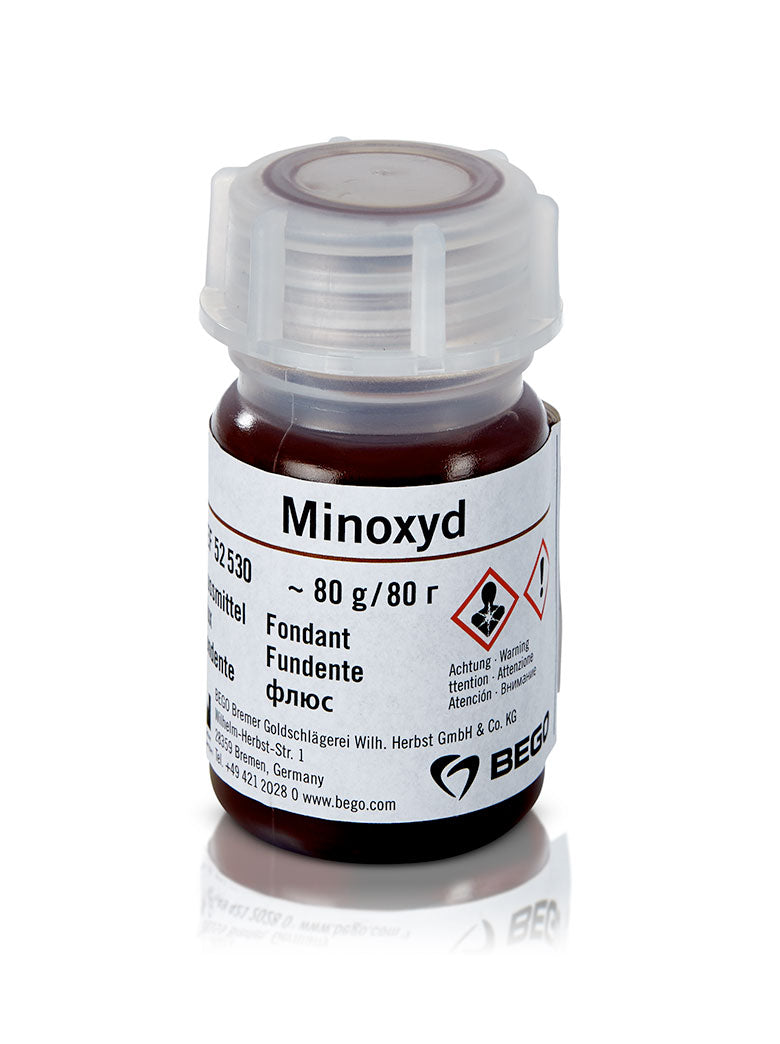
Bego Minoxyd Flux is a dental lab material formulated for use in investment and casting procedures. It functions as a flux, specifically applied during processes involving dental alloys and metals to facilitate proper casting and minimize oxidation.
This product is supplied in a 50 ML volume. It is designed for dental professionals and lab technicians who perform casting and metal work, providing support for consistent results in alloy manipulation.
Product
- Manufacturer
- Bego
- Manufacturer #
- 52530
- Item code
- 011-1060
- UPC / Barcode
- 52530
Catalog path
- Marketplace
- Laboratory
- Category
- Investment & Casting
- Subcategory
- Alloys & Metals
Ordering
- Status
- In stock
More from Alloys & Metals
Stocked in the same subcategory.


Questions
What is Bego Minoxyd Flux - 50 Ml Hh used for?
Bego Minoxyd Flux is a dental lab material formulated for use in investment and casting procedures.
When does it ship?
In-stock orders placed before 3 PM ET ship the same day; anything not on our shelf ships within 3 business days.Ground shipping is free over $10.
About soldering supplies
Soldering supplies and torches join cast parts: soldering is a traditional way of joining fixed partial denture components with an intermediate metal. A flux is a substance applied to the surfaces to be joined to clean them, free them from oxides and promote union. The shelf holds soldering rods, flux, laser welding wire and torch tips.
A base metal alloy is an alloy composed of metals that are not noble. The FDA describes a base metal alloy as composed primarily of base metals such as nickel, chromium or cobalt, for cast or porcelain-fused-to-metal crown and bridge restorations (21 CFR 872.3710).
ISO 22674 sets the requirements and test methods for the metallic materials used to make dental restorations and appliances, with or without a ceramic veneer.
How cobalt-chrome alloys, nickel-chrome alloys and soldering supplies differ
- Cobalt-Chrome Alloys — Cobalt with up to 30 percent chromium; the framework alloy.
- Nickel-Chrome Alloys — Nickel-based; listed here as a ceramic alloy.
- Soldering & Torches — What joins cast parts: solder, flux, welding wire and torch tips.
What to look at when choosing an alloy
Use: ISO 22674 covers metallic materials recommended for use with a ceramic veneer, without one, or for both.
Handling: base metal alloys are technique sensitive in the laboratory, especially during casting and soldering.
Soldered joints: one study found no significant difference in joint strength or porosity between gas-oxygen torch and infrared soldering, or between gaps of 0.3 mm and 0.5 mm.
Sources: The Glossary of Prosthodontic Terms, 9th edition (J Prosthet Dent 2017) · FDA 21 CFR 872.3710, Base metal alloy · ISO 22674:2022, Dentistry — Metallic materials for fixed and removable restorations and appliances · Oxidation heat treatment and the porcelain to base metal alloy bond strength, 2022 (PMC9170503) · Infrared ray and gas torch soldering of Ni-Cr base metal alloy, 2010 (PMC3024500)
