

Keystone IndustriesIn stock
Keystone KeyPrint KeySplint 3D Printing Resin · Soft · Clear · 1 kg
SKU 010-3979MFR# 4220161
Type
Soft
Soft$378.03
Hard$372.95
Color
Clear
Clear$378.03
Light Violet$385.23
Size
1 kg
1 kg$378.03
0.5 kg
Keyprint KeySplint Soft 3D Printing Resin, Light Violet, Translucent, 0.5 kg/Bottle. For printing splints, night guards & bleaching trays. Protects teeth from disorders like bruxism and offers added flexibility increasing patient comfort. Easy to clean and polish. Strong, flexible, biocompatible material. Indicated for the fabrication of orthodontic and dental appliances such as mouth guards, nightguards, splints, repositioners, and bleaching trays.
Product
- Manufacturer
- Keystone Industries
- Manufacturer #
- 4220161
- Item code
- 010-3979
Catalog path
- Marketplace
- Laboratory
- Category
- Digital Lab & CAD/CAM
- Subcategory
- 3D Printing Resins
Ordering
- Status
- In stock
More from 3D Printing Resins
Stocked in the same subcategory.



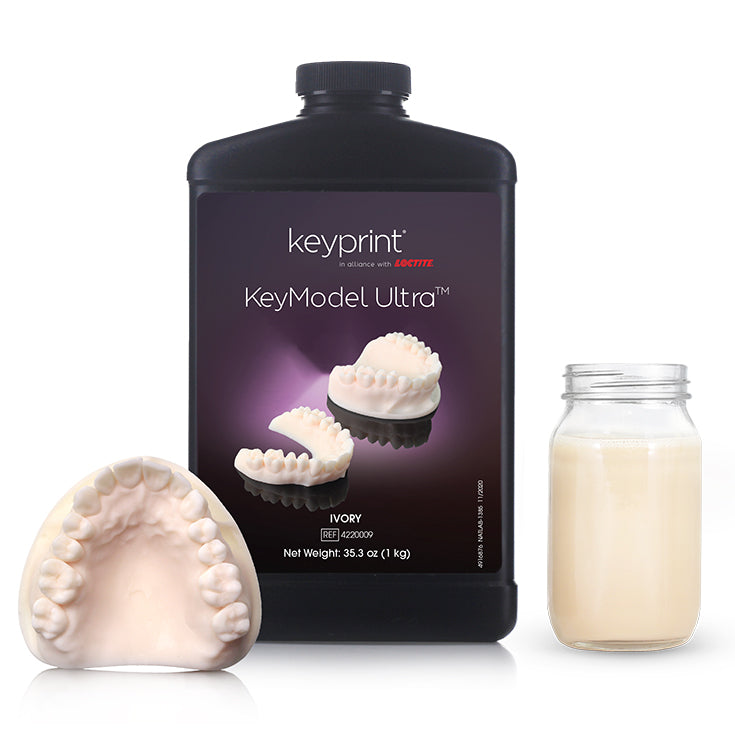
Keystone Industries
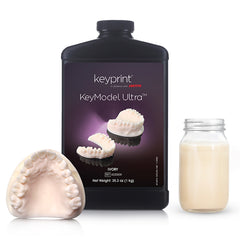
Keystone KeyPrint KeyModel Ultra 3D Printing Resin
In stock
11 sold this monthfrom $73.80

Questions
What is KeySplint used for?
Keyprint KeySplint Soft 3D Printing Resin, Light Violet, Translucent, 0.5 kg/Bottle.
Which type and color and size options are on this page?
This page carries 2 type options: Soft, Hard. This page carries 2 color options: Clear, Light Violet. This page carries 2 size options: 1 kg, 0.5 kg. Pick one to see its price, part number and stock.
When does it ship?
In-stock orders placed before 3 PM ET ship the same day; anything not on our shelf ships within 3 business days.Ground shipping is free over $10.
About night guard resins
Night guard resin prints occlusal devices, which the glossary defines as removable artificial occlusal surfaces used for diagnosis or therapy. Occlusal splints are among the parts that DLP and LCD printers can make chairside in a single session.
A 3D printing resin is a liquid, light-sensitive resin that a printer hardens layer by layer. The glossary describes stereolithography in dentistry as the layering of light-reactive resin to make replicas of casts and devices. Printing in a vat of resin has become the benchmark in dental practice, and comes in three technologies: SLA, DLP and LCD.
When the resin is exposed to light of a specific wavelength, photoinitiators in it start the reaction that joins the monomers into polymer chains.
How the types of printing resin differ
- Model resin — For models that stay on the bench, not for parts worn in the mouth.
- Denture resin — For denture bases.
- Castable resin — A pattern for casting, not a part that is kept.
- Temporary crown resin — For crowns and bridges worn for a limited time.
- Surgical guide resin — For implant guides.
- Night guard resin — For removable occlusal devices such as splints.
- Permanent Crown & Bridge Resin — Filed for printed crowns and bridges that stay in place, where temporary crown resin is filed for provisionals.
The shelf also holds resin for permanent crowns and bridges; no source on the allowed list describes it yet, so it has no entry here.
What to look at when choosing a printing resin
Wavelength: photoinitiators are activated between 365 and 405 nm depending on the technology and the printer. A resin from one brand may not print on a printer from another brand if the wavelengths do not match.
After printing: the part is rinsed with a resin solvent to remove unpolymerised resin, dried, cured again in a light device, and its supports are removed. The rinse is generally 99% isopropyl alcohol.
Print settings: build orientation, layer thickness and post-curing all affect the printed result.
Sources: A Review of 3D Printing in Dentistry: Technologies, Affecting Factors, and Applications (Scanning 2021) · The Glossary of Prosthodontic Terms, 9th edition (J Prosthet Dent 2017) · Vat Photopolymerization 3D Printing in Dentistry: A Comprehensive Review of Actual Popular Technologies (Materials 2024) · Marginal and Internal Gap of Metal Copings Fabricated Using Three Types of Resin Patterns with Subtractive and Additive Technology (Materials 2022) · FDA 21 CFR 872.3770, Temporary crown and bridge resin
