

Keystone IndustriesIn stock
Keystone KeyPrint KeyGuide 3D Printing Resin · 0.5 kg
SKU 010-3987MFR# 4200001
Size
0.5 kg
0.5 kg$125.70
1 kg$210.27
Keystone KeyPrint® KeyGuide® – Surgical Guide 3D Printing Resin, 0.5 kg Bottle (Keystone item #4200001) A stiff, biocompatible 3D printing resin for transparent, stable surgical guides that allow implant placement at a precise angle and depth. • For partial and full-arch surgical guides; clear for maximum visibility • Stiff and durable to withstand the forces of guided surgery in the oral cavity • Autoclavable and easy to polish • BPA, MMA and phthalate free • Typical values: flexural strength 106 MPa, flexural modulus 2,400 MPa (ASTM D790), Shore D hardness 95 D • For DLP, LCD and MSLA 3D printers at 385–405 nm In the package: One 0.5 kg bottle of KeyGuide resin. How it's used: The printed guide is a disposable device for a single patient and requires steam sterilization before use in surgery. Keystone's validated US cycle is prevacuum, 132 °C for 4 minutes, with 30 minutes dry time. For use by a dental professional. Manufacturer: Keystone Industries, Gibbstown, New Jersey, USA. Made in USA.
Product
- Manufacturer
- Keystone Industries
- Manufacturer #
- 4200001
- Item code
- 010-3987
Catalog path
- Marketplace
- Laboratory
- Category
- Digital Lab & CAD/CAM
- Subcategory
- 3D Printing Resins
Ordering
- Status
- In stock
More from 3D Printing Resins
Stocked in the same subcategory.


Keystone Industries
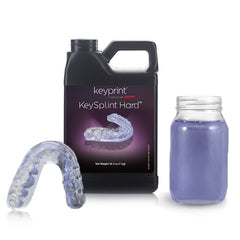
Keystone KeyPrint KeySplint 3D Printing Resin
In stock
15 sold this monthfrom $214.17


Keystone Industries
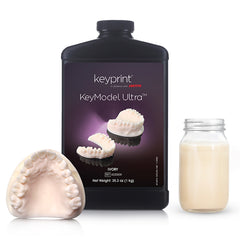
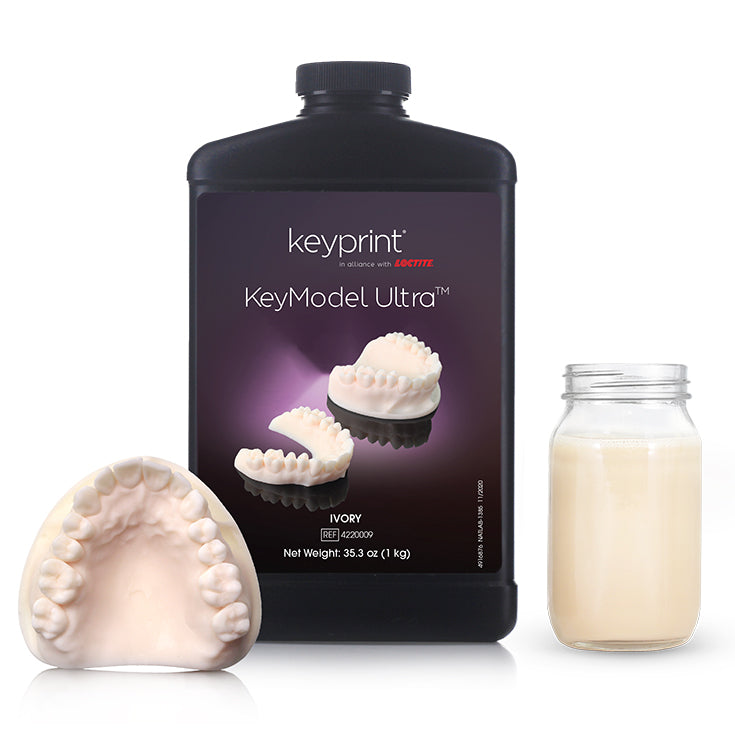
Keystone KeyPrint KeyModel Ultra 3D Printing Resin
In stock
11 sold this monthfrom $73.80
Questions
What is KeyGuide used for?
Keystone KeyPrint® KeyGuide® – Surgical Guide 3D Printing Resin, 0.5 kg Bottle (Keystone item #4200001) A stiff, biocompatible 3D printing resin for transparent, stable surgical guides that allow implant placement at a precise angle and depth. • For partial and full-arch surgical guides; clear for maximum visibility • Stiff and durable to withstand the forces of guided surgery in the oral cavity • Autoclavable and easy to polish • BPA, MMA and phthalate free • Typical values: flexural strength 106 MPa, flexural modulus 2,400 MPa (ASTM D790), Shore D hardness 95 D • For DLP, LCD and MSLA 3D printers at 385–405 nm In the package: One 0.5 kg bottle of KeyGuide resin.
Which size options are on this page?
This page carries 2 size options: 0.5 kg, 1 kg. Pick one to see its price, part number and stock.
When does it ship?
In-stock orders placed before 3 PM ET ship the same day; anything not on our shelf ships within 3 business days.Ground shipping is free over $10.
About surgical guide resins
Surgical guide resin is a 3D printing resin for the guide that assists the surgical placement and angulation of dental implants. In one study of printed guides, autoclave sterilisation at 134 °C was the only method among those tested that significantly increased the stiffness of the samples.
A 3D printing resin is a liquid, light-sensitive resin that a printer hardens layer by layer. The glossary describes stereolithography in dentistry as the layering of light-reactive resin to make replicas of casts and devices. Printing in a vat of resin has become the benchmark in dental practice, and comes in three technologies: SLA, DLP and LCD.
When the resin is exposed to light of a specific wavelength, photoinitiators in it start the reaction that joins the monomers into polymer chains.
How the types of printing resin differ
- Model resin — For models that stay on the bench, not for parts worn in the mouth.
- Denture resin — For denture bases.
- Castable resin — A pattern for casting, not a part that is kept.
- Temporary crown resin — For crowns and bridges worn for a limited time.
- Surgical guide resin — For implant guides.
- Night guard resin — For removable occlusal devices such as splints.
- Permanent Crown & Bridge Resin — Filed for printed crowns and bridges that stay in place, where temporary crown resin is filed for provisionals.
The shelf also holds resin for permanent crowns and bridges; no source on the allowed list describes it yet, so it has no entry here.
What to look at when choosing a printing resin
Wavelength: photoinitiators are activated between 365 and 405 nm depending on the technology and the printer. A resin from one brand may not print on a printer from another brand if the wavelengths do not match.
After printing: the part is rinsed with a resin solvent to remove unpolymerised resin, dried, cured again in a light device, and its supports are removed. The rinse is generally 99% isopropyl alcohol.
Print settings: build orientation, layer thickness and post-curing all affect the printed result.
Sources: A Review of 3D Printing in Dentistry: Technologies, Affecting Factors, and Applications (Scanning 2021) · The Glossary of Prosthodontic Terms, 9th edition (J Prosthet Dent 2017) · Vat Photopolymerization 3D Printing in Dentistry: A Comprehensive Review of Actual Popular Technologies (Materials 2024) · Marginal and Internal Gap of Metal Copings Fabricated Using Three Types of Resin Patterns with Subtractive and Additive Technology (Materials 2022) · FDA 21 CFR 872.3770, Temporary crown and bridge resin
