

Keystone KeyPrint® KeyCast® – Resin for Investment Casting, 1 kg Bottle (Keystone item #4220000) A highly precise 3D printing resin for investment molding, used with chrome, cobalt, gold and silver. • Low-shrinkage formula controls thermal expansion to give pore-free, accurate castings • Works with rapid burnout and gradual temperature ramp workflows; no residual ash • Typical values: shrinkage <2% (ASTM D792); burnout <0.05% • Violet liquid; KeyPrint resins work with DLP, LCD and MSLA printers at 385–405 nm • Uncured resin may cause an allergic skin reaction: wear gloves and eye or face protection In the package: One 1 kg bottle of KeyCast resin. How it's used: Keystone recommends Kerr Satin Cast 20 or Ransom & Randolph Ultra-Vest investment. Vacuum or centrifuge the flask to remove air bubbles and bench cure 2 hours before burnout. Hold the ramp at 500 °F (260 °C) for at least one hour, depending on flask size. For use by a dental professional. Manufacturer: Keystone Industries, Gibbstown, New Jersey, USA. Made in USA.
Product
- Manufacturer
- Keystone Industries
- Manufacturer #
- 4220000
- Item code
- 010-1913
- UPC / Barcode
- 4220000
Catalog path
- Marketplace
- Laboratory
- Category
- Digital Lab & CAD/CAM
- Subcategory
- 3D Printing Resins
Ordering
- Status
- In stock
- Weight
- 2.44 lb
More from 3D Printing Resins
Stocked in the same subcategory.


Keystone Industries
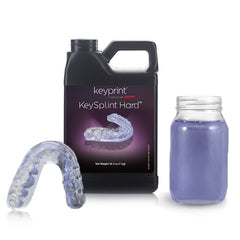
Keystone KeyPrint KeySplint 3D Printing Resin
In stock
24 sold this monthfrom $234.06
Keystone Industries
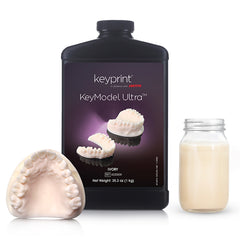
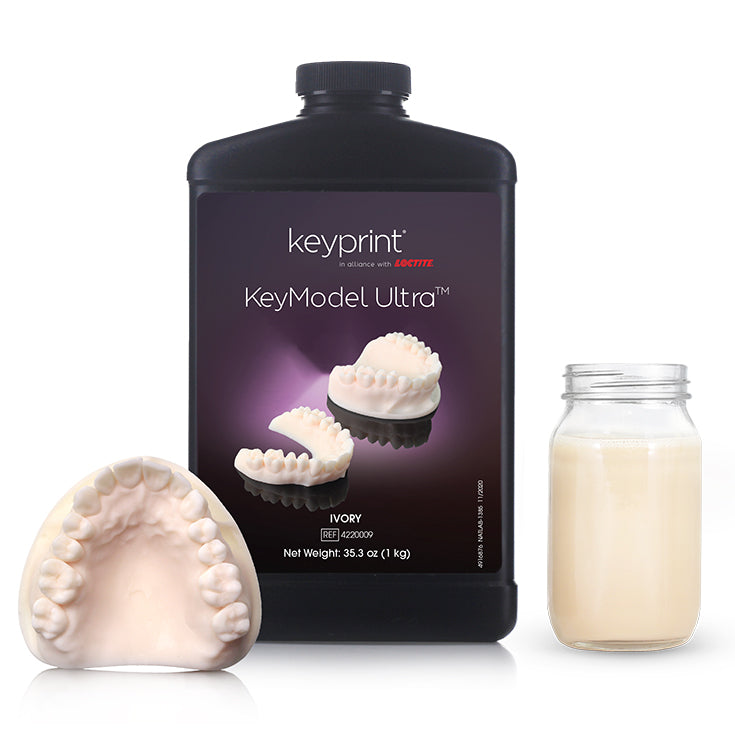
Keystone KeyPrint KeyModel Ultra 3D Printing Resin
In stock
13 sold this monthfrom $71.30


Questions
What is Keystone KeyCast 1kg used for?
Keystone KeyPrint® KeyCast® – Resin for Investment Casting, 1 kg Bottle (Keystone item #4220000) A highly precise 3D printing resin for investment molding, used with chrome, cobalt, gold and silver. • Low-shrinkage formula controls thermal expansion to give pore-free, accurate castings • Works with rapid burnout and gradual temperature ramp workflows; no residual ash • Typical values: shrinkage <2% (ASTM D792); burnout <0.05% • Violet liquid; KeyPrint resins work with DLP, LCD and MSLA printers at 385–405 nm • Uncured resin may cause an allergic skin reaction: wear gloves and eye or face protection In the package: One 1 kg bottle of KeyCast resin.
When does it ship?
In-stock orders placed before 3 PM ET ship the same day. An item we don't keep on the shelf shows its own ship-by date on its page, and you can cancel it for a full refund until it ships.Ground shipping is free over $49.
About castable resins
A castable resin prints the pattern that is then cast in metal by the lost-wax technique, in the place of a wax pattern. Resin patterns are made both by milling and by 3D printing.
A 3D printing resin is a liquid, light-sensitive resin that a printer hardens layer by layer. The glossary describes stereolithography in dentistry as the layering of light-reactive resin to make replicas of casts and devices. Printing in a vat of resin has become the benchmark in dental practice, and comes in three technologies: SLA, DLP and LCD.
When the resin is exposed to light of a specific wavelength, photoinitiators in it start the reaction that joins the monomers into polymer chains.
How the types of printing resin differ
- Model resin — For models that stay on the bench, not for parts worn in the mouth.
- Denture resin — For denture bases.
- Castable resin — A pattern for casting, not a part that is kept.
- Temporary crown resin — For crowns and bridges worn for a limited time.
- Surgical guide resin — For implant guides.
- Night guard resin — For removable occlusal devices such as splints.
- Permanent Crown & Bridge Resin — Filed for printed crowns and bridges that stay in place, where temporary crown resin is filed for provisionals.
The shelf also holds resin for permanent crowns and bridges; no source on the allowed list describes it yet, so it has no entry here.
What to look at when choosing a printing resin
Wavelength: photoinitiators are activated between 365 and 405 nm depending on the technology and the printer. A resin from one brand may not print on a printer from another brand if the wavelengths do not match.
After printing: the part is rinsed with a resin solvent to remove unpolymerised resin, dried, cured again in a light device, and its supports are removed. The rinse is generally 99% isopropyl alcohol.
Print settings: build orientation, layer thickness and post-curing all affect the printed result.
Sources: A Review of 3D Printing in Dentistry: Technologies, Affecting Factors, and Applications (Scanning 2021) · The Glossary of Prosthodontic Terms, 9th edition (J Prosthet Dent 2017) · Vat Photopolymerization 3D Printing in Dentistry: A Comprehensive Review of Actual Popular Technologies (Materials 2024) · Marginal and Internal Gap of Metal Copings Fabricated Using Three Types of Resin Patterns with Subtractive and Additive Technology (Materials 2022) · FDA 21 CFR 872.3770, Temporary crown and bridge resin
