
Size
1 kg
1 kg$278.00
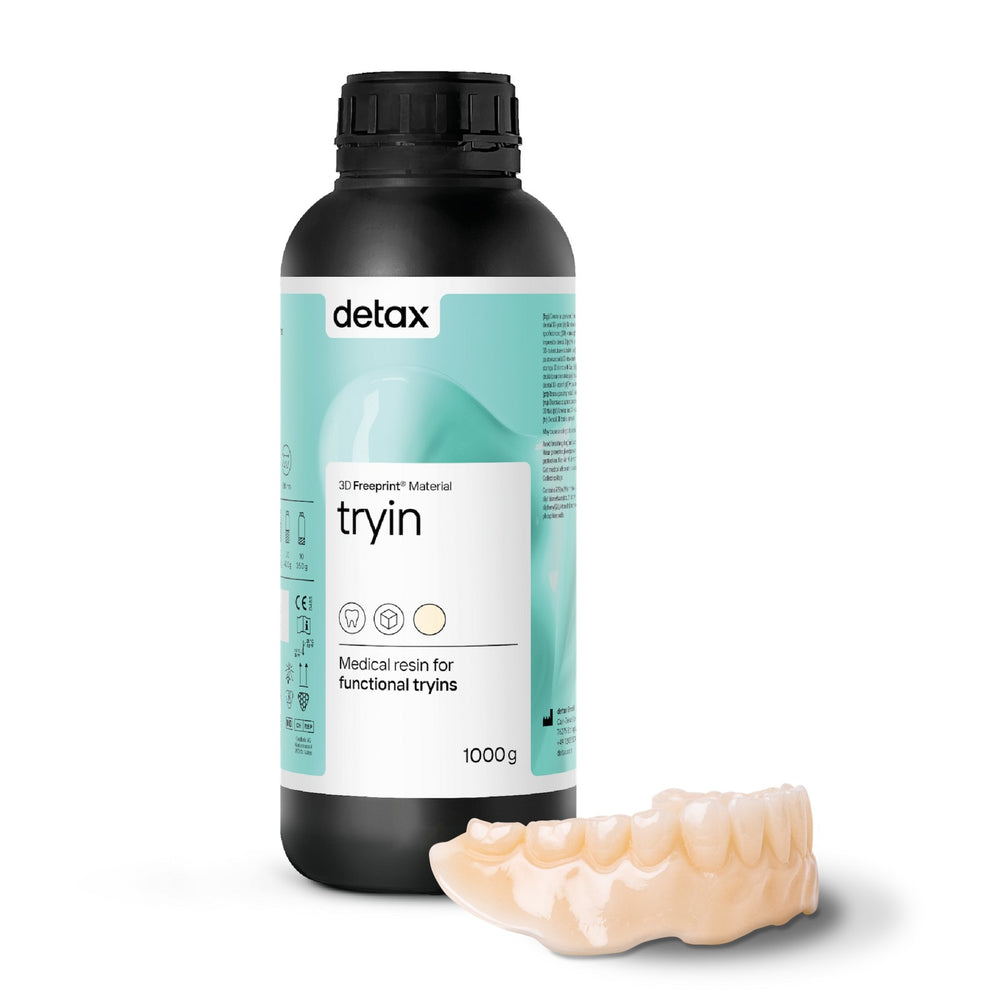
Freeprint® tryin 385 is Detax's light-curing resin for 3D-printed functional try-ins. Detax indicates it as a monolithic try-in denture: one printed piece, in a tooth-coloured shade, used to verify fit, function, occlusion, bite registration and esthetics before the definitive complete or partial denture is made. It contains no MMA and no THF-MA.
What it is used for
- Monolithic functional try-ins for complete and partial dentures
- Checking fit, function and occlusion of a digitally designed tooth set-up
- Bite registration and esthetic approval with the patient
Why labs choose it
- One printed piece instead of a wax set-up, so the try-in comes off the printer ready to seat
- Flexural strength above 100 MPa and a flexural modulus above 2200 MPa to ISO 178 — it survives handling and seating
- Tooth-coloured shade for a realistic esthetic preview
- Low material use and easy processing; optional mechanical polish with rotating brushes and prepolishing paste
- MMA- and THF-MA-free
Details
- Shade: A2 (Detax also makes A1, article 04094, and A3, article 04105)
- Detax article number: 04101 — Freeprint tryin A2, 1000 g bottle
- Wavelength: 385 nm DLP, with a Detax parameter set also published for the 405 nm Formlabs Form 4B
- Regulatory: FDA Class I, FDA listing D280112; EU medical device Class IIa; Health Canada Class I licence
- Hardness above 85 Shore D; depth of cure above 3 mm; viscosity 850–1750 mPas; water sorption under 32 µg/cm³
- Biocompatibility fulfilled to ISO 10993-1; MR Safe per Detax
- Printing: 100 µm layers. Detax limits the resin to two days in the printer vat, or a maximum of 10 print cycles
- Post-processing: clean twice with isopropyl alcohol of at least 98 % purity, then post-cure in a validated curing unit
- Storage: dry, 15–28 °C / 59–82 °F, protected from light
Questions about this product
- What is Freeprint tryin used for?
- Detax indicates it as a monolithic try-in denture. The material is used to fabricate functional try-ins that let you control occlusion, bite registration and esthetics before the definitive complete or partial denture is made.
- What shades does Detax offer for Freeprint tryin?
- Detax lists three shades — A1 (article 04094), A2 (04101) and A3 (04105) — each in a 1000 g bottle. This page is the A2 shade.
- What is the regulatory status of Freeprint tryin in the USA?
- Detax lists it in its 3D US Guide as an FDA Class I device under FDA listing number D280112. In the EU it is a Class IIa medical device, and it holds a Health Canada Class I licence. Detax does not state a 510(k) clearance for this material.
- Which printers does Detax validate for Freeprint tryin?
- Detax publishes parameter sets for Asiga Max, Max 2, Pico 2, PRO 2, PRO 4K and Ultra, Formlabs Form 4B, Microlay Versus, Miicraft Ultra Series, Rapidshape D10+ to D40+, Pro20 and Pro30, and Way2Production SolFlex and SolLab Series. Detax states the material is only approved on the devices named in its instructions for use.
- How long can Freeprint tryin stay in the printer vat?
- Detax allows a maximum of two days in the vat, or 10 print cycles, whichever comes first. Resin left in the vat must never be poured back into the bottle.
- Does a printed try-in need to be polished?
- Polishing is optional. Detax says you may prepolish mechanically with rotating brushes and prepolishing paste, then bring it to high gloss with buffing wheels and a high-shine composite polishing paste.
- What layer thickness does Detax specify for Freeprint tryin?
- Detax specifies 100 µm layers across every validated printer, with a recommended build orientation of 0 to 90 degrees.
- What is the difference between Freeprint tryin and Freeprint denture?
- Freeprint tryin prints the whole try-in as one tooth-coloured monolithic piece for checking fit and occlusion. Freeprint denture, denture impact and denture flex are the denture base resins in gum shades, used for the definitive prosthesis and cleared by the FDA as Class II devices.
Product
- Manufacturer
- Detax
- Manufacturer #
- 04101
- Item code
- 118-0022
Catalog path
- Marketplace
- Laboratory
- Category
- Digital Lab & CAD/CAM
- Subcategory
- 3D Printing Resins
Ordering
- Status
- In stock
More from 3D Printing Resins
Stocked in the same subcategory.


Keystone Industries
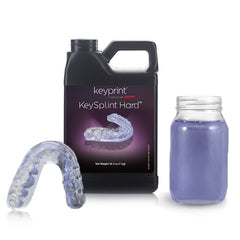
Keystone KeyPrint KeySplint 3D Printing Resin
In stock
22 sold this monthfrom $214.17
Keystone Industries
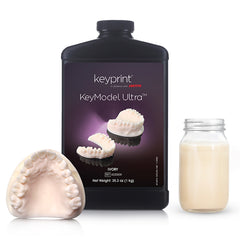
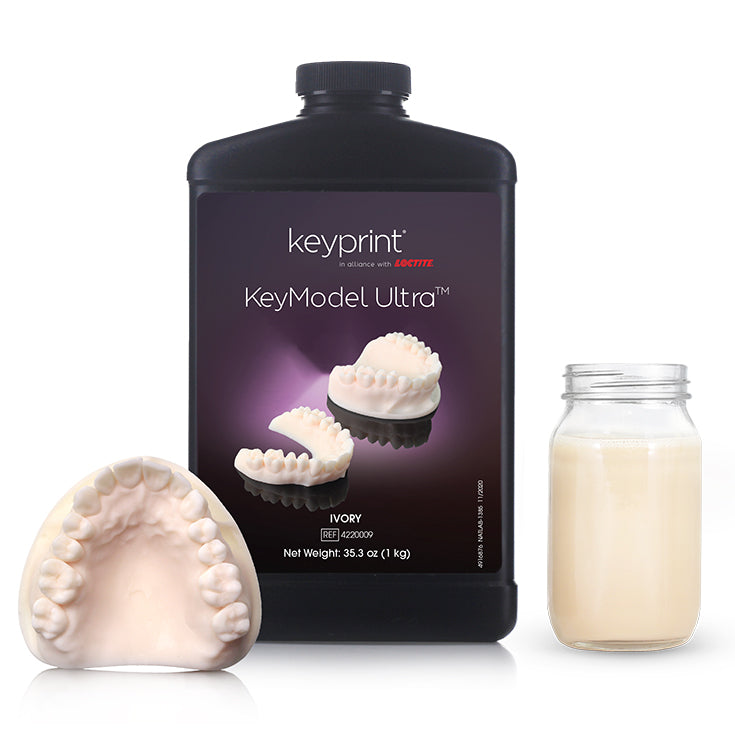
Keystone KeyPrint KeyModel Ultra 3D Printing Resin
In stock
13 sold this monthfrom $73.80


About denture resins
3D printing denture resin prints the resin base of a complete denture straight from the design file, without moulds, cutting tools or fixtures.
A 3D printing resin is a liquid, light-sensitive resin that a printer hardens layer by layer. The glossary describes stereolithography in dentistry as the layering of light-reactive resin to make replicas of casts and devices. Printing in a vat of resin has become the benchmark in dental practice, and comes in three technologies: SLA, DLP and LCD.
When the resin is exposed to light of a specific wavelength, photoinitiators in it start the reaction that joins the monomers into polymer chains.
How the types of printing resin differ
- Model resin — For models that stay on the bench, not for parts worn in the mouth.
- Denture resin — For denture bases.
- Castable resin — A pattern for casting, not a part that is kept.
- Temporary crown resin — For crowns and bridges worn for a limited time.
- Surgical guide resin — For implant guides.
- Night guard resin — For removable occlusal devices such as splints.
- Permanent Crown & Bridge Resin — Filed for printed crowns and bridges that stay in place, where temporary crown resin is filed for provisionals.
The shelf also holds resin for permanent crowns and bridges; no source on the allowed list describes it yet, so it has no entry here.
What to look at when choosing a printing resin
Wavelength: photoinitiators are activated between 365 and 405 nm depending on the technology and the printer. A resin from one brand may not print on a printer from another brand if the wavelengths do not match.
After printing: the part is rinsed with a resin solvent to remove unpolymerised resin, dried, cured again in a light device, and its supports are removed. The rinse is generally 99% isopropyl alcohol.
Print settings: build orientation, layer thickness and post-curing all affect the printed result.
Sources: A Review of 3D Printing in Dentistry: Technologies, Affecting Factors, and Applications (Scanning 2021) · The Glossary of Prosthodontic Terms, 9th edition (J Prosthet Dent 2017) · Vat Photopolymerization 3D Printing in Dentistry: A Comprehensive Review of Actual Popular Technologies (Materials 2024) · Marginal and Internal Gap of Metal Copings Fabricated Using Three Types of Resin Patterns with Subtractive and Additive Technology (Materials 2022) · FDA 21 CFR 872.3770, Temporary crown and bridge resin
