
Sold out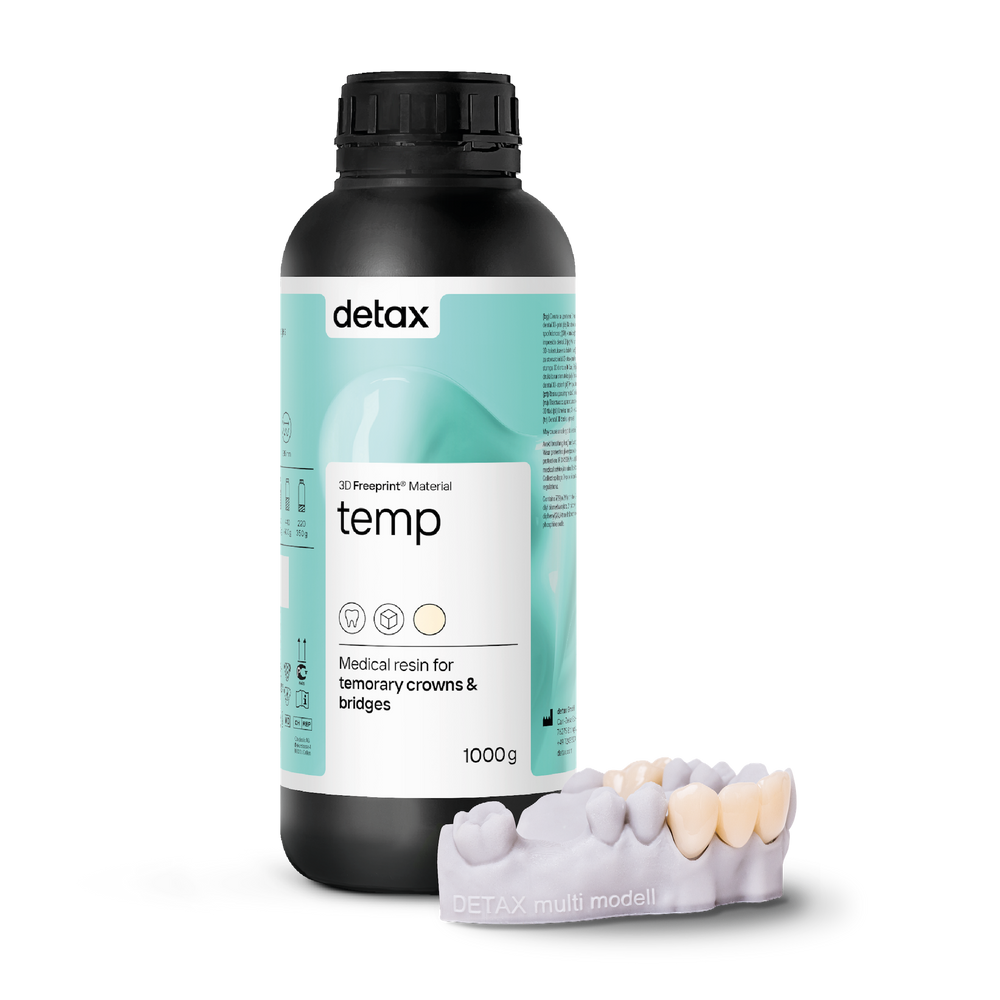
DetaxSold out
Detax Freeprint Temp 385 Temporary Crown & Bridge Resin · A2 · 1 kg
SKU 118-0029MFR# 02130
$428.00
· Sold out
Size
1 kg
1 kg$428.00
500 g$218.00
Freeprint® temp 385 is Detax's light-curing resin for 3D-printed temporary crowns and bridges. Detax indicates it for temporary dental restorations worn less than 30 days in the mouth, in anterior and posterior teeth, and describes the cured material as brilliant and translucent with high fracture, flexural and abrasion resistance. It contains no MMA monomer and no phthalates.
What it is used for
- Temporary single crowns and bridges, anterior and posterior
- Temporary restorations of anterior and posterior teeth, for wear under 30 days
- Chairside and lab temporaries that need to survive chewing and abrasion until the definitive restoration is seated
Why labs choose it
- Flexural strength above 100 MPa and a flexural modulus above 2300 MPa to ISO 10477
- Water absorption under 40 µg/mm³ and solubility under 7.5 µg/mm³
- Translucent tooth shades that polish easily and can be characterised with the Detax smartrepair system or with composites
- Low viscosity, so less material is used and cleaning is quicker
- No MMA monomer, no phthalates; neutral in odour and taste
- Cleared by the FDA as a Class II device under 510(k) K200273
Shades and bottle sizes
Three shades, each in a 500 g and a 1 kg bottle — pick the shade and size above. The number is the Detax article number.
| Shade | 500 g | 1 kg |
|---|---|---|
| A1 | 02014 | 02120 |
| A2 | 02108 | 02130 |
| A3 | 02119 | 02131 |
Details
- Wavelength: 385 nm DLP, with Detax parameter sets also published for 388 nm and 405 nm printers
- Classification: ISO 10477 Type 2 Class 2; FDA Class II, 510(k) K200273; EU MDR Class IIa; Health Canada Class II licence. Caution — US federal law restricts this device to sale by or on the order of a dentist
- Hardness above 40 Barcol; biocompatibility fulfilled to ISO 10993-1; MR Safe per Detax
- Bottle sizes: 500 g and 1 kg
- Printing: 50 µm layers
- Post-processing: clean with isopropyl alcohol of at least 98 % purity, then post-cure in a validated curing unit; biocompatibility is only guaranteed after complete polymerisation
- Storage: dry, 15–28 °C / 59–82 °F, protected from light
Questions about this product
- How long can a Freeprint temp restoration stay in the mouth?
- Detax indicates Freeprint temp for temporary dental restorations with a duration of less than 30 days in the oral environment.
- Which shades is Freeprint temp available in?
- Detax makes Freeprint temp in A1, A2 and A3, each in a 500 g and a 1 kg bottle.
- Is Freeprint temp FDA cleared?
- Yes. Detax lists it in its 3D US Guide as an FDA Class II device under 510(k) number K200273. It is also EU MDR Class IIa and holds a Health Canada Class II licence.
- Does Freeprint temp contain MMA?
- No. Detax states that Freeprint temp contains no MMA monomer and no phthalates. The cured material contains (meth)acrylics and phosphine oxide.
- What printers and curing units does Detax validate for Freeprint temp?
- Detax publishes parameter sets for Aidite Cameo CPD-100, Asiga Max, Max 2, Pico 2, PRO 2, PRO 4K and Ultra, Formlabs Form 4B, Heygears UltraCraft A2D, Ivoclar PrograPrint PR5, Microlay Versus, Miicraft Alpha and Ultra Series, Rapidshape ONE, D10+ to D40+, D70+/D90+, Pro20 and Pro30, Rayshape Edge E2 and Edge Mini, Shining 3D AccuFab L4D, W2P SolFlex 250 UHD and Way2Production SolFlex. Curing units include Asiga Cure, Dentalfarm Photopol, Dentsply Sirona Digital Cure, Formlabs Form Cure 2nd generation, Heygears UltraCraft PCU 3.0, Ivoclar PrograPrint Cure, NK Optik Otoflash G171 and 250/500, and Rapidshape RS cure and RS cure XL.
- Can a printed temporary be individualised or stained?
- Yes. Detax states that the surface is easy to process and polish and can be characterised individually with the smartrepair system or with composites.
- How is Freeprint temp stored?
- Detax says to store it dry at 15–28 °C / 59–82 °F and protected from light, because even slight light exposure can start polymerisation, and to cover the material in the vat with its lid or a glass plate.
- What is the difference between Freeprint temp and Freeprint crown?
- Freeprint temp is the temporary material, indicated for under 30 days in the mouth and offered in A1, A2 and A3. Freeprint crown is the permanent restorative, with a flexural modulus above 2800 MPa, nine shades and a wearing period Detax gives as ten years or more.
Product
- Manufacturer
- Detax
- Manufacturer #
- 02130
- Item code
- 118-0029
Catalog path
- Marketplace
- Laboratory
- Category
- Digital Lab & CAD/CAM
- Subcategory
- 3D Printing Resins
Ordering
- Status
- Sold out
More from 3D Printing Resins
In stock in the same subcategory. Not the same product — check the specs before you swap.


Keystone Industries
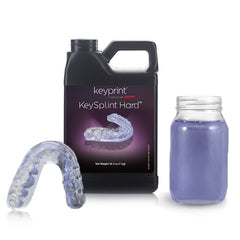
Keystone KeyPrint KeySplint 3D Printing Resin
In stock
20 sold this monthfrom $214.17
Keystone Industries
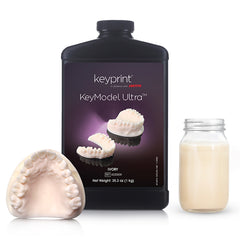
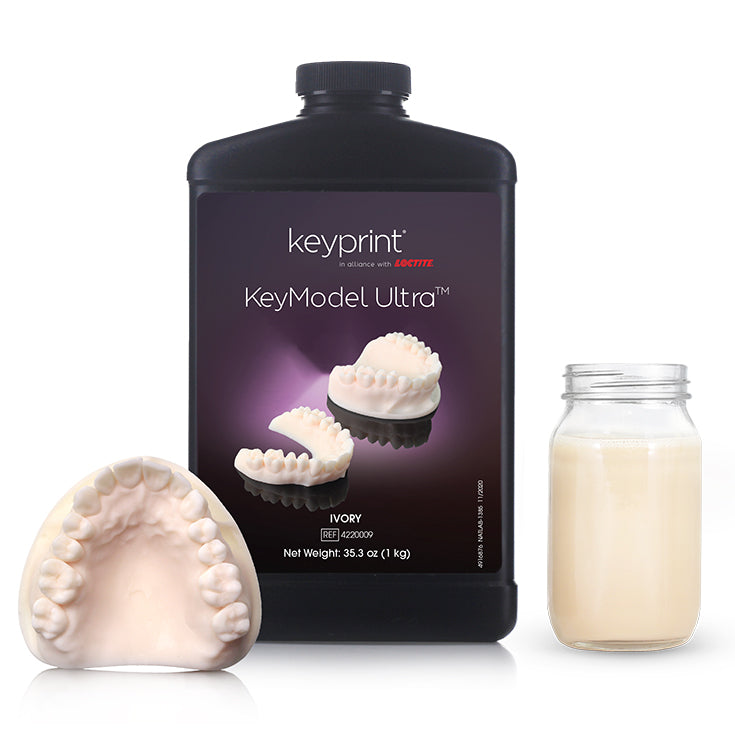
Keystone KeyPrint KeyModel Ultra 3D Printing Resin
In stock
12 sold this monthfrom $73.80


About temporary crown resins
Temporary crown resin prints interim crowns and bridges. The glossary defines an interim prosthesis as one made for a limited period, after which it is replaced by the definitive prosthesis. The FDA lists temporary crown and bridge resin as a Class II device (21 CFR 872.3770).
A 3D printing resin is a liquid, light-sensitive resin that a printer hardens layer by layer. The glossary describes stereolithography in dentistry as the layering of light-reactive resin to make replicas of casts and devices. Printing in a vat of resin has become the benchmark in dental practice, and comes in three technologies: SLA, DLP and LCD.
When the resin is exposed to light of a specific wavelength, photoinitiators in it start the reaction that joins the monomers into polymer chains.
How the types of printing resin differ
- Model resin — For models that stay on the bench, not for parts worn in the mouth.
- Denture resin — For denture bases.
- Castable resin — A pattern for casting, not a part that is kept.
- Temporary crown resin — For crowns and bridges worn for a limited time.
- Surgical guide resin — For implant guides.
- Night guard resin — For removable occlusal devices such as splints.
- Permanent Crown & Bridge Resin — Filed for printed crowns and bridges that stay in place, where temporary crown resin is filed for provisionals.
The shelf also holds resin for permanent crowns and bridges; no source on the allowed list describes it yet, so it has no entry here.
What to look at when choosing a printing resin
Wavelength: photoinitiators are activated between 365 and 405 nm depending on the technology and the printer. A resin from one brand may not print on a printer from another brand if the wavelengths do not match.
After printing: the part is rinsed with a resin solvent to remove unpolymerised resin, dried, cured again in a light device, and its supports are removed. The rinse is generally 99% isopropyl alcohol.
Print settings: build orientation, layer thickness and post-curing all affect the printed result.
Sources: A Review of 3D Printing in Dentistry: Technologies, Affecting Factors, and Applications (Scanning 2021) · The Glossary of Prosthodontic Terms, 9th edition (J Prosthet Dent 2017) · Vat Photopolymerization 3D Printing in Dentistry: A Comprehensive Review of Actual Popular Technologies (Materials 2024) · Marginal and Internal Gap of Metal Copings Fabricated Using Three Types of Resin Patterns with Subtractive and Additive Technology (Materials 2022) · FDA 21 CFR 872.3770, Temporary crown and bridge resin
