
DentonicsIn stock
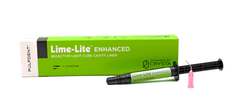
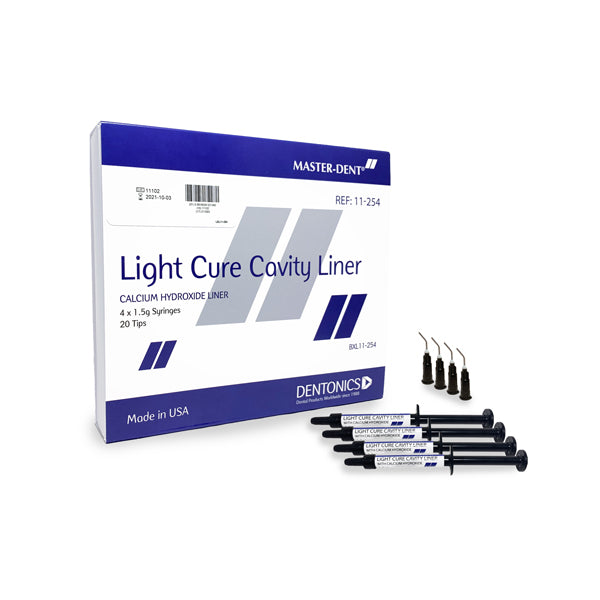
Dentonics Light-Cure Cavity Liner · 4 × 1.5 g syringes with 20 tips
SKU 113-0030MFR# 11-254
Pack
4 × 1.5 g syringes with 20 tips
4 × 1.5 g syringes with 20 tips$50.70
8 g syringe$42.00
Cavity Liner - 4 Syringes/Pk. Light-Cure, Filled with Hydroxyapetite, Barium Sulfate and Fluoride. 4 - 1.5 gram Syringes and 20 Tips.
Dentonics Light-Cure Cavity Liner is a calcium hydroxide liner from Dentonics.
This page carries 2 pack options: 4 × 1.5 g syringes with 20 tips, 8 g syringe.
Find it on our Restorative & Cosmetic shelf, under Bases & Liners.
Orders placed before 3 PM ET ship the same day when the item is on our shelf (otherwise within 3 business days), and ground shipping is free over $10.
Product
- Manufacturer
- Dentonics
- Manufacturer #
- 11-254
- Item code
- 113-0030
Catalog path
- Marketplace
- Clinical
- Category
- Restorative & Cosmetic
- Subcategory
- Bases & Liners
Ordering
- Status
- In stock
More from Bases & Liners
Stocked in the same subcategory.


Vericom
DenFil Light-Cure Micro-Hybrid Composite Capsules, 0.25 g — 20/Pack
In stock
144 sold this month$30.40

RMH3 Dental
MiFlo Delivery Tips, Pre-Bent Needle Tip with Brush Padded End, 19G — 100/Box
In stock
51 sold this month$28.03

RMH3 Dental
Articulating Paper, Blue/Red — 12 Books × 12 Sheets
In stock
23 sold this monthfrom $3.80

Questions
Which pack options are on this page?
This page carries 2 pack options: 4 × 1.5 g syringes with 20 tips, 8 g syringe. Pick one to see its price, part number and stock.
When does it ship?
In-stock orders placed before 3 PM ET ship the same day; anything not on our shelf ships within 3 business days.Ground shipping is free over $10.
About bases & liners
Liners were historically used to protect the pulp from the potentially toxic effects of restorative materials, and are now also used to seal the dentinal tubules against microorganisms at the join between tooth and restoration. A base is any substance placed under a restoration that blocks out undercuts in the preparation, acts as a thermal or chemical barrier to the pulp, or controls the thickness of the restoration above it. A calcium hydroxide cavity liner is a Class II device applied to the inside of a prepared cavity before the restorative material goes in, to protect the pulp (21 CFR 872.3250). Cavity varnish is a separate Class II device: a compound that coats a prepared cavity to prevent restorative material penetrating the dentinal tissue (21 CFR 872.3260).
Liners and bases are protective materials applied to the area near the pulp, under a restoration. The shelf holds light-cured liners, cavity varnishes, and the powders and cements mixed for use under a filling.
How the materials on this shelf differ
Calcium hydroxide has long been the most widely used liner, and conventional calcium hydroxide liners have a low elastic modulus, low compressive strength and high solubility. Light-curable calcium hydroxide cements made with methacrylate monomers were developed for that reason, and they give a controlled working time, low solubility in acid and their full mechanical properties as soon as they are cured. When resin-containing materials are used in deep cavities, unpolymerised monomers can diffuse into the pulp tissue through the dentinal tubules.
Glass ionomer is a cement, luting or restorative agent made of an acid-soluble glass, polyacrylic acid and water that sets by an acid-base reaction. Glass ionomers are traditionally classified into four types by what they are used for, and the lining and base cements are Type III.
Cavity varnish is a combination of copal resin or other synthetic resins dissolved in an organic solvent. Zinc oxide-eugenol is listed by the FDA as a base cement and as a temporary tooth filling, and as a material applied to a tooth to protect the pulp.
What to look at when choosing
Standard: ISO 9917-1 covers acid-base dental cements for permanent cementation, lining and restoration, and sets its limits according to whether the cement is meant as a luting agent, a base or liner, a restorative material or a pit and fissure sealing cement. Strength: the ADA standard for dental cements sets a minimum compressive strength of 50 MPa for luting, base and lining cements, and 100 MPa for restorations.
Particle size: smaller glass particles of about 15 microns serve as cements and larger ones of about 50 microns as restoratives, and film thickness and the powder-to-liquid ratio shape how a glass ionomer is classified and used.
Sources: Jafari et al. 2023, Ion release, biocompatibility, and bioactivity of resin-modified calcium hydroxide cavity liners (BMC Oral Health) · The Glossary of Prosthodontic Terms, 9th edition (J Prosthet Dent 2017) · FDA 21 CFR 872.3250, Calcium hydroxide cavity liner · FDA 21 CFR 872.3260, Cavity varnish · ADA Oral Health Topics: Materials for Direct Restorations · FDA 21 CFR 872.3275, Dental cement · ISO 9917-1:2025, Dentistry — Water-based cements — Part 1: Acid-base cements
