
DentonicsIn stock
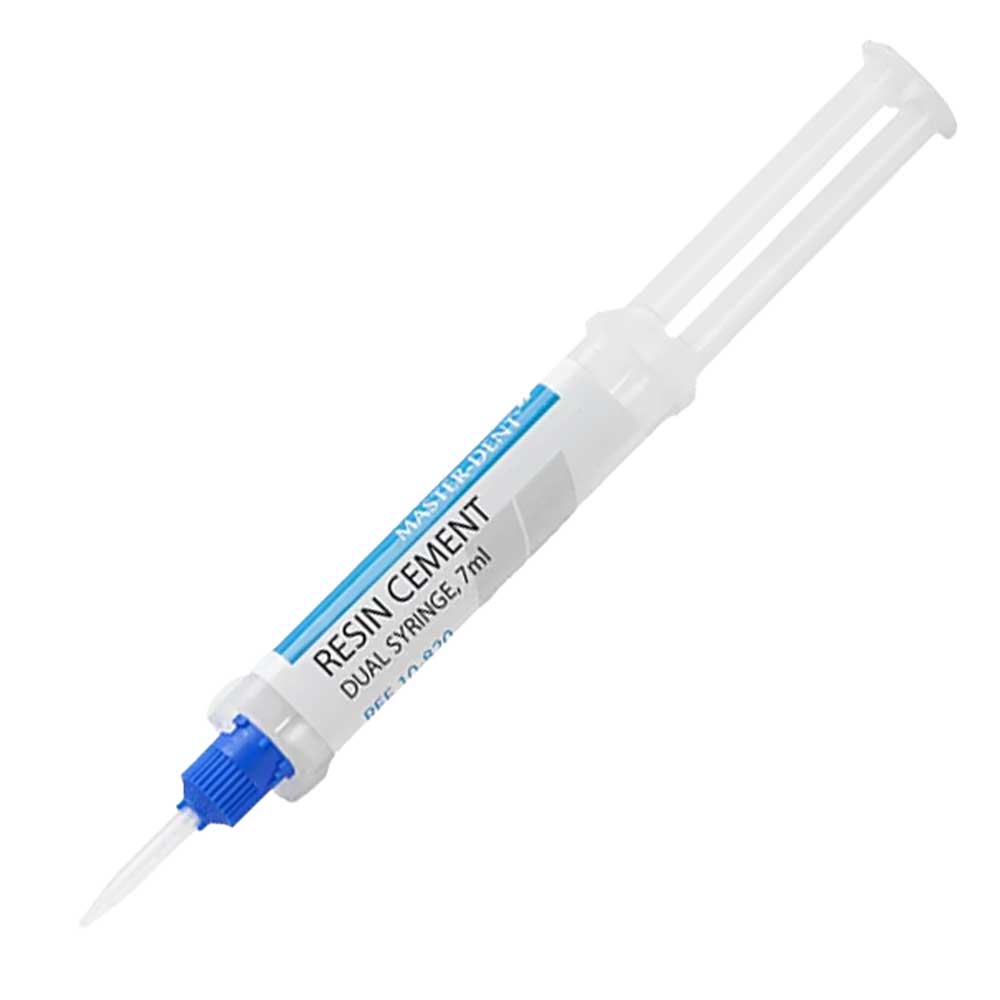
Dentonics Resin Cement Dual Barrel Syringe (8GM) with Automix Tips
SKU 113-0021MFR# 10-820
Master-Dent® Resin Cement – 7 mL Automix (Dentonics item #10-820) A reinforced, self-curing, self-adhesive, multi-purpose permanent cement for final cementation of crowns, bridges, veneers, implant prostheses, pins and posts. Its bond strength to dentin and metals helps prevent marginal leakage and loss of retention. • Two-stage set: firm enough to hold the restoration first, with an extra 60–80 seconds to remove the excess • Final set about 2 minutes after it is placed in the mouth • Insoluble in oral fluids; non-eugenol • Biocompatible – minimizes post-operative discomfort • Convenient automix delivery In the package: one 7 mL dual-barrel automix cartridge with mixing tips. For use by a dental professional. Dentonics, Inc. (Master-Dent®).
| Cure | Self |
|---|---|
| GTIN / barcode | 816526020176 |
Product
- Manufacturer
- Dentonics
- Manufacturer #
- 10-820
- Item code
- 113-0021
- UPC / Barcode
- 816526020176
Catalog path
- Marketplace
- Clinical
- Category
- Restorative & Cosmetic
- Subcategory
- Permanent Cements
Ordering
- Status
- In stock
- Weight
- 0.25 lb
More from Permanent Cements
Stocked in the same subcategory.



Veratiq Dental
Veratiq Etchera 37% Phosphoric Acid Etchant Gel
In stock
168 sold this monthfrom $5.69
Questions
What is Master-Dent used for?
Master-Dent® Resin Cement – 7 mL Automix (Dentonics item #10-820) A reinforced, self-curing, self-adhesive, multi-purpose permanent cement for final cementation of crowns, bridges, veneers, implant prostheses, pins and posts.
When does it ship?
In-stock orders placed before 3 PM ET ship the same day; anything not on our shelf ships within 3 business days.Ground shipping is free over $10.
About resin cements
Resin cements are the most recent luting material developed for dentistry, and they can form a chemical bond with dentine and enamel. They divide into adhesive cements, used after the tooth is etched with phosphoric acid and an adhesive is applied, and self-adhesive cements, which call for neither step except on enamel. A self-adhesive cement carries components such as MDP that bond to the tooth and to the restoration at the same time, and a review notes that glass ceramics still need the etching and silane layer. They are also grouped as chemical-cure, light-cure or dual-cure, and a dual-cure cement holds both chemical and light initiators, so its catalyst finishes hardening the cement where light cannot reach.
A luting agent is any material used to attach or cement indirect restorations to prepared teeth. A review lists the long-term cements as zinc phosphate, zinc polycarboxylate, glass ionomer, resin-modified glass ionomer and resin cement. They fall into two families by composition, water-based and resin-based.
How the types of permanent cement differ
- Glass Ionomer & RMGI Cements — Water-based, and it releases fluoride. The resin-modified kind sets by an acid-base reaction and by polymerisation together, and ISO 9917-2 is the standard for those.
- Resin Cements — Resin-based rather than water-based, and chemically similar to composite filling material. A restoration cemented adhesively has to be sectioned to come off.
- Dental Cements — A water-based cement of this kind sets by an acidic reaction and holds the restoration without bonding to it. A crown cemented with zinc phosphate or polycarboxylate can be removed with care instead of being sectioned.
- Cement Application Accessories — Pick-up sticks, an applicator and try-in paste rather than the cement itself.
- Bases & Liners — Zinc phosphate and polycarboxylate cements that are also filed under bases and liners.
What to look at when choosing a permanent cement
Film thickness: the ADA standard for dental cements sets a maximum of 25 microns for a luting cement.
How it is supplied: these cements come hand-mixed or encapsulated for mechanical mixing. A review notes that modifying the powder-to-liquid ratio can increase the solubility of a luting agent threefold, and calls that a frequent cause of clinical failures.
Age and track record: zinc phosphate has been in use since 1878 and has high compressive strength and a reasonable working time, with high solubility in oral fluid, low tensile strength and the potential for hypersensitivity from its initially low pH among its drawbacks.
Light reaching the cement: a review reports light-cured cements being used for restorations under 1.5 mm thick that let enough light through, and the chemical cure of a dual-cure cement being what sets it under zirconia and thick ceramic. Excess cement: a review notes that removing resin cement completely from margins that are hard to reach is a problem for restorations with margins below the gum line.
Standard: ISO 4049 covers polymer-based luting materials for cementing inlays, onlays, veneers, crowns and bridges, but not those with an adhesive component inside the material. FDA class: zinc oxide-eugenol is a Class I device and dental cement other than zinc oxide-eugenol is Class II (21 CFR 872.3275).
Sources: The Glossary of Prosthodontic Terms, 9th edition (J Prosthet Dent 2017) · Heboyan et al. 2023, Dental Luting Cements: An Updated Comprehensive Review (Molecules) · ADA Oral Health Topics: Materials for Direct Restorations · ISO 9917-2:2017, Dentistry — Water-based cements — Part 2: Resin-modified cements · ISO 9917-1:2025, Dentistry — Water-based cements — Part 1: Acid-base cements · ISO 4049:2019, Dentistry — Polymer-based restorative materials · FDA 21 CFR 872.3275, Dental cement
