
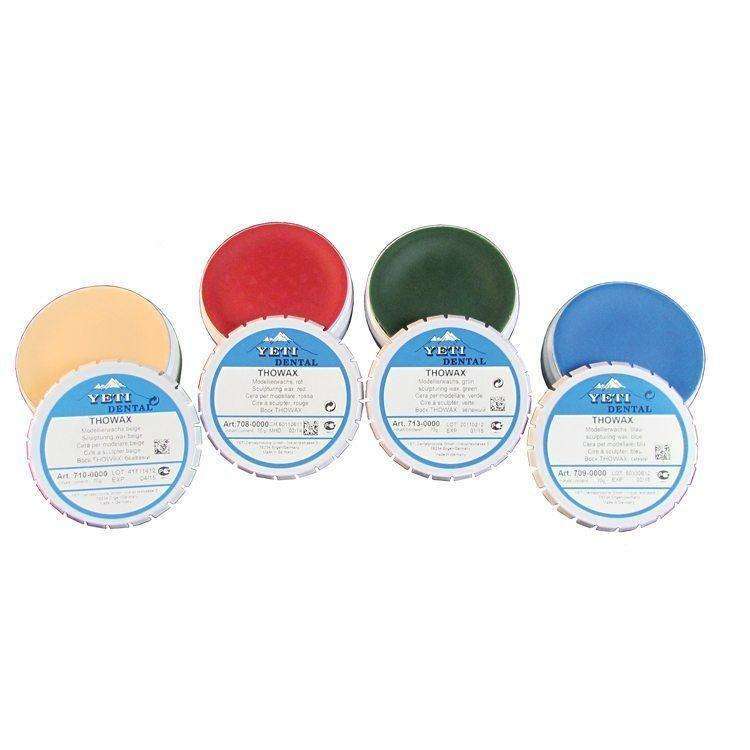
The Keystone Yeti Beige Opaque Sculpturing Wax 60 g is a dental laboratory product supplied by Keystone. Catalog code 1860064.
Yeti Beige Opaque Sculpturing Wax, 60 g is a modeling wax from Yeti. Key facts — Wax type: Sculpturing; Material: Wax. Manufacturer part number 1860064.
Find it on our Wax shelf, under Modeling & Carving Wax.
Orders placed before 3 PM ET ship the same day when the item is on our shelf (otherwise within 3 business days), and ground shipping is free over $49.
| Wax type | Sculpturing |
|---|---|
| Material | Wax |
Product
- Manufacturer
- Yeti
- Manufacturer #
- 1860064
- Item code
- 010-1618
- UPC / Barcode
- 1860064
Catalog path
- Marketplace
- Laboratory
- Category
- Wax
- Subcategory
- Modeling & Carving Wax
Ordering
- Status
- Special order
More from Modeling & Carving Wax
Stocked in the same subcategory.


Questions
What is Yeti Beige Opaque Sculpturing Wax, 60 g used for?
The Keystone Yeti Beige Opaque Sculpturing Wax 60 g is a dental laboratory product supplied by Keystone.
When does it ship?
In-stock orders placed before 3 PM ET ship the same day. An item we don't keep on the shelf shows its own ship-by date on its page, and you can cancel it for a full refund until it ships.Ground shipping is free over $49.
About modeling wax
Modeling wax on this shelf comes in tins and sets, in colours for the dentin, enamel and opaque parts of the pattern.
Modeling wax is a wax suitable for making patterns in the fabrication of restorations. Waxing is the contouring of a wax pattern, or of the wax base of a trial denture, into the desired form. The wax pattern sets the shape, size and contour of the restoration.
The FDA lists intraoral dental wax, used to construct the patterns from which metal prostheses are cast, as a Class I device (21 CFR 872.6890).
How modeling, carving, cervical and dipping wax and wax discs differ
- Modeling Wax — The wax that is added and shaped to build the pattern.
- Carving Wax — Sold as blocks and rods to be cut to shape.
- Cervical Wax — Used at the neck of the pattern, at or near the cemento-enamel junction.
- Dipping Wax — Kept molten in a bath; the die is dipped to make a coping pattern in one step.
- Wax Discs — A blank for the milling machine, not for hand waxing.
- Pattern Wire Wax — Ready-made wax shapes that are placed on the cast in place of free-hand waxing.
What to look at when choosing
Flow: under ANSI/ADA specification No. 4 a Type 1 wax may flow at most 1 percent at 37 °C, and Type 1 and Type 2 waxes must flow between 70 and 90 percent at 45 °C.
Shrinkage on cooling: cooling from 37 °C to 25 °C can contract inlay wax by up to 0.35 percent.
Distortion: a wax pattern can hold internal strains from the way it was worked, and it distorts when the strain relaxes. Time and temperature both make it worse, which is why patterns are generally invested immediately after they leave the die or cast.
Sources: The Glossary of Prosthodontic Terms, 9th edition (J Prosthet Dent 2017) · Distortion in Wax Patterns Fabricated Using Conventional and Electrical Heat Sources, 2023 (Cureus, PMC10388666) · FDA 21 CFR 872.6890, Intraoral dental wax · Ram et al. 2019, Microcomputed tomography to evaluate the fit of a restoration as compared to conventional replica technique (PMC6685334) · ISO 15854:2023, Casting and baseplate waxes
