

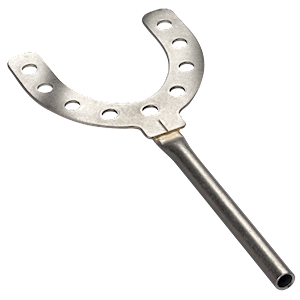
Fork
#8609 Standard
The Whip Mix Number 9661 Facebow Fork Offset with Quick-Lock Toggle is a component designed for use with a facebow system in dental laboratory and clinical applications. It features an offset design along with a quick-lock toggle mechanism for streamlined attachment and adjustment. This part is manufactured by Whip Mix Corporation and is identified by manufacturer code 34333.
Product
- Manufacturer
- Whip Mix
- Manufacturer #
- 04464
- Item code
- 009-0248
Catalog path
- Marketplace
- Laboratory
- Category
- Articulators & Facebows
- Subcategory
- Facebows
Ordering
- Status
- Ships in 3 business days
More from Facebows
Stocked in the same subcategory.


Whip Mix
Whip Mix Quick Mount Face Bow with Screws – Model 8645, Includes Facebow Fork 8610
009-0257
$310.80

Whip Mix
Whip Mix 9155Q Indirect Mounting Face Bow with QuickLock Toggle (QLT) and Quick Mount System
009-0294
$912.72


Questions
What is Whip Mix Facebow Bite Forks used for?
The Whip Mix Number 9661 Facebow Fork Offset with Quick-Lock Toggle is a component designed for use with a facebow system in dental laboratory and clinical applications.
Which fork options are on this page?
This page carries 6 fork options: #8609 Standard, #8610 Curved stem, dentulous, #8631 Offset, #8632 Curved stem, edentulous, #9659 For Quick-Lock Toggle, #9661 Offset, for Quick-Lock Toggle. Pick one to see its price, part number and stock.
When does it ship?
In-stock orders placed before 3 PM ET ship the same day; anything not on our shelf ships within 3 business days.Ground shipping is free over $10.
About facebow forks
The facebow fork is the part of the facebow that attaches the occlusion rim or the natural teeth to the bow.
A facebow is an instrument that records the position of the upper dental arch relative to anatomic reference points and transfers that relationship to an articulator. It orients the cast in the same relationship to the opening axis of the articulator. The usual references are the hinge axis of the lower jaw and one other point toward the front of the face.
The FDA describes a facebow as a device used in making dentures to place the casts accurately into an articulator, and lists it as Class I (21 CFR 872.3220).
What the parts of a facebow do
- Facebow units — The bow itself, which carries the record from the patient to the articulator.
- Facebow forks — The part that goes in the mouth and joins the teeth or occlusion rim to the bow.
- Facebow accessories — Replaceable and add-on parts for a facebow system.
- Articulator accessories — Add-on parts, where replacement parts restore what the instrument came with.
What to look at when choosing a facebow
How the axis is found: an average axis facebow estimates the hinge axis from average landmarks, a kinematic facebow locates it.
The articulator it serves: the record relates the upper cast to the condylar elements of an articulator, so the facebow and the articulator work as a pair. Every facebow on this shelf comes from one maker, and each is made for that maker's articulators.
Cleaning between patients: the CDC lists items used in making prostheses, such as occlusal rims and bite registrations, as possible sources of cross-contamination.
Sources: The Glossary of Prosthodontic Terms, 9th edition (J Prosthet Dent 2017) · FDA 21 CFR 872.3220, Facebow · CDC, Guidelines for Infection Control in Dental Health-Care Settings, 2003 (MMWR 52 RR-17)
