

Whip MixShips in 3 business days
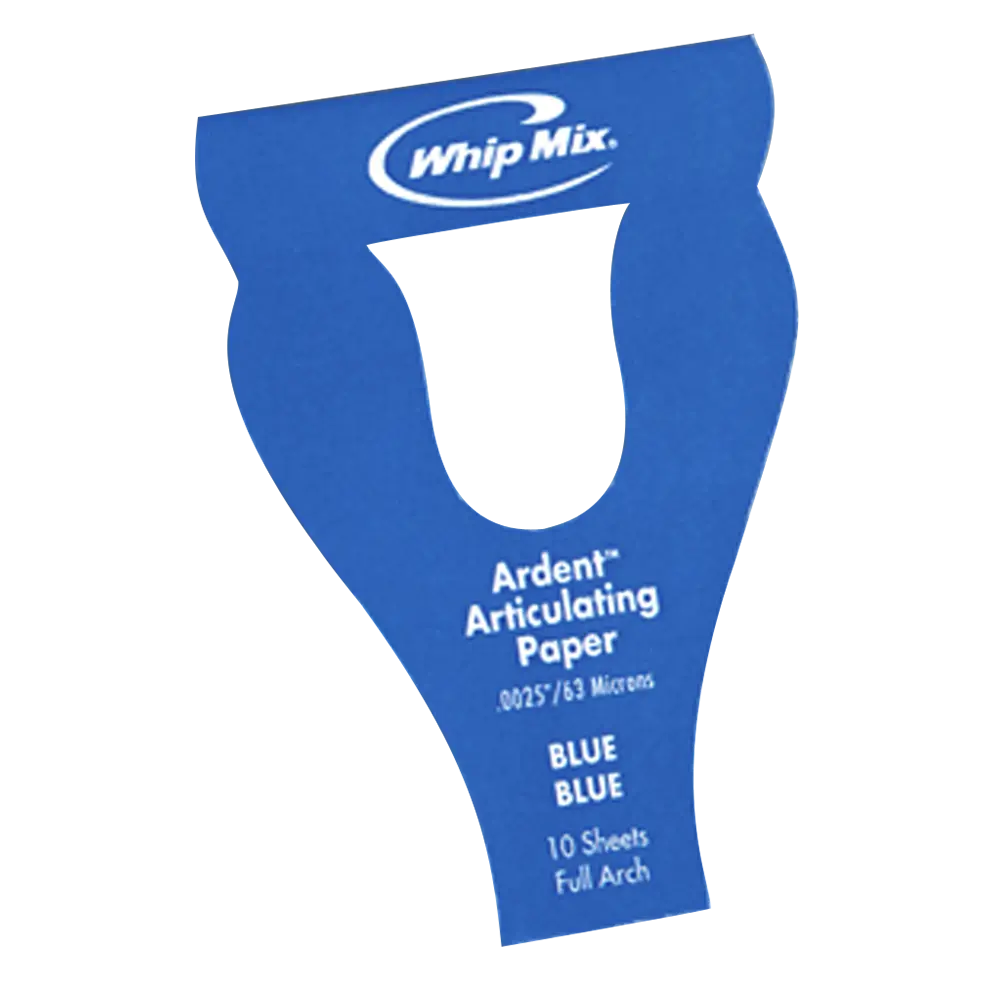
Whip Mix Ardent Full Arch Horseshoe Articulating Paper, 63 µm · Blue / Blue · 60 sheets
SKU 009-0317MFR# 60101
Color
Blue / Blue
Blue / Blue$34.34
Red / Blue
Pack
60 sheets
60 sheets$34.34
72 sheets
Whip Mix Ardent Full Arch Horseshoe articulating paper is available in red and blue at 63 microns and is sold in a package of 6 books containing 72 sheets total. Manufactured to precise quality control standards, it delivers clear, positive markings without smudging by ensuring exact coating and ink penetration that virtually eliminates false markings. The horseshoe design accommodates full arch applications, and the paper performs reliably in both wet and dry fields.
Product
- Manufacturer
- Whip Mix
- Manufacturer #
- 60101
- Item code
- 009-0317
Catalog path
- Marketplace
- Clinical
- Category
- Restorative & Cosmetic
- Subcategory
- Articulating Paper & Film
Ordering
- Status
- Ships in 3 business days
More from Articulating Paper & Film
Stocked in the same subcategory.


Bausch Articulating Papers
Bausch Arti-Check Micro-Thin Articulating Paper, 40 Microns
109-0003
$9.78


Vericom
DenFil Light-Cure Micro-Hybrid Composite Capsules, 0.25 g — 20/Pack
In stock
144 sold this month$30.40

RMH3 Dental
MiFlo Delivery Tips, Pre-Bent Needle Tip with Brush Padded End, 19G — 100/Box
In stock
51 sold this month$28.03

RMH3 Dental
Articulating Paper, Blue/Red — 12 Books × 12 Sheets
In stock
23 sold this monthfrom $3.80

Questions
What is it used for?
Whip Mix Ardent Full Arch Horseshoe articulating paper is available in red and blue at 63 microns and is sold in a package of 6 books containing 72 sheets total.
Which color and pack options are on this page?
This page carries 2 color options: Blue / Blue, Red / Blue. This page carries 2 pack options: 60 sheets, 72 sheets. Pick one to see its price, part number and stock.
When does it ship?
In-stock orders placed before 3 PM ET ship the same day; anything not on our shelf ships within 3 business days.Ground shipping is free over $10.
About articulating paper
Articulating papers differ in thickness, commonly 200, 100, 60 and 40 microns, and in width, material and dye. Thicker paper leaves broader marks; thinner paper shows the number and spread of contacts more precisely.
Articulating paper is ink-coated paper in strips, used to locate and mark the points where upper and lower teeth touch. The FDA lists articulation paper as a Class I device (21 CFR 872.6140), placed between the upper and lower teeth in the bite position to locate uneven or high areas.
Its thickness runs from 8 to 200 microns, and the base may be paper, polyester or silk. Published studies describe the marks as showing where teeth touch, not how hard: they cannot determine the sequence or the strength of contacts.
How paper, film, high spot indicators and pressure paste differ
- Articulating paper — Placed between the teeth, it marks whatever touches it.
- Articulating film — The thinnest of the indicators; it needs a firmer bite to leave a mark.
- High spot indicators — Coats the restoration itself; contact wears the colour away at the high spot. It can be used on highly polished surfaces such as gold or ceramic.
- Pressure indicator paste — Goes on the fitting surface of a denture or other prosthesis to show how it seats, not between the biting surfaces.
What to look at when choosing articulating paper
Thickness: thin papers of 8 or 40 microns are more flexible and follow the shape of the biting surface more closely than thick ones.
Shape: articulating paper comes in strips and in horseshoe-shaped sheets.
Base material: foils are the thinnest indicators, but their marking shows less under light pressure and on glossy surfaces. Articulating silk is tear-resistant and flexible enough to follow cusps and fossae.
Moisture: saliva can ruin ordinary articulating paper, and some papers and films carry a bonding or wetting agent so that they mark on moist surfaces.
Sources: The Glossary of Prosthodontic Terms, 9th edition (J Prosthet Dent 2017) · FDA 21 CFR 872.6140, Articulation paper · Manziuc et al. 2024, Insights into Occlusal Analysis: Articulating Paper versus Digital Devices (J Clin Med) · Bozhkova et al. 2021, Occlusal Indicators Used in Dental Practice: A Survey Study (Biomed Res Int) · Sharma et al. 2013, Materials used for recording static and dynamic occlusal contact marks: a literature review (J Clin Exp Dent)
