


Size
Small
Pack
100/box
100/box$7.32
200/box
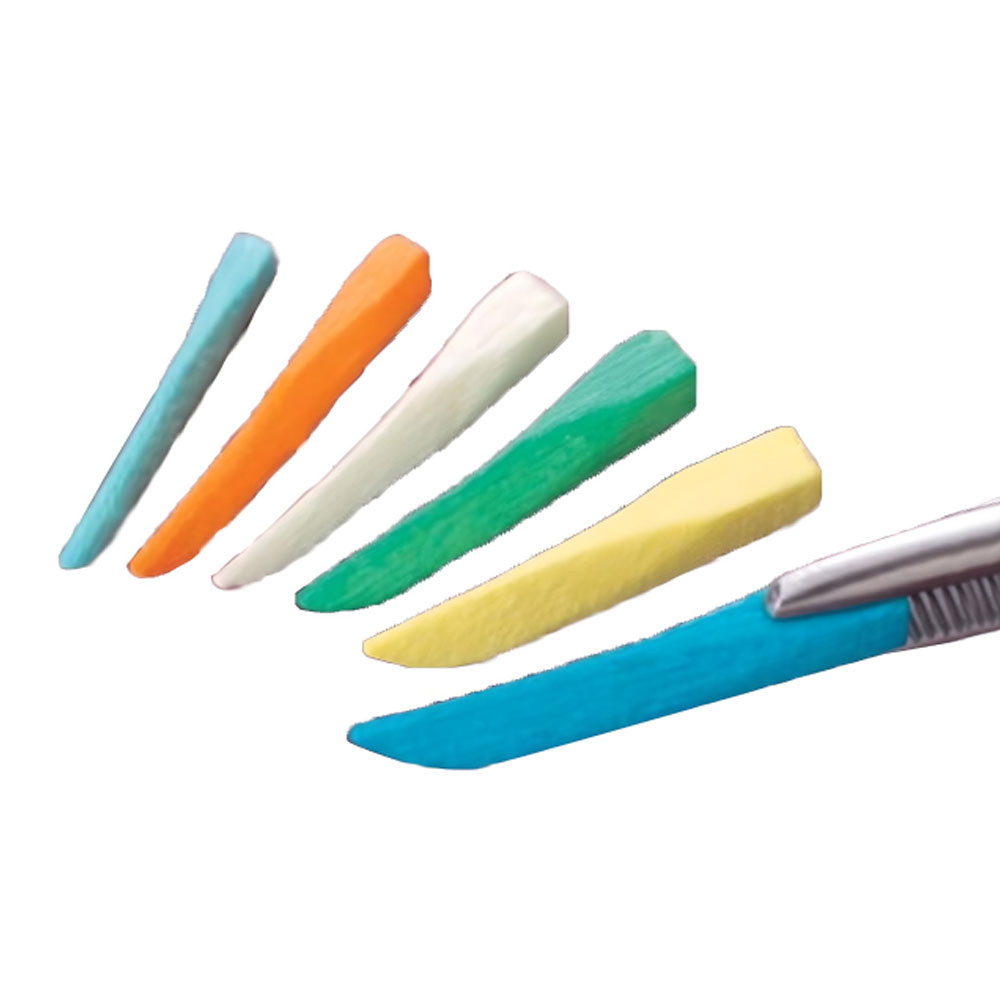
Veratiq Dental birch wooden wedges for Class II composite and amalgam restorations. Choose Small for narrow interproximal spaces, Slim Jim for the tightest contacts, Large, Wide Base for large embrasures and deep proximal boxes, or the Assorted box (50 each).
Product
- Manufacturer
- Veratiq Dental
- Manufacturer #
- TWS100
- Item code
- 200-0500
Catalog path
- Marketplace
- Clinical
- Category
- Matrix & Wedges
- Subcategory
- Wedges
Ordering
- Status
- In stock
More from Wedges
Stocked in the same subcategory.




Questions
What is Veratiq Dental Wooden Wedges used for?
Veratiq Dental birch wooden wedges for Class II composite and amalgam restorations.
Which size and pack options are on this page?
This page carries 5 size options: Small, Slim Jim, Large, Wide Base, Assorted (50 each). This page carries 2 pack options: 100/box, 200/box. Pick one to see its price, part number and stock.
When does it ship?
In-stock orders placed before 3 PM ET ship the same day; anything not on our shelf ships within 3 business days.Ground shipping is free over $10.
About interdental wedges
A wedge is pushed in between two teeth to adapt the matrix to the contour at the gum line, hold it steady and separate the teeth a little. If the wedge is too narrow the matrix will not adapt properly to the tooth surface and a correct marginal seal is not obtained. A wedge that is too wide pushes the matrix beyond the space meant for the restoration and leaves a concavity. Wedges are made of wood, of plastic and of silicone.
A matrix band can be held in place with a wedge, a separation ring, PTFE tape, or block-out or flowable resin, and of those the wedge is the most used for sealing at the gum line and holding the matrix. Protecting the surface of the neighbouring tooth during preparation is described as one of the important biological principles in fixed prosthodontics. Damage to that surface leaves the tooth more open to caries, more sensitive to temperature and more exposed to periodontal disease.
What to look at when choosing a wedge
Height and width: the correct height and width of the wedge is described as crucial to avoid undesirable effects, and the number of heights and widths on the market is limited. A study reports that in many cases the wedge has to be customised, for example with a bur, to do its job.
How a size gets picked: the same study found no published guide or technique for choosing a wedge, so it is usually picked by eye at the size the clinician believes is about right, often after trying several. Trying several sizes costs working time and raises the risk of damage to the tissue between the teeth.
Overhangs: in one study of bone loss over 25 years, loss beside over-contoured restorations averaged 0.16 mm a year against 0.06 mm beside unrestored teeth.
Wedges and guards that protect the next tooth
One study reported damage in 74 percent of preparations where no protection was used, against 50 percent with a metal matrix band and 46 percent with a wooden wedge. A later study of crown preparations found obvious damage on 16 percent of the far surfaces and 4 percent of the near surfaces when a metal band and a wooden wedge were both applied.
Alongside plain wedges, this shelf carries wedge guards and interproximal protection strips made for that job.
Sources: Gancedo-Gancedo et al. 2024, New Technique for Wedge Selection in Direct Class II Restorations: A Pilot Study (J Clin Med) · Faour et al. 2024, Assessment of Iatrogenic Damage to Adjacent Teeth After Applying Different Prevention Methods (Cureus)
