

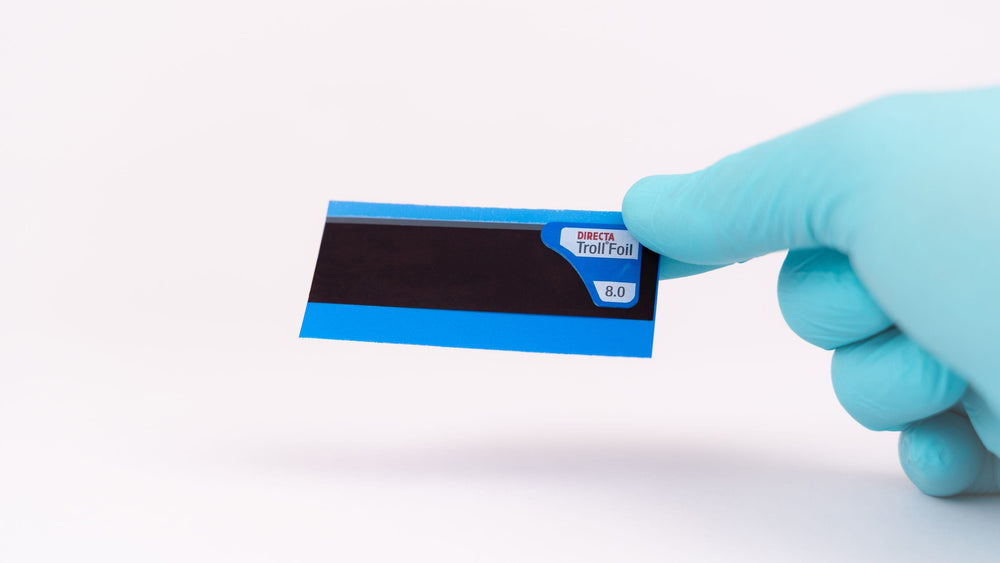
The Directa TrollFoil 4.5 Blue is a restorative & cosmetic product supplied by Directa for restorative use. Catalog code 12000145.
Directa TrollFoil 4.5 Blue is a film from Directa, part of the Trollfoil line. Manufacturer part number 12000145.
Find it on our Restorative & Cosmetic shelf, under Articulating Paper & Film.
Orders placed before 3 PM ET ship the same day when the item is on our shelf (otherwise within 3 business days), and ground shipping is free over $49.
| GTIN / barcode | 17310230000788 |
|---|
Product
- Manufacturer
- Directa
- Manufacturer #
- 12000145
- Item code
- 107-0452
- UPC / Barcode
- 17310230000788
Catalog path
- Marketplace
- Clinical
- Category
- Restorative & Cosmetic
- Subcategory
- Articulating Paper & Film
Ordering
- Status
- Special order
More from Articulating Paper & Film
Stocked in the same subcategory.


Bausch Articulating Papers
Bausch Arti-Check Micro-Thin Articulating Paper, 40 Microns
109-0003
$9.78


Veratiq Dental
Veratiq Etchera 37% Phosphoric Acid Etchant Gel
In stock
269 sold this monthfrom $5.69
Questions
What is Directa TrollFoil 4.5 Blue used for?
The Directa TrollFoil 4.5 Blue is a restorative & cosmetic product supplied by Directa for restorative use.
When does it ship?
In-stock orders placed before 3 PM ET ship the same day. An item we don't keep on the shelf shows its own ship-by date on its page, and you can cancel it for a full refund until it ships.Ground shipping is free over $49.
About articulating film
Articulating film, also called articulation foil, is the thinnest occlusal indicator and registers contacts between teeth more accurately than paper. It marks less clearly under light pressure and on glossy surfaces, so more pressure is needed than with paper. Some films carry an added emulsifier that lets them mark on moist biting surfaces.
Articulating paper is ink-coated paper in strips, used to locate and mark the points where upper and lower teeth touch. The FDA lists articulation paper as a Class I device (21 CFR 872.6140), placed between the upper and lower teeth in the bite position to locate uneven or high areas.
Its thickness runs from 8 to 200 microns, and the base may be paper, polyester or silk. Published studies describe the marks as showing where teeth touch, not how hard: they cannot determine the sequence or the strength of contacts.
How paper, film, high spot indicators and pressure paste differ
- Articulating paper — Placed between the teeth, it marks whatever touches it.
- Articulating film — The thinnest of the indicators; it needs a firmer bite to leave a mark.
- High spot indicators — Coats the restoration itself; contact wears the colour away at the high spot. It can be used on highly polished surfaces such as gold or ceramic.
- Pressure indicator paste — Goes on the fitting surface of a denture or other prosthesis to show how it seats, not between the biting surfaces.
What to look at when choosing articulating paper
Thickness: thin papers of 8 or 40 microns are more flexible and follow the shape of the biting surface more closely than thick ones.
Shape: articulating paper comes in strips and in horseshoe-shaped sheets.
Base material: foils are the thinnest indicators, but their marking shows less under light pressure and on glossy surfaces. Articulating silk is tear-resistant and flexible enough to follow cusps and fossae.
Moisture: saliva can ruin ordinary articulating paper, and some papers and films carry a bonding or wetting agent so that they mark on moist surfaces.
Sources: The Glossary of Prosthodontic Terms, 9th edition (J Prosthet Dent 2017) · FDA 21 CFR 872.6140, Articulation paper · Manziuc et al. 2024, Insights into Occlusal Analysis: Articulating Paper versus Digital Devices (J Clin Med) · Bozhkova et al. 2021, Occlusal Indicators Used in Dental Practice: A Survey Study (Biomed Res Int) · Sharma et al. 2013, Materials used for recording static and dynamic occlusal contact marks: a literature review (J Clin Exp Dent)
