

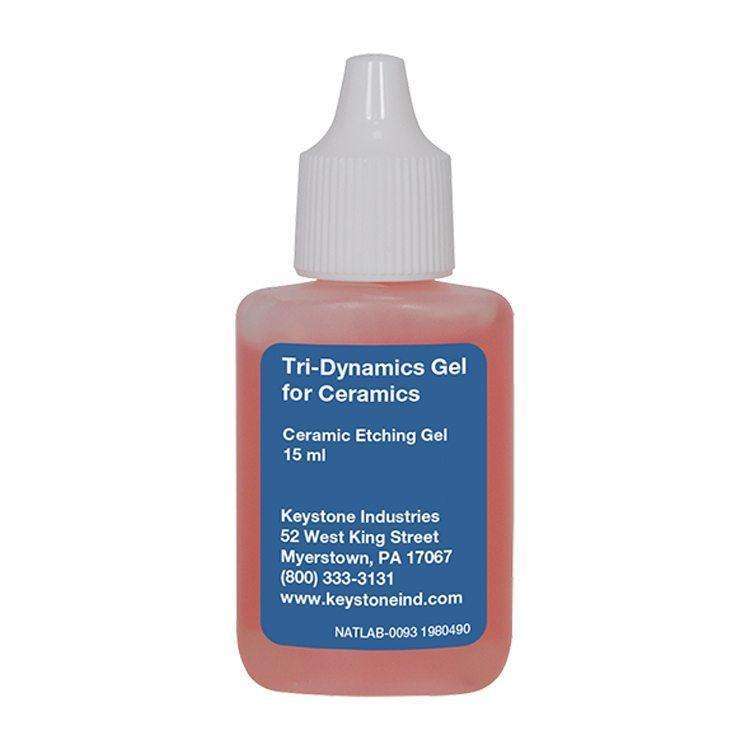
Keystone Tri-Dynamics Ceramic Etch Gel is a material designed for surface treatment of ceramic restorations. It is applied as part of restorative and cosmetic dental procedures to prepare ceramic surfaces, facilitating improved adhesion for subsequent bonding agents.
This product is provided in a 15ml bottle, with one bottle per pack. This packaging is suitable for dental professionals in practices or laboratories who require a consistent supply for their ceramic bonding and adhesive applications.
Product
- Manufacturer
- Keystone Industries
- Manufacturer #
- 5920840
- Item code
- 010-2006
- UPC / Barcode
- 5920840
Catalog path
- Marketplace
- Clinical
- Category
- Restorative & Cosmetic
- Subcategory
- Bonding & Etch
Ordering
- Status
- In stock
- Weight
- 0.06 lb
More from Bonding & Etch
Stocked in the same subcategory.


Pulpdent
Pulpdent Porcelain Etch Gel 9.6% Hydrofluoric Acid Kit, 4 x 1.2 mL Syringes + 8 Tips
106-1193
$54.07


Veratiq Dental
Veratiq Etchera 37% Phosphoric Acid Etchant Gel
In stock
268 sold this monthfrom $5.69
Questions
What is Tri-Dynamics used for?
Keystone Tri-Dynamics Ceramic Etch Gel is a material designed for surface treatment of ceramic restorations.
When does it ship?
In-stock orders placed before 3 PM ET ship the same day. An item we don't keep on the shelf shows its own ship-by date on its page, and you can cancel it for a full refund until it ships.Ground shipping is free over $49.
About ceramic primers and silane
Silane is a coupling agent: it improves the chemical bond between an inorganic surface, such as a dental ceramic, and resin. On glass-based ceramics it is applied after hydrofluoric acid etching; for zirconia-based ceramics a systematic review describes it as optional or not required.
A bonding agent is a resin painted onto the inside of a prepared tooth to improve the retention of a restoration such as a filling. The FDA regulates it as a resin tooth bonding agent, a Class II device (21 CFR 872.3200). An etchant is a chemical agent that selectively dissolves a surface, leaving it retentive.
Bonding to teeth follows an etch-and-rinse or a self-etch strategy; resin-modified glass ionomer, which adheres on its own, is counted as a third. Retention comes from a hybrid layer and resin tags formed when the adhesive hardens inside the etched surface.
How the types of adhesive and etchant differ
- Universal adhesives — One adhesive for any of the three etching approaches. The makers of some still call for a separate activator or a dedicated primer on porcelain and zirconia.
- Self-etch adhesives — No separate acid and no rinsing. It does not etch enamel to the depth phosphoric acid does.
- Total-etch adhesives — Applied after phosphoric acid that is rinsed away. A review calls the three-step systems the most versatile, usable with self-cure, dual-cure and light-cure protocols.
- Etching agents — The acid itself: phosphoric acid for enamel and dentin, hydrofluoric acid for glass-based ceramics.
- Ceramic primers and silane — Prepares the ceramic restoration, not the tooth, for bonding.
- Adhesive accessories — The applicators that carry the adhesive to the tooth.
What to look at when choosing a bonding agent
Bottles and steps: systems run from three bottles to one. A review reports the highest bond strengths for the three-step systems, which are also the most complicated to use.
Compatibility: not all one-bottle etch-and-rinse adhesives are compatible with self-cured or dual-cured materials or with core materials.
Delivery: self-etch adhesives come in bottles or unit doses, and two-part ones are mixed immediately before use.
For ceramics: a systematic review found better bonding when silane was applied separately than when it was only contained in a universal adhesive.
Testing: ISO 29022 describes the shear test used to measure the bond strength between restorative materials and tooth structure.
Sources: FDA 21 CFR 872.3200, Resin tooth bonding agent · The Glossary of Prosthodontic Terms, 9th edition (J Prosthet Dent 2017) · Sofan et al. 2017, Classification review of dental adhesive systems (Ann Stomatol) · Chmielewska et al. 2022, Material Connections in Restorative Dentistry: A Comprehensive Review (Int J Mol Sci) · Dapieve et al. 2018, Silane incorporated to universal adhesives or applied separately: A systematic review (J Indian Prosthodont Soc) · FDA 21 CFR 872.3140, Resin applicator · ISO 29022:2013, Notched-edge shear bond strength test
