

RMH3 DentalShips in 3 business days
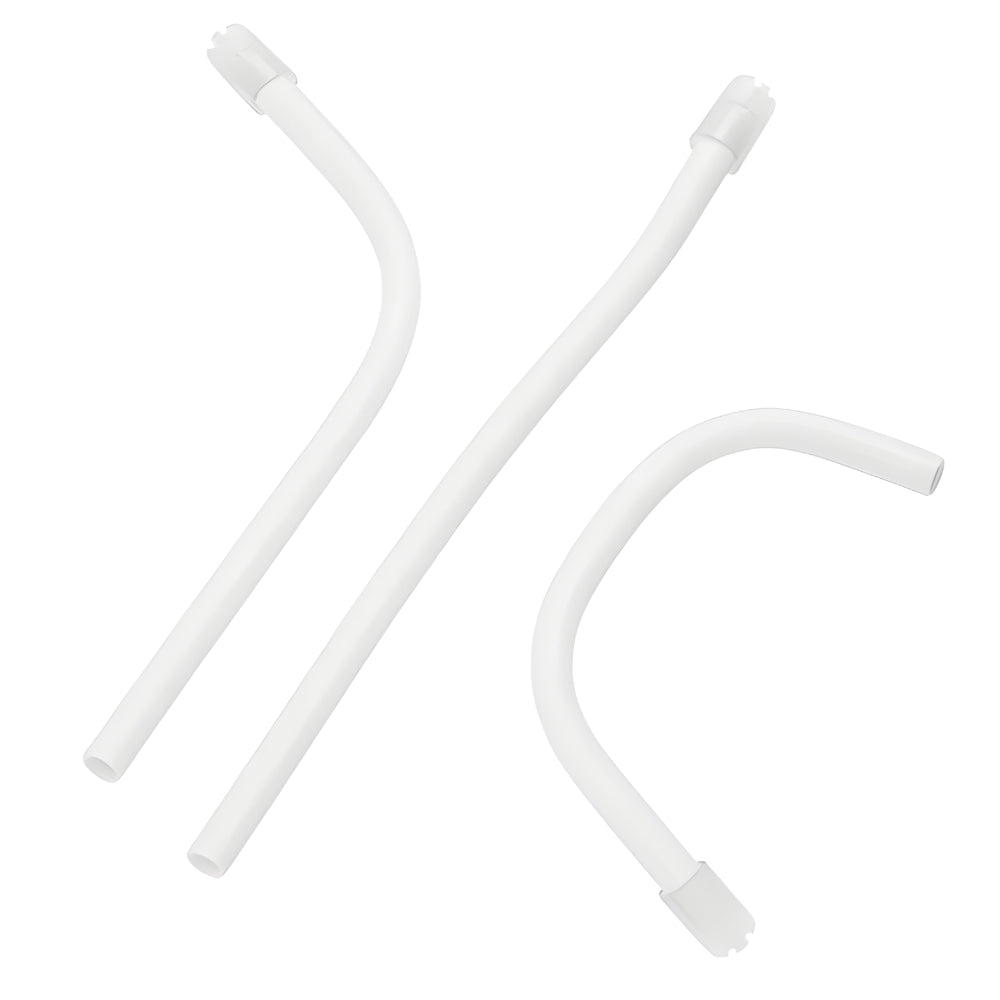
RMH3 Dental Saliva Ejectors, 15 cm · White tube, white tip · 100/Pack
SKU 042-0384MFR# SE-303
Style
White tube, white tip
Pack
100/Pack
100/Pack$3.04
1,000 (10 × 100)
Saliva Ejectors are essential evacuation tools designed for effective fluid removal during dental procedures. Each package contains 100 units featuring a clear tube with blue tip and wire-reinforced construction that maintains shape and structural integrity throughout use. The flexible design balances durability with patient comfort while providing reliable suction performance for consistent chairside management.
Product
- Manufacturer
- RMH3 Dental
- Manufacturer #
- SE-303
- Item code
- 042-0384
Catalog path
- Marketplace
- Clinical
- Category
- Evacuation
- Subcategory
- Saliva Ejectors
Ordering
- Status
- Ships in 3 business days
More from Saliva Ejectors
Stocked in the same subcategory.


Questions
What is RMH3 Dental Saliva Ejectors, 15 cm used for?
Saliva Ejectors are essential evacuation tools designed for effective fluid removal during dental procedures.
Which style and pack options are on this page?
This page carries 3 style options: Clear tube, blue tip, Blue tube, clear tip, White tube, white tip. This page carries 2 pack options: 100/Pack, 1,000 (10 × 100). Pick one to see its price, part number and stock.
How many come in a pack of RMH3 Dental Saliva Ejectors, 15 cm?
100 per pack; the price shown is per pack.
When does it ship?
In-stock orders placed before 3 PM ET ship the same day; anything not on our shelf ships within 3 business days.Ground shipping is free over $10.
About saliva ejectors
A dental unit carries two evacuators attached to one vacuum source: a high-volume evacuator and a low-volume evacuator. The low-volume line is the one used to draw off blood, saliva and the coolant from the drill so that the working area stays clear. Low-volume evacuation is useful for removing pooling saliva and water, but it does not have the power to limit the spread of droplets generated during a procedure.
Backflow from low-volume saliva ejectors occurs when the pressure in the patient’s mouth is less than the pressure in the evacuator. The CDC reports that studies have found backflow in low-volume suction lines can occur, and microorganisms present in the lines be drawn back into the mouth when a seal forms around the ejector, for example when a patient closes the lips around the tip. How often it happens varies, because the quality of the seal formed varies between patients. Studies have also shown that gravity pulls fluid back toward the mouth whenever a length of the suction tubing holding the tip is positioned above the patient’s mouth, or while other high-volume evacuation equipment is in use at the same time.
No adverse health effects associated with the saliva ejector have been reported, and the CDC says practitioners should be aware that in certain situations backflow could occur when one is used. Its recommendation is not to advise patients to close their lips tightly around the tip of the saliva ejector to evacuate oral fluids. Saliva ejectors are commonly available in a disposable form, and the CDC says such items should be disposed of appropriately after each use.
What to look at when choosing a saliva ejector
Suction cannulas come in different diameters: one splatter study compared a 6 mm saliva ejector, an 11 mm suction cannula and three types of 16 mm suction cannula.
A single-use device is designed to be used on one patient and then discarded, not reprocessed for use on another, and single-use devices in dentistry are usually not heat-tolerant and cannot be reliably cleaned.
The handle it plugs into: the handles and dental unit attachments of saliva ejectors do not enter the mouth but are likely to become contaminated with oral fluids, so the CDC says they should be covered with impervious barriers that are changed after each use.
Bacteria and biofilms sit steadily in the pipeline connected to the evacuators, which gives them a surface to form, grow and multiply on and shed from.
Amalgam work: a national standard counts saliva ejectors used in dental procedures involving amalgam as amalgam waste.
Sources: CDC, Guidelines for Infection Control in Dental Health-Care Settings — 2003 (MMWR 52(RR-17)) · Effective disinfecting of negative pressure pipelines of dental chair units reduces the risk of cross infection, 2024 (PMC10773641) · Droplet Distribution in a University Dental Clinic Setting: The Importance of High-Volume Evacuation, 2022 (PMC9499005) · Influence of flow rate and different size of suction cannulas on splatter contamination in dentistry, 2022 (PMC9088725) · ADA Oral Health Topics: Amalgam Separators and Waste Best Management Practices
