
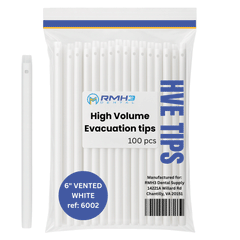

High Volume Evacuation Tips – White Plastic, Vented, 1000/Case (item #6001) White plastic suction tips, vented. • Plastic. • Vented. In the package: 1000 tips, in 10 bags of 100. For use by a dental professional.
Product
- Manufacturer
- RMH3 Dental
- Manufacturer #
- 6001
- Item code
- 001-0997
- UPC / Barcode
- 168429
Catalog path
- Category
- Evacuation
- Subcategory
- HVE Tips
Ordering
- Status
- In stock
More from HVE Tips
Stocked in the same subcategory.



Questions
What is it used for?
High Volume Evacuation Tips – White Plastic, Vented, 1000/Case (item #6001) White plastic suction tips, vented. • Plastic. • Vented.
When does it ship?
In-stock orders placed before 3 PM ET ship the same day. An item we don't keep on the shelf shows its own ship-by date on its page, and you can cancel it for a full refund until it ships.Ground shipping is free over $10.
About high-volume evacuation tips
A high-volume evacuator is a suction device mounted on an evacuation system that draws large volumes of air. It draws in large quantities of air, and the liquid droplets suspended in that air, during procedures such as ultrasonic scaling. The CDC lists high-velocity air evacuation, together with dental dams, among the work practices that should minimise the dissemination of droplets, spatter and aerosols.
The spray from a handpiece or an ultrasonic scaler is mostly large-particle spatter that travels only a short distance and settles out quickly. The same spray may also contain aerosols, which can remain airborne for extended periods and can be inhaled.
A systematic review of aerosol mitigation in real dental clinics calls high-volume evacuation the most widely used device for reducing aerosols. Most of the studies it gathered concluded that high-volume evacuation was effective in decreasing the microbial load of aerosols produced in aerosol-generating procedures. The same review says an unmodified evacuator used as a separate unit should be taken with caution, because one study did not report positive results in reducing aerosol counts and environmental contamination, and that where the tip is held relative to the mouth was critical to the effect. A controlled clinical trial in a large teaching clinic found significant reductions in microbial aerosols when both high-volume evacuation and an intraoral suction device were used.
What to look at when choosing HVE tips
Suction cannulas come in different diameters: one splatter study compared a 6 mm saliva ejector, an 11 mm suction cannula and three types of 16 mm suction cannula. The lowest splatter contamination in that study came from the 16 mm cannulas at a flow rate of 250 litres a minute or more. A guideline cited in the same paper calls for intraoral suction with a cannula of 10 mm diameter or more wherever possible.
Disposable or not: high-volume evacuator tips are commonly available in a disposable form, and the CDC says they should be disposed of appropriately after each use. An item that touches mucous membranes is semicritical, and because most semicritical items in dentistry are heat-tolerant the CDC says they should be sterilized by using heat.
Who holds it: the vacuum a high-volume evacuator generates is strong enough that a dental assistant is needed to stabilise the tip in the mouth. The CDC notes that, unless the provider has an assistant, high-volume evacuation is not commonly used during a procedure with a prophylaxis cup or an ultrasonic scaler.
What it is paired with: a trial found the combination of high-volume evacuation and an intraoral suction device significantly decreased microbial aerosols during oral prophylaxis procedures.
The line behind it: cleaning and disinfecting the suction pipeline has long been a problem in dental infection control, and a 2024 study reported that no domestic or international standard for it is recommended.
Sources: CDC, Guidelines for Infection Control in Dental Health-Care Settings — 2003 (MMWR 52(RR-17)) · Cao et al. 2023, Effectiveness of interventions to reduce aerosol generation in dental environments: a systematic review (Prev Med Rep) · Suprono et al. 2021, A clinical investigation of dental evacuation systems in reducing aerosols (J Am Dent Assoc) · Droplet Distribution in a University Dental Clinic Setting: The Importance of High-Volume Evacuation, 2022 (PMC9499005) · Effective disinfecting of negative pressure pipelines of dental chair units reduces the risk of cross infection, 2024 (PMC10773641) · Influence of flow rate and different size of suction cannulas on splatter contamination in dentistry, 2022 (PMC9088725)
