

RMH3 DentalIn stock
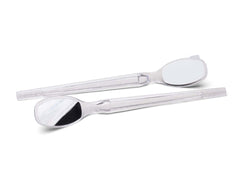
RMH3 Dental Front Surface Mirrors, Cone Socket — 12/Box · #5
SKU 101-0007MFR# Cone Socket 5
Size
#5
#5$8.48
#4$8.31
Front Surface Mouth Mirrors, Size #5, 12/Pk. Designed to deliver crystal-clear, distortion-free reflections for incredibly precise dental examinations. It is built for durability and reliability, directly supporting accurate diagnostics and efficient patient care.
Product
- Manufacturer
- RMH3 Dental
- Manufacturer #
- Cone Socket 5
- Item code
- 101-0007
Catalog path
- Marketplace
- Clinical
- Category
- Instruments
- Subcategory
- Diagnostic Instruments
Ordering
- Status
- In stock
More from Diagnostic Instruments
Stocked in the same subcategory.




Questions
Which size options are on this page?
This page carries 2 size options: #5, #4. Pick one to see its price, part number and stock.
How many come in a pack?
12 per pack; the price shown is per pack.
When does it ship?
In-stock orders placed before 3 PM ET ship the same day; anything not on our shelf ships within 3 business days.Ground shipping is free over $10.
About mouth mirrors
A mouth mirror is a handle with a thin circular mirrored surface on the working end, which lets the inside of the teeth and the rest of the mouth be seen. It is used to look for bacteria, cavities and calculus in places that are hard to see directly. Three mirror faces are in use — front surface, concave and plane surface — and the front-surface mirror is the one most often used because it gives a clear image.
A clinical examination is done with a small standard kit: a mouth mirror, a probe and tweezers. These come either as separate disposable kits or inside a larger procedure kit. The FDA lists the mouth mirror, the periodontic probe, the operative explorer and operative pliers among dental hand instruments, a Class I device (21 CFR 872.4565).
ISO 4865-1 sets the general requirements for non-hinged dental hand instruments, covering materials, hardness, surface finish and resistance to reprocessing. Periodontal probes have a standard of their own, ISO 21672-1, which applies to probes made of austenitic and martensitic stainless steel.
How the diagnostic instruments differ
- Mirrors — The only one of these that does not touch what it examines: it is there for indirect vision and light reflection.
- Probes — Graduated and blunt, so it measures a depth rather than feeling a surface; the reading is a probing depth and not exactly the true pocket depth.
- Explorers — Pointed and unmarked: it feels a surface rather than measuring a depth.
- Cotton pliers — The hinged instrument of the set: it carries things to and from the mouth instead of examining the tooth.
What to look at when choosing a diagnostic instrument
Mirror face: front surface, concave or plane surface, with the front-surface type described as giving a clear image.
Probe markings: a screening pattern carries bands and rings at set depths, while a charting pattern is graduated along the working end. Published work puts the probing force used in examination at around 0.20 to 0.25 N.
Probe material: ISO 21672-1 applies to austenitic and martensitic stainless steel and not to probes whose working ends are made completely of plastics.
Reprocessing: these instruments touch mucous membranes, which the CDC classes as semicritical, and most can and therefore should be heat sterilized.
Disposable or reusable: examination instruments are supplied both as separate disposable kits and as part of a reusable procedure kit.
Sources: Bhatia & Aruede, Oral Surgery, Instruments (StatPearls, NCBI Bookshelf NBK585063) · FDA 21 CFR 872.4565, Dental hand instrument · ISO 4865-1:2023, Dentistry — General requirements of hand instruments — Part 1: Non-hinged hand instruments · ISO 21672-1:2012, Dentistry — Periodontal probes — Part 1: General requirements · Optimization of Dental Devices and Tools Used on Teeth, 2021 (Biomed Res Int) · Deep learning-based object detection of restorative dental instruments, 2025 (Sci Rep) · Chapple 2015, Detection and diagnosis of periodontal conditions amenable to prevention (BMC Oral Health) · CDC: Best Practices for Sterilization in Dental Settings
