
Sold out

RMH3 DentalSold out
RMH3 Dental CAD/CAM PMMA Disc, Monolithic, 98 mm · 25 mm · B1
SKU 001-3622MFR# R9825CB1
$18.00
· Sold out
Thickness
25 mm
Why it works
For milled temporaries
A PMMA disc for temporary crowns and bridges, milled in a dental CAD/CAM system.
One shade per disc
19 shades: A1 to D4 and the bleach shades OM1 to OM3.
Fits open systems
98 mm diameter, for open CAD/CAM milling systems that take 98 mm discs.
8 thicknesses
12, 14, 16, 18, 20, 22, 25 and 30 mm. One disc per package.
A single-shade PMMA disc for milling temporary crowns and bridges in a dental CAD/CAM system. Each disc is one shade, 98 mm in diameter, and fits open CAD/CAM milling systems that take 98 mm discs.
What it is used for
- Milled temporary crowns and bridges
- Temporary restorations worn while the gum forms around an implant, and to check the bite before the final restoration is made
On this page
152 discs: pick the thickness, then the shade.
| Choice | What we carry |
|---|---|
| Thickness | 12, 14, 16, 18, 20, 22, 25 and 30 mm |
| Shade | A1, A2, A3, A3.5, A4, B1, B2, B3, B4, C1, C2, C3, C4, D2, D3, D4 and the bleach shades OM1, OM2, OM3 |
| Diameter | 98 mm |
| In the package | 1 disc |
For use by a dental professional.
Product
- Manufacturer
- RMH3 Dental
- Manufacturer #
- R9825CB1
- Item code
- 001-3622
Catalog path
- Marketplace
- Laboratory
- Category
- Digital Lab & CAD/CAM
- Subcategory
- CAD/CAM Blocks & Discs
Ordering
- Status
- Sold out
More from CAD/CAM Blocks & Discs
In stock in the same subcategory. Not the same product — check the specs before you swap.


Keystone Industries
Keystone KeyPrint KeySplint 3D Printing Resin
In stock
24 sold this monthfrom $234.06
Keystone Industries
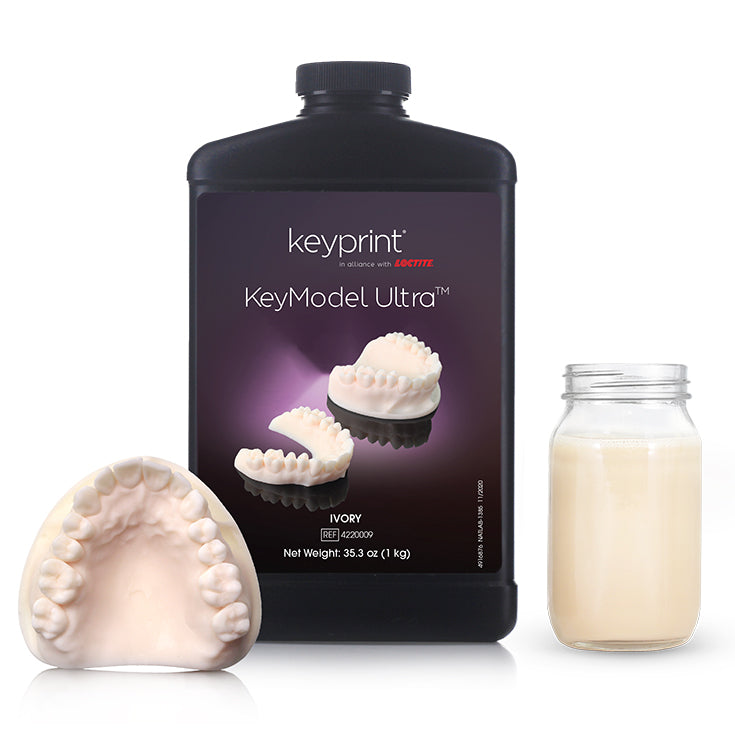
Keystone KeyPrint KeyModel Ultra 3D Printing Resin
In stock
13 sold this monthfrom $71.30


About PMMA discs
PMMA, polymethyl methacrylate, is used in dentistry for artificial teeth, denture bases, retainers and provisional crowns. Milled PMMA is used for long-term provisional restorations, up to one year. The FDA defines temporary crown and bridge resin as a material such as polymethylmethacrylate for a temporary prosthesis used until the permanent restoration is made, Class II (21 CFR 872.3770).
A CAD/CAM block or disc is a prefabricated piece of material from which a restoration is milled by a computer-controlled machine. The Glossary of Prosthodontic Terms defines CAD-CAM as the computer-controlled subtractive fabrication of a three-dimensional object, used to produce crowns, veneers, inlays, onlays and other prostheses. By material, a systematic review groups CAD-CAM materials into silicate ceramics, oxide ceramics, composite resins, PMMA, PEEK, polymer-infiltrated ceramic network materials and metal.
How the types of block and disc differ
- Zirconia discs and blocks — The strongest of the materials here, with aesthetics somewhat below the silicate ceramics. Milled oversize and then sintered, because it shrinks in the furnace.
- Hybrid ceramic blocks — Part ceramic and part polymer, where zirconia is all ceramic. Resin block composites can be used for permanent restorations.
- PMMA discs — A polymer for provisional work, where zirconia and hybrid ceramic are for permanent restorations.
- Wax discs — Not a final material: the milled wax is a pattern that is removed from the mould, usually by heat.
What to look at when choosing a zirconia disc
Yttria content: the cubic phase and the translucency rise with the yttria concentration. More cubic phase improves translucency and lowers strength.
Grade names: with 3 to 8 mol% yttria the material is called partially stabilised zirconia (PSZ), and at about 3 mol% it is close to fully tetragonal (TZP).
Colour: a zirconia restoration is coloured either by using a pre-coloured block or by immersing or brushing the white restoration with colouring solution.
Sintering: the optimum sintering temperature range given in the review is 1350 to 1550 °C.
Sources: Clinical Applications and Mechanical Properties of CAD-CAM Materials in Restorative and Prosthetic Dentistry: A Systematic Review (J Funct Biomater 2023) · The Glossary of Prosthodontic Terms, 9th edition (J Prosthet Dent 2017) · Revolution of Current Dental Zirconia: A Comprehensive Review (Molecules 2022) · Biofilm Formation on Hybrid, Resin-Based CAD/CAM Materials for Indirect Restorations: A Comprehensive Review (Materials 2024) · FDA 21 CFR 872.3770, Temporary crown and bridge resin · Comparison the Marginal and Internal Fit of Metal Copings Cast from Wax Patterns Fabricated by CAD/CAM and Conventional Wax up Techniques (J Dent Shiraz 2013) · FDA 21 CFR 872.6890, Intraoral dental wax · Translucent Zirconia in Fixed Prosthodontics: An Integrative Overview (Biomedicines 2023)
