

Pac-DentShips in 3 business days
Pac-Dent Cement and Core Material Mixing Tips, 25/Pack · HP Permanent Cement: Brown with Black Tip
SKU 103-0518MFR# PD-155
Tip
HP Permanent Cement: Brown with Black Tip
Pac-Dent T-Mixer Temporary Cement Mixing Tips, brown mixing tip with a black mixing element (black tip), 25 per pack. Catalog code PD156.
Pac-Dent Cement and Core Material Mixing Tips, 25/Pack is a mixing tip from Pac-Dent. Each pack holds 25.
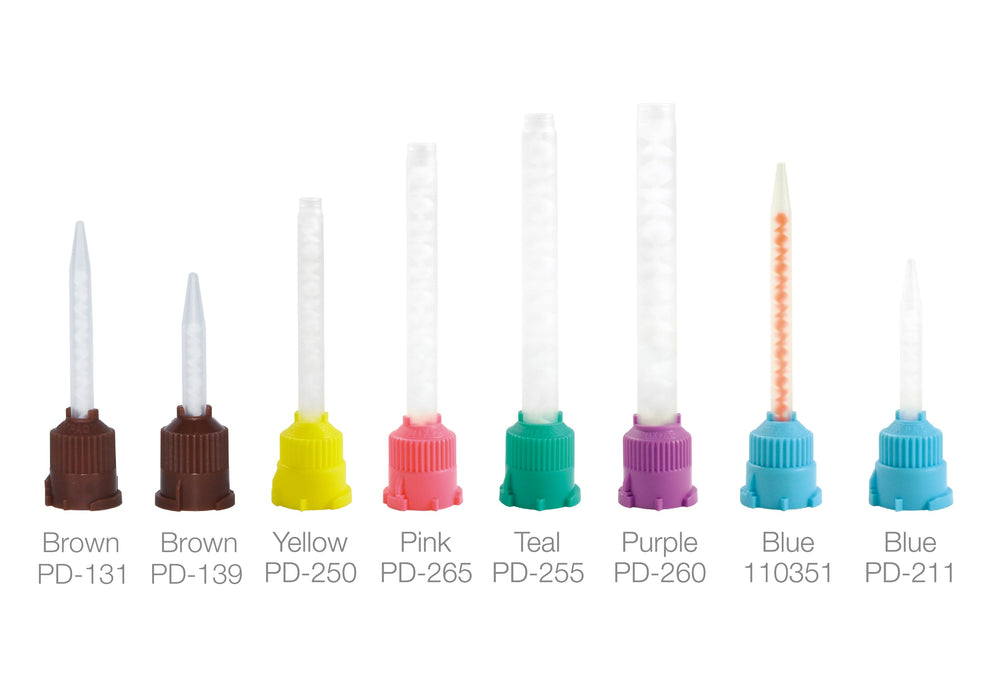
This page carries 5 tip options: HP Permanent Cement: Brown with Black Tip, T-Mixer Temporary Cement: Brown with Black Tip, T-Mixer Permanent Cement: Brown, 1:1, Clear Tip, Core Material: Brown with Extra Fine Intra-Oral Tip, Core Material: Brown with Intra-Oral Tip.
Find it on our Impression Materials shelf, under Mixing Tips & Guns.
Orders placed before 3 PM ET ship the same day when the item is on our shelf (otherwise within 3 business days), and ground shipping is free over $10.
Product
- Manufacturer
- Pac-Dent
- Manufacturer #
- PD-155
- Item code
- 103-0518
Catalog path
- Marketplace
- Clinical
- Category
- Impression Materials
- Subcategory
- Mixing Tips & Guns
Ordering
- Status
- Ships in 3 business days
More from Mixing Tips & Guns
Stocked in the same subcategory.


MN Health
EcoPression VPS Bite Registration Material, 2 × 50 mL Cartridges
In stock
482 sold this monthfrom $9.20

MN Health
EcoPression VPS Impression Material, 4 × 50 mL Cartridges
In stock
277 sold this monthfrom $18.00


Questions
What is it used for?
Pac-Dent T-Mixer Temporary Cement Mixing Tips, brown mixing tip with a black mixing element (black tip), 25 per pack.
Which tip options are on this page?
This page carries 5 tip options: HP Permanent Cement: Brown with Black Tip, T-Mixer Temporary Cement: Brown with Black Tip, T-Mixer Permanent Cement: Brown, 1:1, Clear Tip, Core Material: Brown with Extra Fine Intra-Oral Tip, Core Material: Brown with Intra-Oral Tip. Pick one to see its price, part number and stock.
How many come in a pack?
25 per pack; the price shown is per pack.
When does it ship?
In-stock orders placed before 3 PM ET ship the same day; anything not on our shelf ships within 3 business days.Ground shipping is free over $10.
About mixing tips
A mixing tip screws onto the cartridge and mixes the base and the catalyst as they are pressed through it. Makers colour-code them: one set of instructions pairs a white-base tip with heavy body material and a red-base tip with light body. To keep voids out of the impression, a review describes holding the tip fully immersed in the material being syringed, with a steady flow rate.
Two-part impression and restorative materials are mixed one of three ways: by hand, through a static mixer, or by a machine that mixes them dynamically. A review calls auto-mixed, cartridge-based materials a notable development, and gives two reasons: it removes the spatulation step and the operator errors that go with it, and it cuts the number of voids in the impression by a factor of four to five against mixing by hand. A cartridge is pressed out with a dispensing gun through a mixing tip, a static mixer fixed to the end of the cartridge.
How mixing tips, intraoral tips, guns and bowls differ
- Mixing Tips — The disposable part: used mixers are discarded and the cartridge is resealed with its original cap.
- Intraoral Tips — Added after the mixer, to reach into the mouth.
- Dispensing Guns & Syringes — The reusable part, chosen by cartridge size and mixing ratio. Material comes out easily through a mixer of the right size; one maker warns that excessive force can rupture the cartridge or break the gun.
- Mixing Bowls & Dishes — For material mixed by hand, where a cartridge and tip are not involved.
What to look at when choosing
Fit: makers' instructions name the tip for each cartridge by colour and size, such as a yellow tip for a 50 ml cartridge and a brown tip for a 10 ml one. Some static mixers carry a built-in metal needle tip of a stated gauge, such as 17 or 19 gauge, for more precise placement.
First material out: makers instruct users to express a small amount onto a pad first, to ensure an even mix of base and catalyst.
Gloves: sulfur from natural latex gloves can contaminate the platinum catalyst of a vinyl polysiloxane and hold up its set, and the end of a mixing tip is one of the things a review names as not to be touched with latex gloves on.
Where the voids come from: a review lists mixing of base and catalyst, loading of the tray or syringe, the syringing itself, and working past the working time.
Sources: Addition Silicone Impressions in Fixed Prosthodontics: Clinical Standpoints, 2023 (PMC10517288) · Parkell, Predicta Bioactive Bulk instructions for use · Parkell, Cinch instructions for use · Parkell, Absolute Dentin instructions for use · A Comparative Study to Evaluate the Accuracy of Various Spacer Thickness for Polyvinyl Siloxane Putty-wash Impression Techniques, 2020 (PMC7887158) · Cervino et al. 2018, Alginate Materials and Dental Impression Technique: A Current State of the Art (Mar Drugs) · Pulpdent, ACTIVA BioACTIVE dual cure instructions for use
