
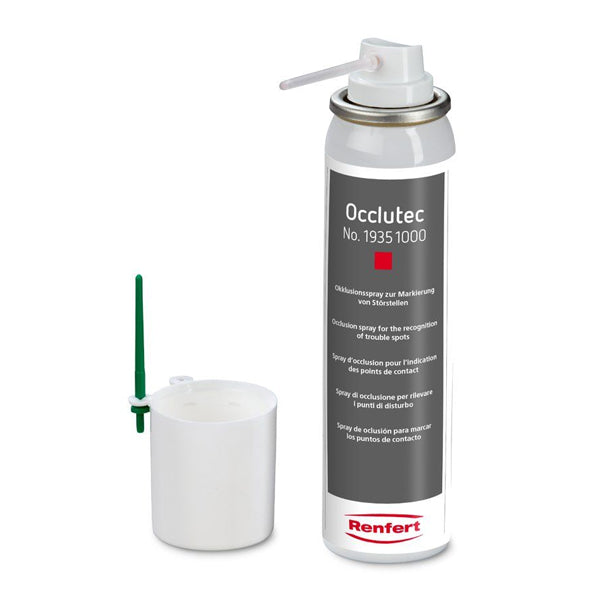
Occlutec Occlusion Spray - Red 75ml Can. High Spot Indicator Spray for Marking of high spots on CrCo dentures, crowns and bridges.
Renfert Occlutec Spray Red 75ml.. is a high spot indicator from Renfert, part of the Occlutec line. Manufacturer part number 19351000.
Find it on our Restorative & Cosmetic shelf, under Articulating Paper & Film.
Orders placed before 3 PM ET ship the same day when the item is on our shelf (otherwise within 3 business days), and ground shipping is free over $49.
Product
- Manufacturer
- Renfert
- Manufacturer #
- 19351000
- Item code
- 043-0976
- UPC / Barcode
- 19351000
Catalog path
- Marketplace
- Clinical
- Category
- Restorative & Cosmetic
- Subcategory
- Articulating Paper & Film
Ordering
- Status
- Sold out
Other in-stock items in Articulating Paper & Film
Not the same product — check the specs before you swap.


About high spot indicators
A high spot indicator is a liquid colour brushed onto the surface to be tested; the solvent evaporates in seconds and leaves a film about 3 microns thick. Each contact removes the colour exactly where it touches, so the material underneath shows through.
Articulating paper is ink-coated paper in strips, used to locate and mark the points where upper and lower teeth touch. The FDA lists articulation paper as a Class I device (21 CFR 872.6140), placed between the upper and lower teeth in the bite position to locate uneven or high areas.
Its thickness runs from 8 to 200 microns, and the base may be paper, polyester or silk. Published studies describe the marks as showing where teeth touch, not how hard: they cannot determine the sequence or the strength of contacts.
How paper, film, high spot indicators and pressure paste differ
- Articulating paper — Placed between the teeth, it marks whatever touches it.
- Articulating film — The thinnest of the indicators; it needs a firmer bite to leave a mark.
- High spot indicators — Coats the restoration itself; contact wears the colour away at the high spot. It can be used on highly polished surfaces such as gold or ceramic.
- Pressure indicator paste — Goes on the fitting surface of a denture or other prosthesis to show how it seats, not between the biting surfaces.
What to look at when choosing articulating paper
Thickness: thin papers of 8 or 40 microns are more flexible and follow the shape of the biting surface more closely than thick ones.
Shape: articulating paper comes in strips and in horseshoe-shaped sheets.
Base material: foils are the thinnest indicators, but their marking shows less under light pressure and on glossy surfaces. Articulating silk is tear-resistant and flexible enough to follow cusps and fossae.
Moisture: saliva can ruin ordinary articulating paper, and some papers and films carry a bonding or wetting agent so that they mark on moist surfaces.
Sources: The Glossary of Prosthodontic Terms, 9th edition (J Prosthet Dent 2017) · FDA 21 CFR 872.6140, Articulation paper · Manziuc et al. 2024, Insights into Occlusal Analysis: Articulating Paper versus Digital Devices (J Clin Med) · Bozhkova et al. 2021, Occlusal Indicators Used in Dental Practice: A Survey Study (Biomed Res Int) · Sharma et al. 2013, Materials used for recording static and dynamic occlusal contact marks: a literature review (J Clin Exp Dent)
