

Size
600 g
600 g$42.00
300 g$22.20
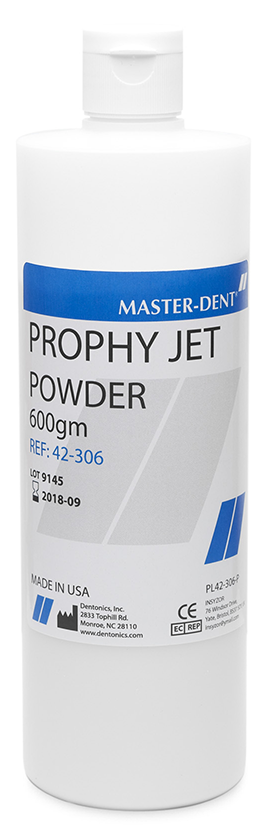
Dentonics Prophy-Jet Powder is a sodium bicarbonate cleaning powder formulated for use with air polishing systems. It is designed for effective removal of extrinsic stains and plaque during professional prophylaxis appointments, preparing tooth surfaces for further treatment.
This powder is provided in a 600gm bottle and is flavored with mint. The 600gm quantity is suitable for dental practices requiring a standard supply for routine air polishing procedures, supporting consistent patient care.
Product
- Manufacturer
- Dentonics
- Manufacturer #
- 42-306
- Item code
- 113-0003
Catalog path
- Marketplace
- Clinical
- Category
- Preventive
- Subcategory
- Air Polishing & Disclosing
Ordering
- Status
- In stock
More from Air Polishing & Disclosing
Stocked in the same subcategory.


Dharma
Citrine 5% Sodium Fluoride Varnish with TCP, Unit Doses
In stock
21 sold this monthfrom $24.89
Questions
What is it used for?
Dentonics Prophy-Jet Powder is a sodium bicarbonate cleaning powder formulated for use with air polishing systems.
Which size options are on this page?
This page carries 2 size options: 600 g, 300 g. Pick one to see its price, part number and stock.
When does it ship?
In-stock orders placed before 3 PM ET ship the same day; anything not on our shelf ships within 3 business days.Ground shipping is free over $10.
About air polishing powders
Powders are classified by particle size, shape, chemical composition and abrasiveness, and those are the factors that decide whether a powder suits use above or below the gum line. Sodium bicarbonate is a non-toxic, water-soluble powder effective on plaque above the gum line and on heavy outside stain. It was the first powder in wide use and is highly abrasive to root cementum, dentin and restoration surfaces. Glycine is a low-abrasive amino acid powder, reported as about 80 percent less abrasive than sodium bicarbonate. Erythritol is a water-soluble sugar alcohol with a particle size similar to or smaller than glycine.
Air polishing cleans a tooth by firing abrasive particles suspended in a jet of compressed air and water at the surface. The stream breaks up the biofilm and detaches the bacteria from the tooth and root surface. A disclosing agent is a colouring compound that binds to the film on the teeth and reveals where plaque is present. Both sit on one shelf here because both belong to the cleaning appointment: one shows the plaque, the other takes it off.
The FDA regulates a paste or powder containing an abrasive material intended to remove debris from the teeth as an oral cavity abrasive polishing agent, a Class I device (21 CFR 872.6030).
How the powders and the disclosing agents differ
- Air Polishing Powders — The abrasive itself, chosen by how coarse it is and where in the mouth it is used. A review lists erythritol particles at 14 to 31 microns against 25 to 65 for glycine.
- Disclosing Agents — A dye that marks where plaque is, with the colour intensity following the thickness of the plaque. A laboratory study notes disclosing agents can stain the gingiva and restorative materials as well as the tooth.
- Disclosing Solutions — The liquid form, painted on rather than chewed: one study had children chew a tablet for 30 to 60 seconds instead. A laboratory study found indicator liquid discoloured restorative materials more than tablet forms did.
What to look at when choosing an air polishing powder or disclosing agent
Where it will be used: a review indicates sodium bicarbonate for biofilm and early calculus above the gum line, and glycine and erythritol above and below it.
Abrasion: extended use of sodium bicarbonate powder may abrade enamel and raise the surface roughness of restorative materials. Glycine and erythritol were developed as less abrasive alternatives.
Form of the disclosing agent: one study found the delivery form changed how much restorations discoloured, with indicator liquid staining more than tablet forms.
Sources: Ifrim et al. 2026, Antimicrobial Efficacy and Soft-Tissue Safety of Air-Polishing Powders in Periodontal Therapy: A Narrative Review (J Funct Biomater) · Effect of plaque disclosing agents on the color stability of different restorative materials, 2026 (Eur Oral Res, PMC13322142) · FDA 21 CFR 872.6030, Oral cavity abrasive polishing agent · Fotopoulou et al. 2019, Detection of dental plaque with disclosing agents in the context of preventive oral hygiene training programs (Heliyon)
