

Home
Clinical
Finishing & Polishing
Polishing Kits
Flexible Silicone Polishers
Directa Composite Finishing Kit
Home
Laboratory
Finishing & Polishing
Polishing Kits
Flexible Silicone Polishers
Directa Composite Finishing Kit
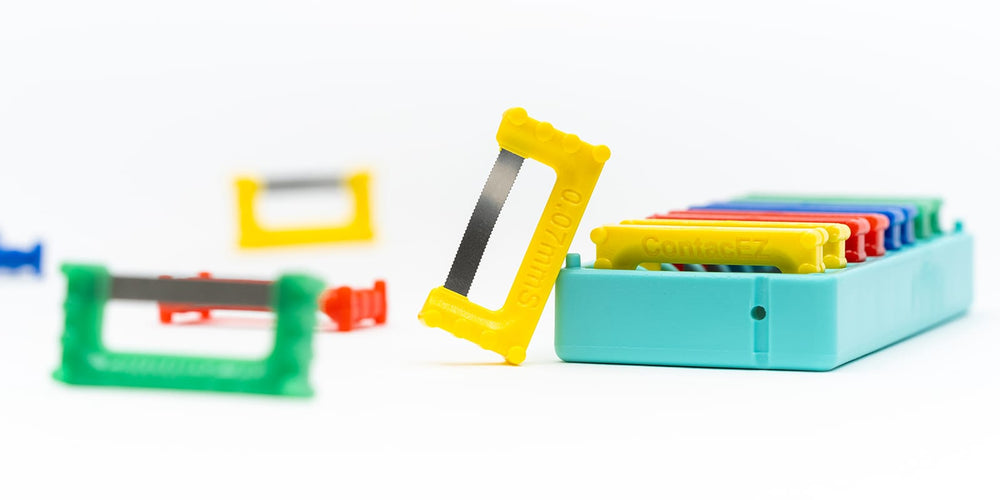
View all 7




The Directa Composite Finishing Kit is a miscellaneous product supplied by Directa for dental use. Catalog code 31026.
Directa Composite Finishing Kit is a flexible silicone polisher from Directa, part of the ContacEZ line. Key facts — Sterile: No; Single-use: No. Manufacturer part number 31026.
Find it on our Finishing & Polishing shelf, under Polishing Kits.
Orders placed before 3 PM ET ship the same day when the item is on our shelf (otherwise within 3 business days), and ground shipping is free over $49.
| Sterile | No |
|---|---|
| Single-use | No |
| GTIN / barcode | 17310230310269 |
Product
- Manufacturer
- Directa
- Manufacturer #
- 31026
- Item code
- 107-0628
- UPC / Barcode
- 17310230310269
Catalog path
- Marketplace
- Clinical · Laboratory
- Category
- Finishing & Polishing
- Subcategory
- Polishing Kits
Ordering
- Status
- Special order
More from Polishing Kits
Stocked in the same subcategory.


Questions
What is Directa Composite Finishing Kit used for?
The Directa Composite Finishing Kit is a miscellaneous product supplied by Directa for dental use.
When does it ship?
In-stock orders placed before 3 PM ET ship the same day. An item we don't keep on the shelf shows its own ship-by date on its page, and you can cancel it for a full refund until it ships.Ground shipping is free over $49.
About flexible silicone polishers
A kit of flexible silicone polishers holds the rubber-bound grades of one line: abrasive particles embedded in rubber carriers rather than coated on paper. Published work describes aluminium oxide impregnated silicone points used before a diamond paste as one of the combinations giving the lowest surface roughness.
Finishing is the contouring of a restoration to the shape wanted; polishing is the use of instruments to reduce the surface irregularities that finishing leaves behind. A glossary defines an abrasive as a substance used for abrading, smoothing or polishing, and polish as a smooth, glossy surface with lustre. A polishing kit is one graded set in a box: the instruments for each step of a sequence, sold together. That matters because the steps are what a system is: a review notes a wide variety of polishing systems, each with different abrasive compounds and number of steps.
The sequence runs from coarse to fine: published work describes conventional protocols as a series of abrasives that gradually decrease in coarseness. Each later grade exists to remove the scratches the one before it left, until a high-gloss surface is reached. A glossary calls the end result the Beilby layer: a relatively scratch-free microcrystalline surface produced by a series of abrasives of decreasing coarseness.
How the kinds of kit on this shelf differ
- Polishing and finishing kits — The complete sequence in a box, where the other sets on this shelf are one step of it in several forms.
- Flexible silicone polishers — All one kind of instrument in several grades or shapes, rather than a mixture of disc, point and paste.
- Polishing paste — The last step of a sequence rather than the whole of it; the FDA regulates the paste itself as an oral cavity abrasive polishing agent.
What to look at when choosing a polishing kit
Number of steps: a review reports multi-step abrasive discs as the system with the highest probability of reaching the lowest surface roughness.
What material it is graded for: a review notes that ceramic systems need a minimum of two steps, with coarse-grit finishing and medium-grit polishing.
What is in the box: kits hold discs, rubber cups and points, brushes, stones or pastes, which a review lists among the tools used.
Grit values: one three-step set is described in published work as medium at 40 microns, fine at 24 microns and superfine at 8 microns.
Time per step: a review notes that each step was indicated to be held for 60 seconds with water coolant for the lowest roughness and the highest gloss.
Sources: Polishing systems for modern aesthetic dental materials: a narrative review, 2024 (Br Dent J) · The Glossary of Prosthodontic Terms, 9th edition (J Prosthet Dent 2017) · Büyükpolat et al. 2025, The effect of polishing pastes on the surface roughness, microhardness, gloss, and color change of resin composites (BMC Oral Health) · FDA 21 CFR 872.6030, Oral cavity abrasive polishing agent · Evaluation of Enamel Surface Roughness and Volumetric Change after Resin Remnant Removal following Orthodontic Bracket Debonding, 2025 (PMC12246803)
