

DirectaShips in 3 business days
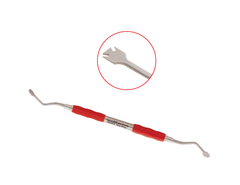
Directa A-DAPT parts - Silicone tip, Brush-Shape, set of 2 pcs.
SKU 107-0430MFR# 20220
The Directa A-DAPT™ parts - Silicone tip, Brush-Shape, set of 2 pcs. is a miscellaneous product supplied by Directa for dental use. Catalog code 20220.
Directa A-DAPT™ parts - Silicone tip, Brush-Shape, set of 2 pcs. is a composite instrument from Directa. Each pack holds 2. Manufacturer part number 20220.
Find it on our Instruments shelf, under Operative & Restorative Instruments.
Orders placed before 3 PM ET ship the same day when the item is on our shelf (otherwise within 3 business days), and ground shipping is free over $10.
Product
- Manufacturer
- Directa
- Manufacturer #
- 20220
- Item code
- 107-0430
- UPC / Barcode
- 20220
Catalog path
- Marketplace
- Clinical
- Category
- Instruments
- Subcategory
- Operative & Restorative Instruments
Ordering
- Status
- Ships in 3 business days
More from Operative & Restorative Instruments
Stocked in the same subcategory.

Whip Mix
Whip Mix Ardent Hold-Tight Disposable Paper/Film Forceps – 100 Pack (MPN: 60300)
009-0325
$37.46


Questions
What is it used for?
The Directa A-DAPT™ parts - Silicone tip, Brush-Shape, set of 2 pcs. is a miscellaneous product supplied by Directa for dental use.
How many come in a pack?
2 per pack; the price shown is per pack.
When does it ship?
In-stock orders placed before 3 PM ET ship the same day; anything not on our shelf ships within 3 business days.Ground shipping is free over $10.
About composite instruments
Composite instruments place and shape restorative material: a plastic filling instrument is used to apply it, and is on the FDA list of hand instruments. Composite is worked in layers rather than condensed: the ADA notes that light-cured composite must be placed incrementally beyond a depth of about 2 mm. Some are a metal handle carrying replaceable non-metal tips in different shapes.
In operative dentistry one hand instrument generally performs one function, so a number of them are needed to place, shape and carve a single restoration. A published study notes that there is no clear consensus on which hand instruments to use, only general guidelines. The FDA lists this family as dental hand instruments, a Class I device, naming the operative burnisher, the operative amalgam carrier, the operative dental amalgam carver, the operative amalgam and foil condenser, the operative dental excavator, the plastic dental filling instrument, the operative matrix contouring instrument and the dental wax carver (21 CFR 872.4565).
ISO 4865-1 sets what these non-hinged hand instruments must meet — materials, hardness, surface finish, resistance to reprocessing and marking — while leaving the shape of the working end out of scope.
How the operative instruments differ
- Amalgam instruments — For a material that is pressed into the cavity and then cut back; a ball burnisher has rounded ends used to smooth and polish the restorative material.
- Composite instruments — Places and shapes a paste that is then light-cured, instead of condensing and carving a metal filling.
- Hand instruments — Not tied to one filling material; the published tray list runs from explorer and mirror to carvers, burnishers and a plastic instrument.
- Carvers — Takes material away to form the surface, where a condenser puts material in and a burnisher only smooths it.
- Wax carvers — Works on a wax pattern on the bench, not on a restoration in the tooth.
- Crown and bridge instruments — Works on a finished indirect restoration, where the rest of the shelf works on material placed in the tooth.
What to look at when choosing an operative instrument
How many instruments a job needs: one working end generally does one task, so sets are assembled rather than bought singly.
Working end shape: carvers are made in anterior and posterior patterns, and burnishers in rounded shapes such as a ball.
Material and finish: ISO 4865-1 covers hardness, surface finish and resistance to reprocessing, and explicitly leaves working-end shape outside its scope.
Amalgam residue: the ADA reports a recommendation to clean amalgam contaminants off instruments before heat sterilization and to avoid heating mercury, amalgam or equipment used with it.
Reprocessing: the CDC states that instruments should be dry before they are packaged, because wet instruments can compromise the packaging.
Sources: Kalman & Xian 2017, Preliminary study of a novel dental hand instrument for restorative procedures (J Dent Res Dent Clin Dent Prospects) · FDA 21 CFR 872.4565, Dental hand instrument · ISO 4865-1:2023, Dentistry — General requirements of hand instruments — Part 1: Non-hinged hand instruments · ADA Oral Health Topics: Amalgam · The Glossary of Prosthodontic Terms, 9th edition (J Prosthet Dent 2017) · Deep learning-based object detection of restorative dental instruments, 2025 (Sci Rep) · ADA Oral Health Topics: Materials for Direct Restorations · CDC: Best Practices for Sterilization in Dental Settings