

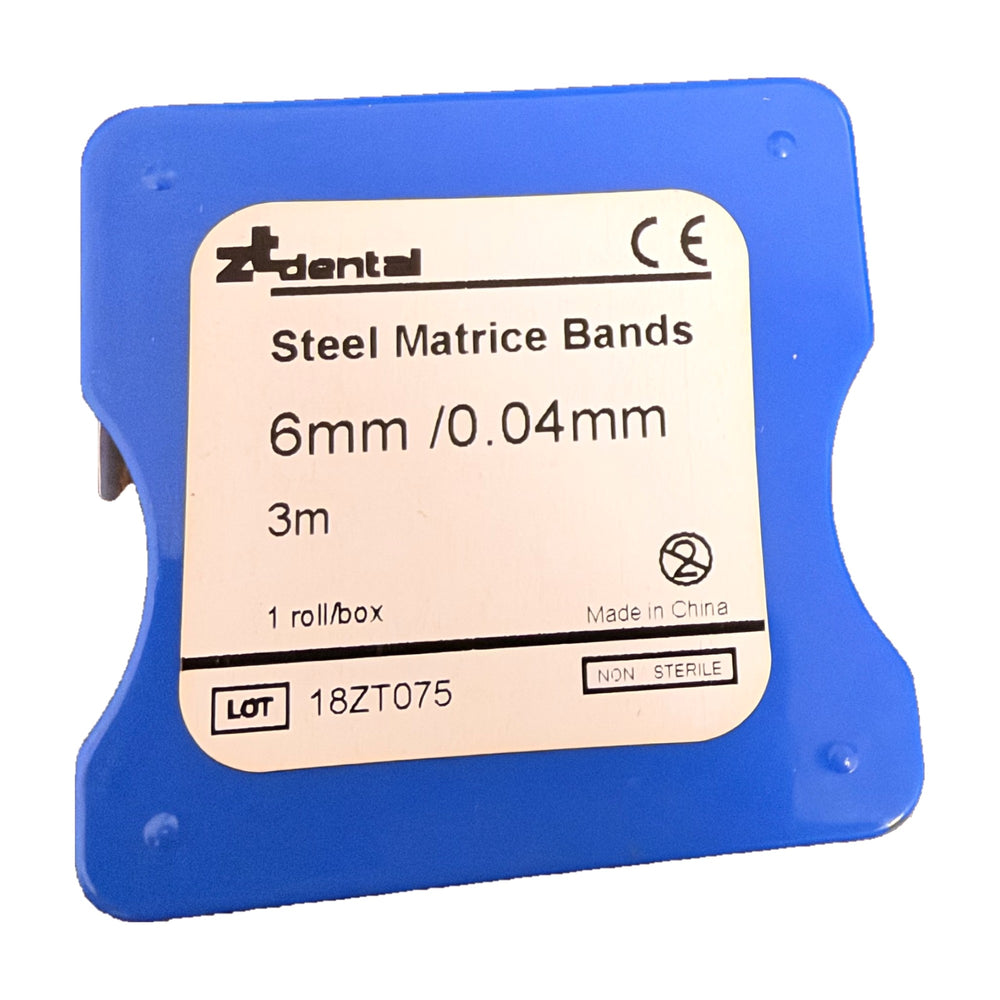
Width
6 mm
6 mm$10.95
7 mm$10.95
Thickness
0.04 mm
0.04 mm$10.95
0.05 mm$10.95
A 3 m roll of stainless steel matrix band in a dispenser box, cut to length for each filling. Pick the width and the thickness.
- 6 mm or 7 mm wide: 6 mm for shallower boxes and smaller teeth, 7 mm for deeper boxes on molars and premolars
- 0.04 mm thin: passes tight contacts and shapes closely to the tooth
- 0.05 mm thick: a firmer band that keeps its shape while you pack the filling
- 3 m roll: cut each band to the length the tooth needs
- Dispenser box: the band feeds from a side slot and stays covered on the bench
- Single use, non-sterile: one band per filling, as marked on the box
In the package: 1 roll of steel matrix band in the width and thickness you pick, 3 m long, in a dispenser box.
How it’s used: Pull out and cut the length you need, wrap it around the tooth and hold it in your matrix retainer. Place and shape the filling, then throw the band away.
For use by a dental professional.
Product
- Manufacturer
- ZT Dental
- Manufacturer #
- DMB0212
- Item code
- 001-0992
Catalog path
- Category
- Matrix & Wedges
- Subcategory
- Matrix Bands & Retainers
Ordering
- Status
- In stock
More from Matrix Bands & Retainers
Stocked in the same subcategory.


About matrix bands
A matrix band is the thin strip placed around a tooth to replace the missing wall, hold the restorative material in and help rebuild the contact area. Bands come in metal and in clear plastic, and a systematic review found no significant difference between metal and polyester matrix systems. Clear acetate strips are described as typical interproximal matrices, useful because the resin can be cured through the transparent matrix. One band is formed into its own loop: the short arm is bent to take the long arm according to the circumference of the tooth, the band is burnished to the contours of the tooth, and a wedge secures it.
A matrix system creates a temporary wall against which the restorative material is packed, so that the contact between neighbouring teeth, its form and its function can be rebuilt. It also helps shape the restoration and reduces the excess that would otherwise spread at the gum line. A published review describes a matrix as a band that imitates the anatomical attributes of the tooth being restored.
The systems on the market are linear or pre-curved sections and non-circular or circumferential matrices, with metal or plastic bands, which may or may not have separation rings. Circumferential matrix systems were first introduced in 1946. A 2025 study describes the traditional circumferential systems, first made for amalgam restorations, as the ones most used by dentists and taught at dental schools.
How bands, retainers and sectional systems differ
- Matrix Bands — The strip itself, metal or clear, that stands in for the missing wall. A study reports that the thickness and shape of the band may influence how tight the contact comes out.
- Matrix Retainers — Holds and tightens a band around the whole crown, instead of pressing one short section against a single surface. The sectional rings and the forceps that place them sit on this shelf too.
- Sectional Matrix Systems — A short pre-contoured section with a ring, rather than a band around the whole crown. One review notes the rounded contour of a sectional matrix does not always match the natural proximal contour, and that close contacts can make it hard to insert without denting it.
What to look at when choosing a matrix band
Material: a systematic review reported the absence of any distinction between translucent and metallic matrix systems. A flexible clear strip used on its own is hard to contour over large areas, which leaves uneven contacts and contours.
Thickness and shape: one study found pre-contoured sectional matrices with a separation ring raised total contact tightness, while a flat circumferential band lowered it.
Fit: a clinical study concluded that appropriate adaptation of the matrix system helps establish successful proximal restorations.
What holds the band: a band can be stabilised with a wedge, a separation ring, PTFE tape, or block-out or flowable resin, and of those the wedge is the most used for sealing at the gum line and holding the matrix.
Why the contact matters: a tight anatomical contact area prevents food impaction, recurrent caries, periodontal disease and tooth movement. The natural contact zone has an area of approximately 1.5 to 2 mm.
Sources: Assessment of anatomical contacts and contours of class II restorations using four different dental matrix systems, 2025 (J Conserv Dent Endod) · Alqarni et al. 2023, Evaluation of Matrix Systems on the Proximal Contact of Class II Composite Restorations: A Systematic Review (Cureus) · Alqahtani et al. 2025, The Effectiveness of Circumferential and Sectional Matrix Systems in Obtaining Optimum Proximal Contact in Class II Composite Restorations (Cureus) · Anterior Matrix Systems for Composite Restorations: A Review, 2023 (Cureus) · Venkataraman et al. 2026, Assessment of Matrix Band Systems in Restoring Proximal Caries of Primary Molars (Int J Clin Pediatr Dent) · Gancedo-Gancedo et al. 2024, New Technique for Wedge Selection in Direct Class II Restorations: A Pilot Study (J Clin Med)
