


Bego Wiromelt. Designed for dental supply and lab use. MPN 52526.
Bego Wiromelt is a cobalt-chrome alloy from Bego. Manufacturer part number 52526.
Find it on our Investment & Casting shelf, under Alloys & Metals.
Orders placed before 3 PM ET ship the same day when the item is on our shelf (otherwise within 3 business days), and ground shipping is free over $10.
Product
- Manufacturer
- Bego
- Manufacturer #
- 52526
- Item code
- 011-1059
- UPC / Barcode
- 52526
Catalog path
- Marketplace
- Laboratory
- Category
- Investment & Casting
- Subcategory
- Alloys & Metals
Ordering
- Status
- Ships in 3 business days
More from Alloys & Metals
Stocked in the same subcategory.
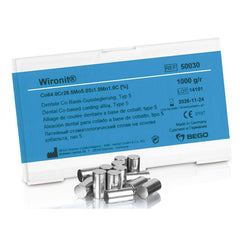


About cobalt-chrome alloys
Cobalt chromium alloy is a low-density base metal dental casting alloy of 60 to 75 percent cobalt and up to 30 percent chromium. The chromium, by its passivation effect, ensures the corrosion resistance of the alloy. The alloys on this shelf are sold for partial denture frameworks and for metal-to-ceramic work.
A base metal alloy is an alloy composed of metals that are not noble. The FDA describes a base metal alloy as composed primarily of base metals such as nickel, chromium or cobalt, for cast or porcelain-fused-to-metal crown and bridge restorations (21 CFR 872.3710).
ISO 22674 sets the requirements and test methods for the metallic materials used to make dental restorations and appliances, with or without a ceramic veneer.
How cobalt-chrome alloys, nickel-chrome alloys and soldering supplies differ
- Cobalt-Chrome Alloys — Cobalt with up to 30 percent chromium; the framework alloy.
- Nickel-Chrome Alloys — Nickel-based; listed here as a ceramic alloy.
- Soldering & Torches — What joins cast parts: solder, flux, welding wire and torch tips.
What to look at when choosing an alloy
Use: ISO 22674 covers metallic materials recommended for use with a ceramic veneer, without one, or for both.
Handling: base metal alloys are technique sensitive in the laboratory, especially during casting and soldering.
Soldered joints: one study found no significant difference in joint strength or porosity between gas-oxygen torch and infrared soldering, or between gaps of 0.3 mm and 0.5 mm.
Sources: The Glossary of Prosthodontic Terms, 9th edition (J Prosthet Dent 2017) · FDA 21 CFR 872.3710, Base metal alloy · ISO 22674:2022, Dentistry — Metallic materials for fixed and removable restorations and appliances · Oxidation heat treatment and the porcelain to base metal alloy bond strength, 2022 (PMC9170503) · Infrared ray and gas torch soldering of Ni-Cr base metal alloy, 2010 (PMC3024500)
