

VacalonShips in 3 business days
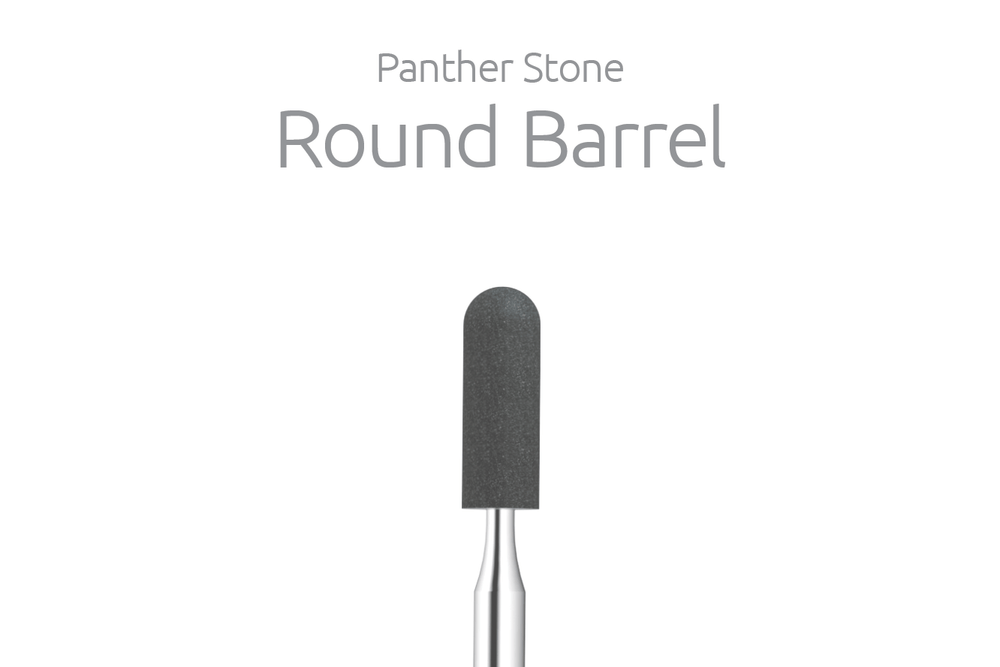
Vacalon Panther Stones · Round Barrel 3.5 × 10 mm
SKU 090-1113MFR# 52312
Shape
Round Barrel 3.5 × 10 mm
Round Barrel 3.5 × 10 mm$39.00
Small Wheel 12 × 2.4 mm$54.00
Small Barrel 5 × 13 mm$41.00
Tapered Barrel 4 × 10.5 mm$38.00
Small Inverted Cone 5 × 3.5 mm$39.00
Small Bullet 2.5 × 7 mm$33.00
Inverted Cone 12 × 10 mm$54.00
Knife-Edge 22 × 2 mm$63.00
Medium Wheel 15 × 3.5 mm$58.00
Large Wheel 22 × 3 mm$81.00
Mini Wheel 6 × 3.5 mm$33.00
Tapered Point 3.5 × 10.8 mm$33.00
Ball 4 mm$33.00
Vacalon Panther Stones are diamond-infused ceramic grinders for adjusting zirconia, lithium disilicate (e.max) and conventional porcelain in the dental lab. The open-structure ceramic binder stays sharp, does not load up and runs cool, so the stone takes material off quickly without chipping the restoration or overheating it.
What they are used for
- Bulk reduction and contouring of sintered zirconia and pressed or milled lithium disilicate
- Blending margins and refining contact points
- Adjusting occlusal surfaces and smoothing surface texture before polishing
Why labs choose them
- Diamond throughout the stone – it keeps cutting as it wears
- Open structure resists clogging and keeps heat down, which lowers the risk of microfractures
- Holds its shape for a long working life
- One stone for zirconia, lithium disilicate and porcelain
Shapes, sizes and speeds
Thirteen shapes, each sold individually – pick the shape above.
| Shape | Size | Best speed | Maximum speed |
|---|---|---|---|
| Round Barrel | 3.5 × 10 mm | 15,000 rpm | 20,000 rpm |
| Small Wheel | 12 × 2.4 mm | 10,000 rpm | 20,000 rpm |
| Small Barrel | 5 × 13 mm | 15,000 rpm | 20,000 rpm |
| Tapered Barrel | 4 × 11 mm | 15,000 rpm | 20,000 rpm |
| Small Inverted Cone | 5 × 3.5 mm | 15,000 rpm | 20,000 rpm |
| Small Bullet | 2.5 × 7 mm | 15,000 rpm | 20,000 rpm |
| Inverted Cone | 12 × 10 mm | 6,000 rpm | 20,000 rpm |
| Knife-Edge | 22 × 2 mm | 6,000 rpm | 20,000 rpm |
| Medium Wheel | 15 × 3.5 mm | 8,000 rpm | 20,000 rpm |
| Large Wheel | 22 × 3 mm | 6,000 rpm | 20,000 rpm |
| Mini Wheel | 6 × 3.5 mm | 6,000 rpm | 20,000 rpm |
| Tapered Point | 3.5 × 10.8 mm | 10,000 rpm | 20,000 rpm |
| Ball | 4 mm | 6,000 rpm | 20,000 rpm |
Details
- Shank: HP (104), 2.35 mm – fits a straight lab handpiece
- Sold individually, one stone per pack
- Made in Germany
Product
- Manufacturer
- Vacalon
- Manufacturer #
- 52312
- Item code
- 090-1113
Catalog path
- Marketplace
- Laboratory
- Category
- Lab Burs & Rotary
- Subcategory
- Mounted Points & Stones
Ordering
- Status
- Ships in 3 business days
More from Mounted Points & Stones
Stocked in the same subcategory.




About mounted stones
A lab mounted stone is a bonded abrasive, abrasive particles held together by a bond, fixed on its own shank for grinding and shaping. OSHA's abrasive-wheel rule treats mounted wheels of 2 inches and under as a group of their own.
A mounted point or stone is an abrasive already fixed on its own shank; the FDA names the abrasive point among the abrasive devices of 21 CFR 872.6010, Class I. OSHA groups abrasive wheels by bond: organic, such as resin, rubber or shellac, and inorganic, such as clay, glass or porcelain.
How the types on this shelf differ
- Mounted Stones — A rigid bonded abrasive, for grinding and shaping.
- Mounted Rubber Points — A rubber-bonded point already fixed on its own shank.
- Flexible Silicone Polishers — The abrasive is embedded in a flexible silicone body.
- Polishing Wheels — A wheel for the smoothing steps that follow grinding.
- Grinding Wheels — The coarse step: it shapes the work and removes excess material.
- Ceramic & Porcelain Polishers — Polishes the ceramic itself, in place of a glaze layer.
- Rotary Points — Lab points and silicone, rubber and polyurethane polishers.
What to look at when choosing
Sequence: a review describes polishing in three stages, coarse finishing, intermediate polishing and final polishing. Coarse tools shape the work and remove excess material; medium ones smooth out the grooves and scratches the coarse ones leave.
Size: ISO 2157 sets the nominal diameters of the working part of burs, laboratory burs, grinding instruments, diamond instruments and mandrels, and how they are designated.
Shank: the part that fits into the handpiece. ISO 1797 sets shank dimensions and material properties.
Speed: OSHA's abrasive-wheel rule has the spindle speed checked against the maximum operating speed marked on the wheel.
Reuse: the CDC states that burs, polishing points and rag wheels used on contaminated appliances or prostheses should be heat-sterilised, disinfected between patients, or discarded.
Sources: FDA 21 CFR 872.6010, Abrasive device and accessories · OSHA 29 CFR 1910.211, Machinery and machine guarding: definitions · OSHA 29 CFR 1910.94, Ventilation (grinding, polishing and buffing operations) · OSHA 29 CFR 1910.215, Abrasive wheel machinery · ISO 21671:2006, Rotary polishers · Does Sterilization Affect the Performance of Single-Step Resin Composite Polishers? (Dent J 2023) · A Comprehensive Review of the Surface and Chromatic Properties of Monolithic Zirconia: Polishing and Finishing Methods (Cureus 2024) · ISO 2157:2016, Nominal diameters and designation code numbers for rotary instruments · ISO 1797:2017, Shanks for rotary and oscillating instruments · CDC, Guidelines for Infection Control in Dental Health-Care Settings, 2003 (MMWR 52 RR-17)
