


Type
Premium
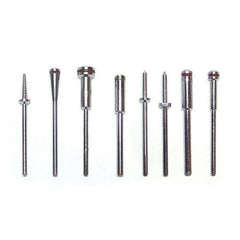
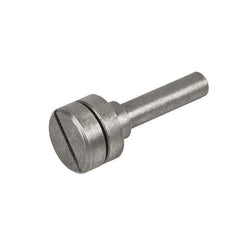
Vacalon HP Mandrels mount rubber polishers, separating discs, diamond discs and wheels on a straight handpiece. A screw passes through the disc and threads into the mandrel body, clamping the attachment firmly for stable work in the lab or the operatory.
The four styles
- Standard – general-purpose, compact; 5 mm head
- Heavy Duty – a thicker upper shaft for more rigidity under load; 5 mm head
- Wide Head Heavy Duty – an 8 mm head that clamps more of the disc or wheel, steadying wider attachments
- Premium – a tapered profile for a more refined feel in the handpiece; 5 mm head
Details
- Shank: HP (104), 2.35 mm – fits a straight lab handpiece
- Maximum speed 20,000 rpm
- Sold 10 per pack
- Made in Germany
Product
- Manufacturer
- Vacalon
- Manufacturer #
- 51809
- Item code
- 090-1084
Catalog path
- Marketplace
- Laboratory
- Category
- Lab Burs & Rotary
- Subcategory
- Mandrels & Rotary Accessories
Ordering
- Status
- Ships in 3 business days
More from Mandrels & Rotary Accessories
Stocked in the same subcategory.



About mandrels
ISO 10323 sets the bore diameters of discs and wheels so that they and the mandrels they run on are interchangeable. A sandpaper mandrel holds the sandpaper used to finish denture acrylic.
A mandrel is an axle, spindle or arbor, usually tapered or cylindrical, placed in the hole of a part to support it while it turns. ISO 13295 covers the mandrels that carry discs and polishers in dentistry.
How mandrels and arbor bands differ
- Mandrels — The holder that goes into the handpiece.
- Arbor Bands — The coated abrasive band itself, not the holder.
- Rotary Accessories — Adapters, chucks and a felt mounted kit, filed beside the mandrels and arbor bands.
What to look at when choosing a mandrel
Fit: the bore of the disc or wheel has to match the mandrel, which is what ISO 10323 standardises.
Size: ISO 2157 sets the nominal diameters of the working part of burs, laboratory burs, grinding instruments, diamond instruments and mandrels, and how they are designated.
ISO 6360 identifies every dental rotary instrument by a 15-digit number.
Speed: OSHA's abrasive-wheel rule has the spindle speed checked against the maximum operating speed marked on the wheel.
Sources: The Glossary of Prosthodontic Terms, 9th edition (J Prosthet Dent 2017) · ISO 13295:2007, Mandrels for rotary instruments · ISO 10323:2013, Bore diameters for rotary instruments such as discs and wheels · Rao et al. 2015, Surface roughness of three heat-cured acrylic denture base resins with different conventional lathe polishing techniques (J Indian Prosthodont Soc) · OSHA 29 CFR 1910.94, Ventilation (grinding, polishing and buffing operations) · ISO 2157:2016, Nominal diameters and designation code numbers for rotary instruments · OSHA 29 CFR 1910.215, Abrasive wheel machinery
