
Sold out
Sold out
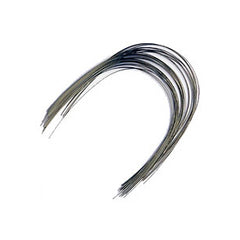
Stainless Steel Arch Wire, Natural Form, Rectangular .018" x .025" Upper — 10/Pack
SKU 001-3044MFR# 3044
$4.90
· Sold out
This stainless steel orthodontic arch wire has a natural arch form with a rectangular .018" x .025" size, for the upper arch. Each pack contains 10 wires.
Stainless Steel Arch Wire, Natural Form, Rectangular .018" x .025" Upper — 10/Pack is a stainless steel archwire. Each pack holds 10. Key facts — Arch form: Natural; Wire material: Stainless; Wire cross section: Rectangular. Manufacturer part number 3044.
Find it on our Orthodontics shelf, under Archwires & Ligatures.
Orders placed before 3 PM ET ship the same day when the item is on our shelf (otherwise within 3 business days), and ground shipping is free over $10.
| Arch form | Natural |
|---|---|
| Wire material | Stainless |
| Wire cross section | Rectangular |
Product
- Manufacturer #
- 3044
- Item code
- 001-3044
- UPC / Barcode
- 3044
Catalog path
- Marketplace
- Clinical
- Category
- Orthodontics
- Subcategory
- Archwires & Ligatures
Ordering
- Status
- Sold out
More from Archwires & Ligatures
In stock in the same subcategory. Not the same product — check the specs before you swap.


Questions
What is it used for?
This stainless steel orthodontic arch wire has a natural arch form with a rectangular .018" x .025" size, for the upper arch.
How many come in a pack?
10 per pack; the price shown is per pack.
When does it ship?
In-stock orders placed before 3 PM ET ship the same day. An item we don't keep on the shelf shows its own ship-by date on its page, and you can cancel it for a full refund until it ships.Ground shipping is free over $10.
About stainless steel archwires
Stainless steel archwires are described as the material of choice in orthodontic treatment for their high tensile strength and corrosion resistance. They are made by drawing steel rods cold through dies and then polishing them, which gives some of the smoothest surfaces of any orthodontic material. A review describes that smooth surface and the low friction it brings as an advantage in the phases of treatment that call for precise control of tooth movement and efficient sliding.
The FDA treats the orthodontic appliance and its accessories as one Class I device, affixed to a tooth so that pressure can be exerted on the teeth, and the list includes the orthodontic band, the elastic band, the metal bracket, the tube and the wire (21 CFR 872.5410). ISO 15841 is the standard for wires used in fixed and removable orthodontic appliances; it includes preformed archwires but leaves out springs and other preformed components. It sets out how the physical and mechanical properties of orthodontic wires are presented, the test methods for them, and the packaging and labelling information.
ISO 21606 is the standard for all elastomeric auxiliaries used in orthodontics, inside and outside the mouth, with fixed and removable appliances. Elastic ligatures and chains are used for correcting a midline, closing a gap or an extraction space, closing space generally, moving a canine back, correcting a rotated tooth, and attaching the archwire to the brackets.
How the wires and the elastics differ
- Stainless Steel Archwires — Smooth and stiff: a review found steel archwires showed low friction because of their smooth surfaces. Supplied in round and in rectangular cross-sections, and a rectangular wire is expected to produce more friction because it touches more of the bracket slot.
- Nickel Titanium Archwires — Very flexible and superelastic, but a review found these wires show higher friction than steel because of surface roughness. The alloying and cooling often leave surface oxides and unevenness, giving a relatively rough texture compared with other archwire materials.
- Ligature Ties — One ring per bracket, holding the wire in the slot. A self-ligating bracket has a built-in clip or gate instead, so no separate ligature is needed.
- Elastic Chains & Hooks — A chain pulls teeth towards each other along the wire; a tie only holds the wire in one bracket. In a five-week study, closed chains held higher forces than open ones across all the brands tested.
What to look at when choosing
Wire size: a review reports that the diameter of the archwire is directly proportional to friction, a larger diameter producing higher frictional forces because of the greater surface area.
How an elastic loses force: most investigators report that force loss is at its greatest during the first 24 hours and continues at a slow but steady rate after that.
What affects how long an elastic lasts: the composition and the diameter of the elastomer determine its endurance the most. Temperature, moisture, pH, tooth movement, food, salivary enzymes and mouth rinses have all been shown to affect force decay as well.
Sources: FDA 21 CFR 872.5410, Orthodontic appliance and accessories · ISO 15841:2014, Dentistry — Wires for use in orthodontics · ISO 21606:2022, Dentistry — Elastomeric auxiliaries for use in orthodontics · Csekő et al. 2022, The Effect of Extrinsic Factors on the Mechanical Behavior and Structure of Elastic Dental Ligatures and Chains (Polymers) · Frictional resistance in orthodontic archwires: A comprehensive review, 2025 (J Orthod Sci) · Arora et al. 2025, Self-Ligating Versus Conventional Brackets: A Narrative Review (Cureus) · Virdi et al. 2024, Force Decay Behavior of Orthodontic Elastomeric Chains in Simulated Oral Conditions (Cureus) · Leite et al. 2014, Comparison of frictional resistance between self-ligating and conventional brackets tied with elastomeric and metal ligature (Dental Press J Orthod) · Force decay of orthodontic power chains during five weeks in artificial saliva, 2025 (J Orthod Sci)