

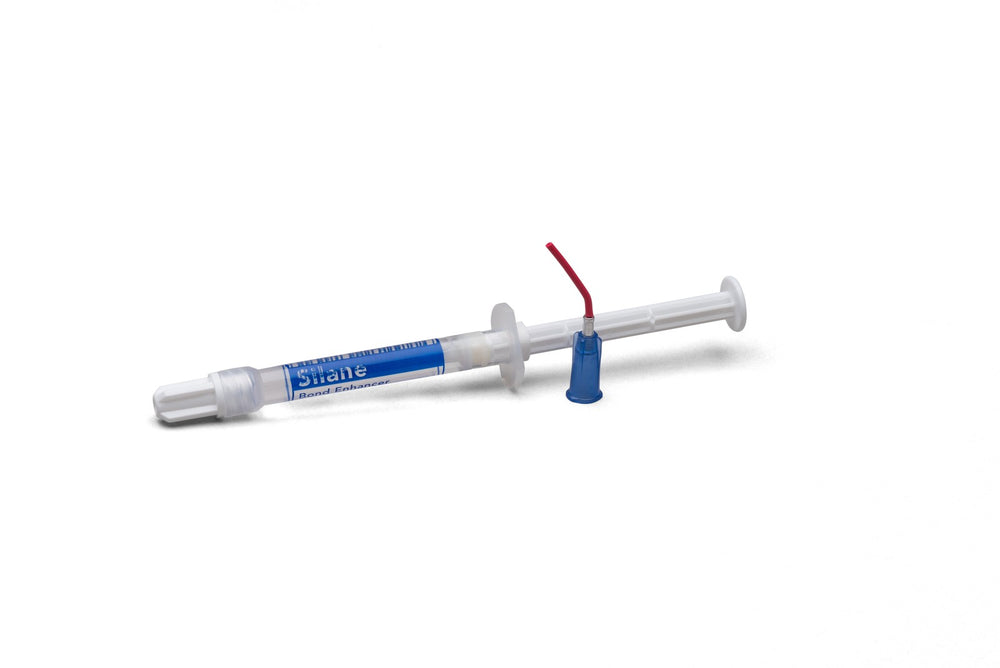
A single-component silane that increases the bond strength of composites and resin cements to porcelain. One 3 mL refill syringe.
• Single-component material • Increases the bond strength of composites and resin cements to porcelain • Dispenses one drop at a time from the syringe • Pulpdent lists its 22 gauge dropper tips (22DR series) as compatible
In the package: one 3 mL syringe of silane.
How it's used: Apply to porcelain that has been etched and dried. Tips are sold separately (Pulpdent 22DR dropper tips).
For use by a dental professional. Made in USA by Pulpdent Corporation.
Product
- Manufacturer
- Pulpdent
- Manufacturer #
- SIL-3
- Item code
- 106-1230
- UPC / Barcode
- SIL-3
Catalog path
- Marketplace
- Clinical
- Category
- Restorative & Cosmetic
- Subcategory
- Bonding & Etch
Ordering
- Status
- In stock
- Weight
- 0.06 lb
More from Bonding & Etch
Stocked in the same subcategory.


Pulpdent
Pulpdent Porcelain Etch Gel 9.6% Hydrofluoric Acid Kit, 4 x 1.2 mL Syringes + 8 Tips
106-1193
$54.07


Veratiq Dental
Veratiq Etchera 37% Phosphoric Acid Etchant Gel
In stock
257 sold this monthfrom $5.69
Questions
What is it used for?
A single-component silane that increases the bond strength of composites and resin cements to porcelain.
When does it ship?
In-stock orders placed before 3 PM ET ship the same day. An item we don't keep on the shelf shows its own ship-by date on its page, and you can cancel it for a full refund until it ships.Ground shipping is free over $49.
About ceramic primers and silane
Silane is a coupling agent: it improves the chemical bond between an inorganic surface, such as a dental ceramic, and resin. On glass-based ceramics it is applied after hydrofluoric acid etching; for zirconia-based ceramics a systematic review describes it as optional or not required.
A bonding agent is a resin painted onto the inside of a prepared tooth to improve the retention of a restoration such as a filling. The FDA regulates it as a resin tooth bonding agent, a Class II device (21 CFR 872.3200). An etchant is a chemical agent that selectively dissolves a surface, leaving it retentive.
Bonding to teeth follows an etch-and-rinse or a self-etch strategy; resin-modified glass ionomer, which adheres on its own, is counted as a third. Retention comes from a hybrid layer and resin tags formed when the adhesive hardens inside the etched surface.
How the types of adhesive and etchant differ
- Universal adhesives — One adhesive for any of the three etching approaches. The makers of some still call for a separate activator or a dedicated primer on porcelain and zirconia.
- Self-etch adhesives — No separate acid and no rinsing. It does not etch enamel to the depth phosphoric acid does.
- Total-etch adhesives — Applied after phosphoric acid that is rinsed away. A review calls the three-step systems the most versatile, usable with self-cure, dual-cure and light-cure protocols.
- Etching agents — The acid itself: phosphoric acid for enamel and dentin, hydrofluoric acid for glass-based ceramics.
- Ceramic primers and silane — Prepares the ceramic restoration, not the tooth, for bonding.
- Adhesive accessories — The applicators that carry the adhesive to the tooth.
What to look at when choosing a bonding agent
Bottles and steps: systems run from three bottles to one. A review reports the highest bond strengths for the three-step systems, which are also the most complicated to use.
Compatibility: not all one-bottle etch-and-rinse adhesives are compatible with self-cured or dual-cured materials or with core materials.
Delivery: self-etch adhesives come in bottles or unit doses, and two-part ones are mixed immediately before use.
For ceramics: a systematic review found better bonding when silane was applied separately than when it was only contained in a universal adhesive.
Testing: ISO 29022 describes the shear test used to measure the bond strength between restorative materials and tooth structure.
Sources: FDA 21 CFR 872.3200, Resin tooth bonding agent · The Glossary of Prosthodontic Terms, 9th edition (J Prosthet Dent 2017) · Sofan et al. 2017, Classification review of dental adhesive systems (Ann Stomatol) · Chmielewska et al. 2022, Material Connections in Restorative Dentistry: A Comprehensive Review (Int J Mol Sci) · Dapieve et al. 2018, Silane incorporated to universal adhesives or applied separately: A systematic review (J Indian Prosthodont Soc) · FDA 21 CFR 872.3140, Resin applicator · ISO 29022:2013, Notched-edge shear bond strength test
