

S&S ScheftnerSpecial order
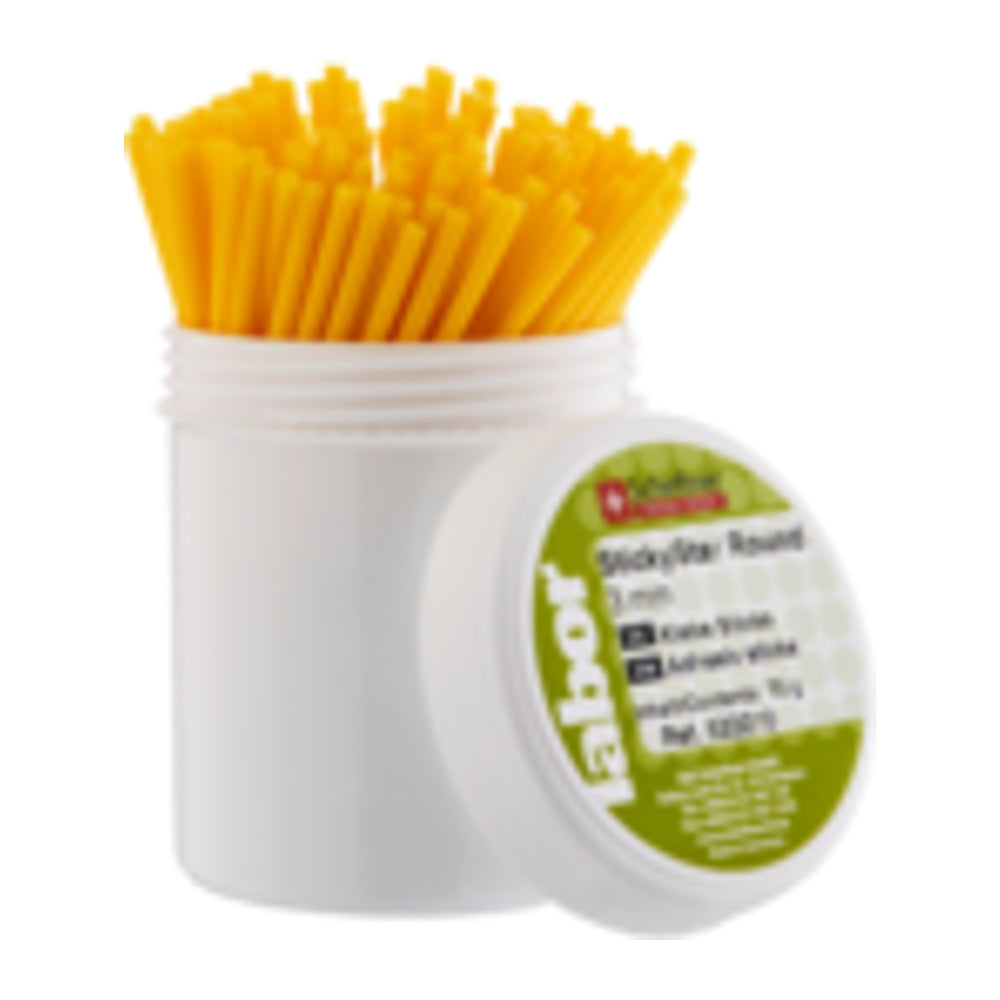
S&S Scheftner StickyStar Adhesive Wax Sticks · 3 mm round, 70 g
SKU 119-0191MFR# 522210
Size
3 mm round, 70 g
StickyStar adhesive wax sticks make the casting object easier to handle and keep it from distorting when it is lifted off the model. Round sticks in 3, 4 and 5 mm.
On this page
| 3 mm round, 70 g | Scheftner Ref. 522210 |
|---|---|
| 4 mm round, 150 g | Scheftner Ref. 522230 |
| 5 mm round, 150 g | Scheftner Ref. 522240 |
Questions about this product
- What is StickyStar used for?
- StickyStar adhesive wax sticks make the casting object easier to handle and keep it from distorting when it is lifted off the model. Round sticks in 3, 4 and 5 mm.
- Which options are on this page?
- 3 mm round, 70 g (Ref. 522210); 4 mm round, 150 g (Ref. 522230); 5 mm round, 150 g (Ref. 522240).
- Who makes StickyStar?
- S&S Scheftner, a dental alloy and laboratory materials maker in Mainz, Germany.
Product
- Manufacturer
- S&S Scheftner
- Manufacturer #
- 522210
- Item code
- 119-0191
Catalog path
- Marketplace
- Laboratory
- Category
- Wax
- Subcategory
- Specialty Wax
Ordering
- Status
- Special order
More from Specialty Wax
Stocked in the same subcategory.




About sticky wax
Sticky wax is used to hold parts in place; one published laboratory method uses it to stabilize a cast and a wax pattern.
This shelf holds the waxes made for one job: block-out and undercut wax, dipping wax, sticky wax, and the brushes used with wax. The FDA lists intraoral dental wax, used to construct the patterns from which metal prostheses are cast, as a Class I device (21 CFR 872.6890).
How the waxes on this shelf differ
- Blockout & Undercut Wax — Fills the undercuts of a cast that the prosthesis must not enter.
- Dipping Wax — Kept molten in a bath; the die is dipped to make a coping pattern in one step.
- Sticky Wax — Holds parts together or in place while the work goes on.
- Wax Brushes — A tool for the wax, not a wax.
- Modeling Wax — The wax that is added and shaped to build the pattern.
- Utility Wax — General-purpose wax in sheets, strips and sticks.
What to look at when choosing
Dipping wax and the die: in one study the die carried two layers of spacer, about 30 micrometres in all, before it was dipped.
Distortion: a wax pattern can hold internal strains from the way it was worked, and it distorts when the strain relaxes. Time and temperature both make it worse, which is why patterns are generally invested immediately after they leave the die or cast.
Sources: FDA 21 CFR 872.6890, Intraoral dental wax · The Glossary of Prosthodontic Terms, 9th edition (J Prosthet Dent 2017) · Ram et al. 2019, Microcomputed tomography to evaluate the fit of a restoration as compared to conventional replica technique (PMC6685334) · Tarek Ahmed et al. 2023, A Feasible and Innovative Method of Investing Wax Pattern for Removable Partial Dentures (PMC10622851) · Distortion in Wax Patterns Fabricated Using Conventional and Electrical Heat Sources, 2023 (Cureus, PMC10388666)
