

S&S ScheftnerSpecial order
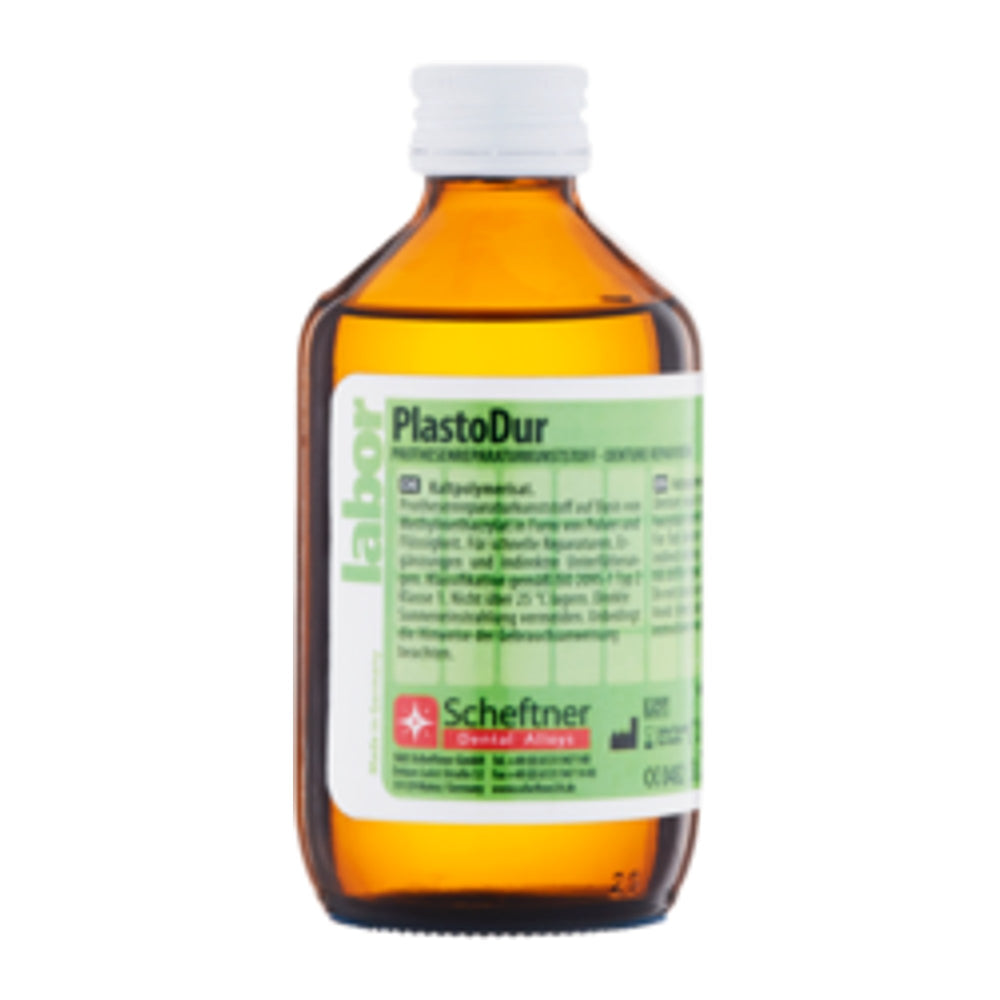
S&S Scheftner PlastoDur Self-Cure Denture Repair Acrylic · Powder, Pink, 500 g
SKU 119-0253MFR# 801310
Component
Powder, Pink, 500 g
PlastoDur is a cold-curing acrylic for quick repairs of full and partial dentures and orthodontic appliances, and for indirect relines and additions. It flows well, bonds strongly to any other acrylic and cures fast. Powder and liquid are sold separately.
What Scheftner says about it
- PlastoDur is the most affordable acrylic resin for quick repair. Whether a full denture is broken or a saddle on a partial denture has been damaged, with PlastoDur you perform the work in minutes.
- Repair of full and partial dentures
- Repair of orthodontic appliances
- Indirect relinings
- Additions
- Very good flowability
- Excellent processing characteristics
- Very high bonding with any other acrylic resin
- Colour stable due to UV- and heat stabilizers
- Fast and safe curing
On this page
| Powder, Pink, 500 g | Scheftner Ref. 801310 |
|---|---|
| Liquid, 250 ml | Scheftner Ref. 801315 |
| Powder, Pink, 1000 g | Scheftner Ref. 801320 |
| Liquid, 500 ml | Scheftner Ref. 801325 |
Questions about this product
- What is PlastoDur used for?
- PlastoDur is a cold-curing acrylic for quick repairs of full and partial dentures and orthodontic appliances, and for indirect relines and additions. It flows well, bonds strongly to any other acrylic and cures fast. Powder and liquid are sold separately.
- Which options are on this page?
- Powder, Pink, 500 g (Ref. 801310); Liquid, 250 ml (Ref. 801315); Powder, Pink, 1000 g (Ref. 801320); Liquid, 500 ml (Ref. 801325).
- Who makes PlastoDur?
- S&S Scheftner, a dental alloy and laboratory materials maker in Mainz, Germany.
Product
- Manufacturer
- S&S Scheftner
- Manufacturer #
- 801310
- Item code
- 119-0253
Catalog path
- Marketplace
- Laboratory
- Category
- Dentures & Acrylics
- Subcategory
- Denture Resins
Ordering
- Status
- Special order
More from Denture Resins
Stocked in the same subcategory.


New Stetic
NewCryl Lower Posterior Denture Teeth — Moulds 30–32 (30L/30M/31M/32F/32L/32M), 8/Card
In stock
from $3.75


New Stetic
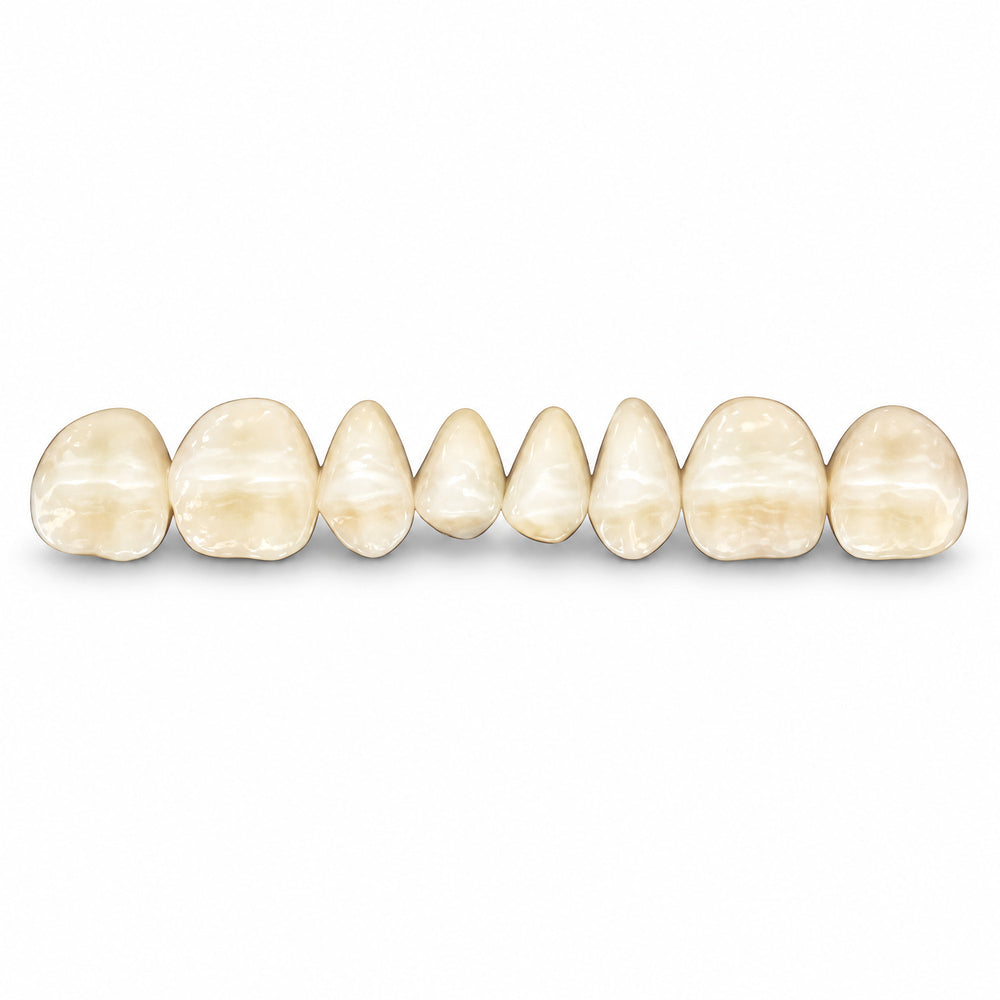
NewCryl Upper Posterior Denture Teeth — Moulds 30–32 (30L/30M/31M/32F/32L/32M), 8/Card
In stock
from $3.75
About self-cure denture resin
A self-cure resin, also called cold-curing or autopolymerizing, is one whose polymerization is sped up by a chemical instead of heat. Its polymerization is never as complete as that of heat-activated resin, which leaves more free monomer: 3 to 5 percent against 0.2 to 0.5 percent.
The denture base is the part of a removable denture that carries the artificial teeth and covers the soft tissue of the mouth. Polymethyl methacrylate, PMMA, has been the most widely used denture base material since 1937. It comes as a powder of pre-polymerized PMMA beads with a little initiator, and a liquid of methyl methacrylate monomer.
The FDA regulates denture relining, repairing or rebasing resin, the resin that forms a new denture base, as a Class II device (21 CFR 872.3760). ISO 20795-1 classifies denture base polymers and sets their requirements.
How the types of denture resin differ
- Heat-Cure Denture Resin — Cured with heat; a review reports greater surface hardness and lower sorption and solubility than cold-cured resin.
- Pourable Denture Resin — A very fluid mix that is poured into the mold.
- Self-Cure Denture Resin — Set off by a chemical activator instead of heat.
- Orthodontic & Retainer Resins — Acrylic for orthodontic appliances, active or passive, not for denture bases.
- Repair Acrylics — The acrylic used to mend a cracked or broken denture.
- Flexible Denture Resin — A thermoplastic that flexes, injected into the mold instead of being mixed from powder and liquid.
- Resin Accessories — Empty cartridges, monomer liquids and processing supplies rather than a complete resin.
- Hard Reline Materials — Powder and liquid reline acrylics, also filed on the reline and repair shelf.
What to look at when choosing a denture resin
Residual monomer: most of it is released in the first twenty-four hours after processing, followed by a moderate and steady release.
Impact strength: high-impact resins are reinforced with butadiene-styrene rubber and are handled like other heat-activated resins, as powder and liquid.
Processing: with heat-cured PMMA, a review reports less polymerization shrinkage for injection molding than for conventional compression molding.
Flexible resins: nylon, a polyamide, is used mainly for flexible tissue-supported partial dentures. The same review notes that polyamides are challenging to process and repair.
Standard: under ISO 20795-1 water sorption should be less than 32 micrograms per cubic millimetre and solubility less than 1.6.
Sources: Binaljadm 2024, Flexible Denture: A Literature Review (Cureus) · Alqutaibi et al. 2023, Polymeric Denture Base Materials: A Review (Polymers) · FDA 21 CFR 872.3760, Denture relining, repairing, or rebasing resin · ISO 20795-1:2013, Base polymers, Part 1: Denture base polymers · The Glossary of Prosthodontic Terms, 9th edition (J Prosthet Dent 2017) · ISO 20795-2:2013, Base polymers, Part 2: Orthodontic base polymers · Ranjan et al. 2021, Joint Surface Preparations and Chemical Surface Treatment on the Transverse Strength of Repaired Denture Base Resin (J Pharm Bioallied Sci) · Kumar et al. 2017, Effect of Reinforced Autopolymerizing Resin on the Flexural Strength of Repaired Heat-polymerized Denture Base Resin (PMC5682712)
