

S&S ScheftnerSpecial order
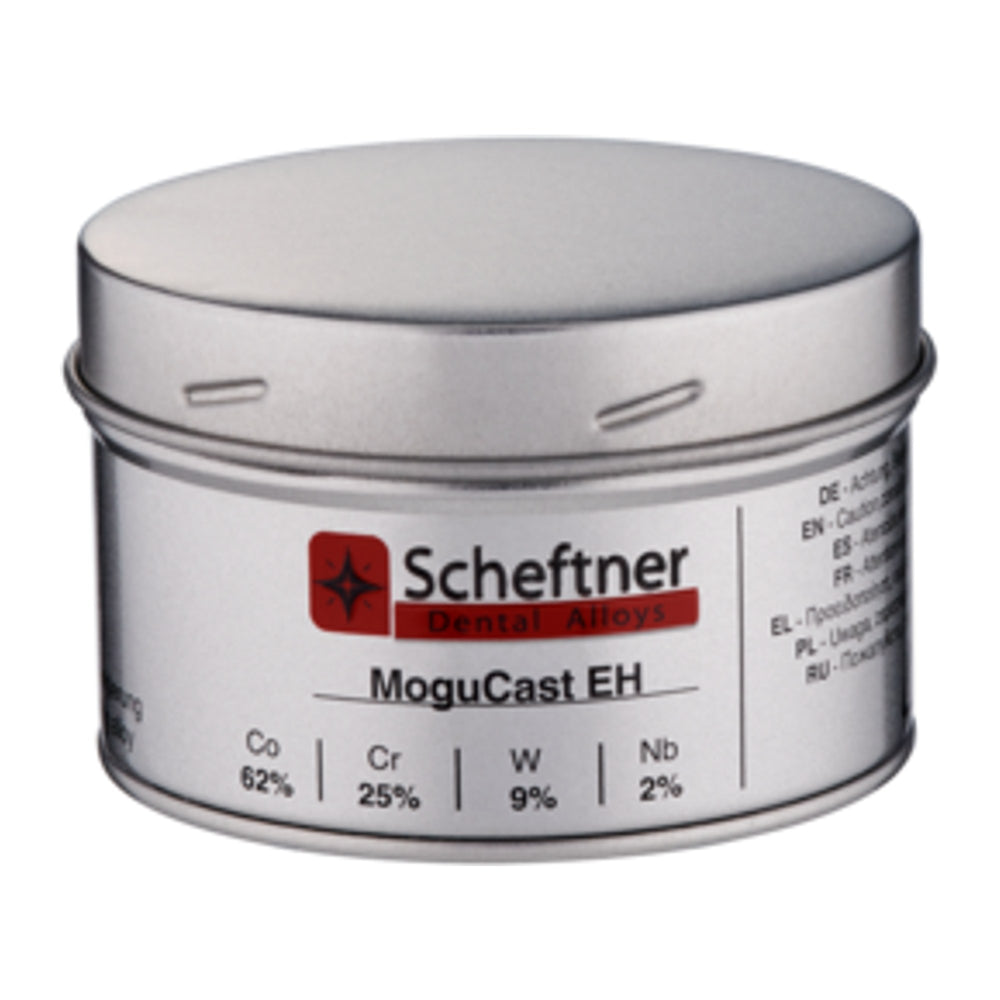
S&S Scheftner Mogucast EH Cobalt-Chrome Partial Denture Alloy · 1 kg
SKU 119-0019MFR# 132200
Size
1 kg
1 kg$226.64
Mogucast EH is an extra-hard cobalt-chrome casting alloy for partial dentures that carry very high loads and for very fine removable frameworks. It is spring-hard at 420 HV 10 and free of nickel and beryllium.
What Scheftner says about it
- Free of nickel, beryllium, lead and cadmium.
- Type 5 pursuant to DIN EN ISO 22674.
- Excellent degree of purity
- Biocompatible and extremely corrosion resistant
- High wearing comfort due to low thermal conductivity
- Spring hard
- Particularly suitable for extremely graceful removables
- Ideal alloy for restorations which are exposed to very high loads
- Excellent for casting of 3D printed plastic parts
- Universally applicable for clasp-retained prostheses and combined techniques
- Pleasant polishing properties and easy finishing
- Optimal conditions for laser welding
- System-free working due to very good alloy properties
Composition
| Cobalt (Co) | 62 % |
|---|---|
| Chromium (Cr) | 25 % |
| Tungsten (W) | 9 % |
| Niobium (Nb) | 2 % |
| C,V,Mo,Mn,Si | 1 % |
Technical data
| Proof stress (Rp 0.2) | 662 MPa |
|---|---|
| Ultimate tensile strength | 877 MPa |
| Elongation | >4% |
| Elastic modulus | 200 - 210 GPa |
| Vickers hardness | 420 HV 10 |
| Density | 8.7 g/cm³ |
| Melting range | 1320 - 1400 °C |
| Preheating temperature | 850 - 950 °C |
| Casting temperature | 1500 - 1550 °C |
| Laser weldable | Yes |
| Type (DIN EN ISO 22674) | 5 |
On this page
| 1 kg | Scheftner Ref. 132200 |
|---|
Questions about this product
- What is Mogucast EH used for?
- Mogucast EH is an extra-hard cobalt-chrome casting alloy for partial dentures that carry very high loads and for very fine removable frameworks. It is spring-hard at 420 HV 10 and free of nickel and beryllium.
- What is Mogucast EH made of?
- Cobalt 62 %, Chromium 25 %, Tungsten 9 %, Niobium 2 %, C,V,Mo,Mn,Si 1 %.
- What is Mogucast EH free of?
- Scheftner states: free of nickel, beryllium, lead and cadmium.
- How hard is Mogucast EH?
- Vickers hardness is 420 HV 10, with a proof stress of 662 MPa and a tensile strength of 877 MPa.
- At what temperature is Mogucast EH cast?
- Scheftner gives a casting temperature of 1500 - 1550 °C and a preheating temperature of 850 - 950 °C.
- Can Mogucast EH be laser welded?
- Yes. Scheftner lists it as laser weldable.
- What size is the pack?
- 1 kg (Ref. 132200).
- Who makes Mogucast EH?
- S&S Scheftner, a dental alloy and laboratory materials maker in Mainz, Germany.
Product
- Manufacturer
- S&S Scheftner
- Manufacturer #
- 132200
- Item code
- 119-0019
Catalog path
- Marketplace
- Laboratory
- Category
- Investment & Casting
- Subcategory
- Alloys & Metals
Ordering
- Status
- Special order
More from Alloys & Metals
Stocked in the same subcategory.


About cobalt-chrome alloys
Cobalt chromium alloy is a low-density base metal dental casting alloy of 60 to 75 percent cobalt and up to 30 percent chromium. The chromium, by its passivation effect, ensures the corrosion resistance of the alloy. The alloys on this shelf are sold for partial denture frameworks and for metal-to-ceramic work.
A base metal alloy is an alloy composed of metals that are not noble. The FDA describes a base metal alloy as composed primarily of base metals such as nickel, chromium or cobalt, for cast or porcelain-fused-to-metal crown and bridge restorations (21 CFR 872.3710).
ISO 22674 sets the requirements and test methods for the metallic materials used to make dental restorations and appliances, with or without a ceramic veneer.
How cobalt-chrome alloys, nickel-chrome alloys and soldering supplies differ
- Cobalt-Chrome Alloys — Cobalt with up to 30 percent chromium; the framework alloy.
- Nickel-Chrome Alloys — Nickel-based; listed here as a ceramic alloy.
- Soldering & Torches — What joins cast parts: solder, flux, welding wire and torch tips.
What to look at when choosing an alloy
Use: ISO 22674 covers metallic materials recommended for use with a ceramic veneer, without one, or for both.
Handling: base metal alloys are technique sensitive in the laboratory, especially during casting and soldering.
Soldered joints: one study found no significant difference in joint strength or porosity between gas-oxygen torch and infrared soldering, or between gaps of 0.3 mm and 0.5 mm.
Sources: The Glossary of Prosthodontic Terms, 9th edition (J Prosthet Dent 2017) · FDA 21 CFR 872.3710, Base metal alloy · ISO 22674:2022, Dentistry — Metallic materials for fixed and removable restorations and appliances · Oxidation heat treatment and the porcelain to base metal alloy bond strength, 2022 (PMC9170503) · Infrared ray and gas torch soldering of Ni-Cr base metal alloy, 2010 (PMC3024500)
