
RMH3 DentalShips in 3 business days
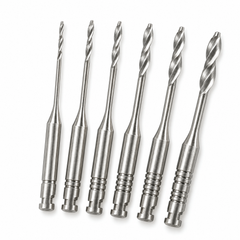
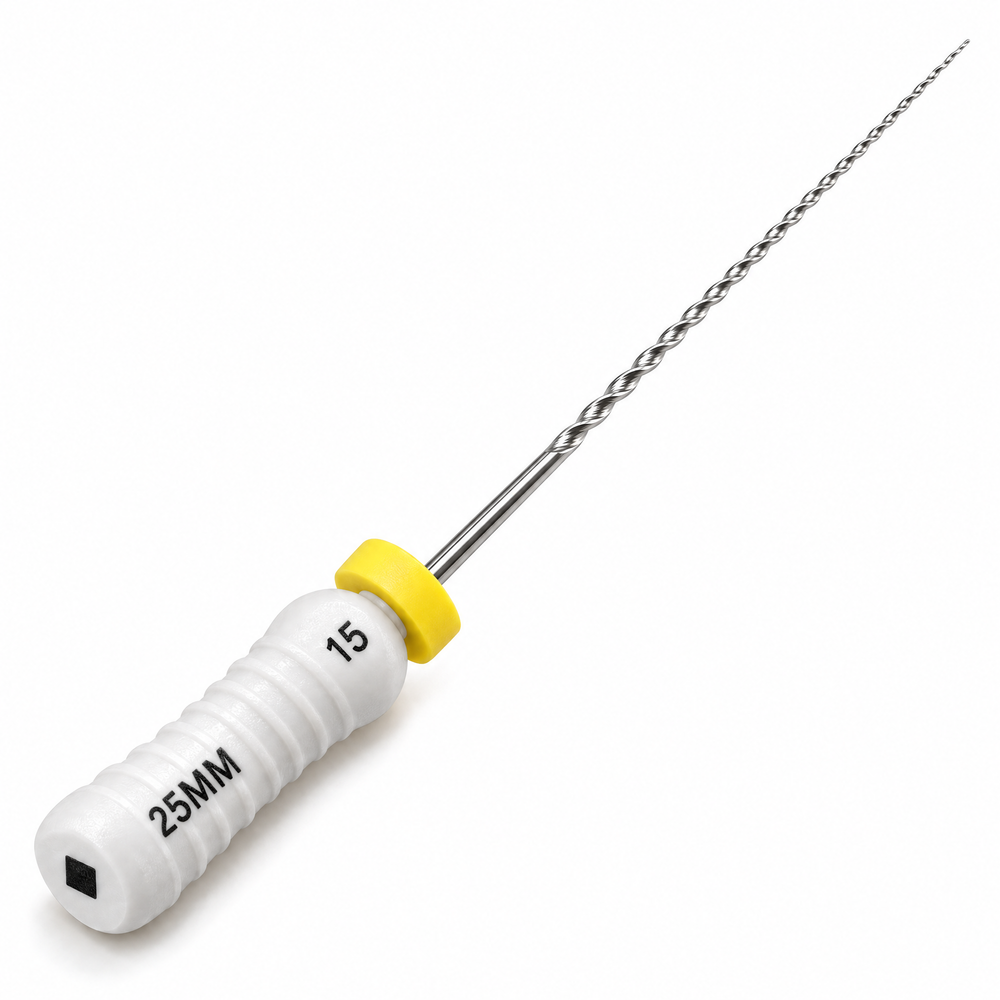
RMH3 Dental RayEndo Pro Stainless Steel K-Files — 6/Box · 25 mm · #15
SKU 001-4106MFR# 2515
Length
25 mm
RayEndo Pro K-Files are stainless steel endodontic hand files for cleaning and shaping the root canal, supplied six per box. Choose the length (21 mm, 25 mm or 31 mm) and the size, from #06 to #50, or an assorted box of #15 to #40.
| Alloy | Stainless steel |
|---|---|
| Motion | Hand |
| Lengths | 21 mm, 25 mm, 31 mm |
| Pack | 6 per box |
For use by a dental professional.
Product
- Manufacturer
- RMH3 Dental
- Manufacturer #
- 2515
- Item code
- 001-4106
Catalog path
- Marketplace
- Clinical
- Category
- Endodontics
- Subcategory
- Files & Reamers
Ordering
- Status
- Ships in 3 business days
More from Files & Reamers
Stocked in the same subcategory.




About hand files
Stainless steel hand files are used to explore the canal and to establish and keep a glide path before rotary nickel-titanium instruments go in. The small sizes used for that, up to size 0.15 with a fixed 2 percent taper, are traditionally called pathfinding files. Hedstrom files have long been used by hand for their tactile control, and one paper notes that they take longer than rotary systems.
Root canal treatment runs in three phases: shaping, cleaning and obturation. Shaping, the phase these instruments are used in, is described in one review as influencing the efficiency of the cleaning and obturation steps.
The FDA lists the endodontic pulp canal file, the pulp canal reamer and the endodontic broach among dental hand instruments, a Class I device (21 CFR 872.4565). ISO 3630-1 is the international standard for endodontic instruments, and covers size designations, colour-coding, packaging and identification symbols as well as test methods.
How the types of file and reamer differ
- Hand Files — Turned by hand, with a stiffness that one study calls an advantage in a complex canal. That same stiffness is why steel hand files are described as unsuited to highly curved or calcified canals.
- Rotary Files — Machine-driven and flexible, in place of stiff steel that tends to straighten inside the canal. The drawback named for them is a high fracture risk.
- Reciprocating Files — Driven back and forth rather than in continuous rotation, and reported to have higher cyclic fatigue resistance than the rest.
- Reamers — Sized to open the canal space, including the space prepared for a post.
- Gates Glidden Drills — Opens the top of the canal rather than shaping it to the end, and is designed to separate near the handpiece so a fractured piece can be taken out.
- Barbed Broaches — Used to remove the pulp tissue from the canal, not to cut or shape it.
- File Accessories — Used with the files rather than in place of them.
- File Organizers & Blocks — Holds the instruments rather than working in the canal, and goes through cleaning and heat sterilization with them. The CDC says never to reach into trays or containers holding sharp instruments that cannot be seen.
What to look at when choosing files and reamers
Size and taper: a glide path is a smooth, reproducible passage from the canal orifice to its physiological terminus, and the files that make it are the small, low-taper ones.
Fracture: the rate of defects and fractures is affected by the size, taper and cross-sectional shape of the instrument, the operator, high-torque motors and the length of the pecking motion. Clinical studies have reported unwinding and fracture of nickel-titanium files in up to 38 percent of cases, rising with repeated use.
Time: rotary glide path files, continuous or reciprocating, shorten the shaping and glide path preparation time compared with hand files.
Reuse: one review notes that fracture of nickel-titanium files is more often the result of overservice than of manufacturing defects. The CDC states that most single-use devices are labelled for one use only and carry no reprocessing instructions.
Sources: Glide Path in Endodontics: A Literature Review of Current Knowledge, 2024 (Dent J) · FDA 21 CFR 872.4565, Dental hand instrument · ISO 3630-1:2019, Dentistry — Endodontic instruments — Part 1: General requirements · Comparative Analysis of Endodontic 0.15 Stainless-Steel K-Files, 2024 (Dent J) · Comparative Evaluation of Efficacy of Gutta-Percha Removal in Root Canal Retreatment Using Manual and Rotary Instruments, 2025 (J Pharm Bioallied Sci) · The Biomechanics of Nickel Titanium Instrument Fracture in Root Canal Therapy: A Narrative Review, 2024 (Materials) · Design, Metallurgical Features and Mechanical Behavior of Five Reciprocating NiTi Endodontic Systems, 2026 (Iran Endod J) · Residual Dentin Thickness of Bifurcated Maxillary Premolars Following Two Post Space Preparation Methods, 2013 (Iran Endod J) · The Effect of Gates-Glidden Drills on the Quality of Root Canal Treatment, 2018 (Open Access Maced J Med Sci) · Effect of Root Canal Dressings on Extraradicular pH in a Sealed Apex Model, 2026 (Clin Exp Dent Res) · ISO 3630-4:2023, Dentistry — Endodontic instruments — Part 4: Auxiliary instruments · Intracanal placement of calcium hydroxide: a comparison of a specially designed paste carrier technique with other techniques, 2013 (BMC Oral Health) · CDC: Best Practices for Sterilization in Dental Settings · CDC: Sterilization and Disinfection, Summary of Infection Prevention Practices in Dental Settings
