


The Dedeco Pumice Wheels 7/8" X 1/8" 100/BX is a dental laboratory product supplied by Dedeco for finishing, polishing, and general lab use. Catalog code 6512.
Dedeco Pumice Wheels 7/8" X 1/8" 100/BX is a polishing wheel from Dedeco. Each pack holds 100. Manufacturer part number 6512.
Find it on our Finishing & Polishing shelf, under Polishers, Points & Wheels.
Orders placed before 3 PM ET ship the same day when the item is on our shelf (otherwise within 3 business days), and ground shipping is free over $10.
Product
- Manufacturer
- Dedeco
- Manufacturer #
- 6512
- Item code
- 050-1867
- UPC / Barcode
- 6512
Catalog path
- Marketplace
- Clinical
- Category
- Finishing & Polishing
- Subcategory
- Polishers, Points & Wheels
Ordering
- Status
- Ships from the manufacturer
More from Polishers, Points & Wheels
Stocked in the same subcategory.


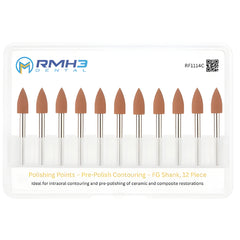
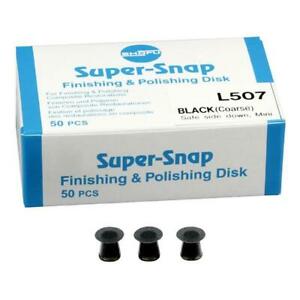


Questions
What is Dedeco Pumice Wheels 7/8" X 1/8" 100/BX used for?
The Dedeco Pumice Wheels 7/8" X 1/8" 100/BX is a dental laboratory product supplied by Dedeco for finishing, polishing, and general lab use.
How many come in a pack of Dedeco Pumice Wheels 7/8" X 1/8" 100/BX?
100 per pack; the price shown is per pack.
When does it ship?
In-stock orders placed before 3 PM ET ship the same day. An item we don't keep on the shelf shows its own ship-by date on its page, and you can cancel it for a full refund until it ships.Ground shipping is free over $10.
About polishing wheels
A polishing wheel is a flat wheel of abrasive, or of soft material charged with a polishing agent, that reaches flat and broad surfaces. The FDA names the polishing wheel in its Class I list of abrasive devices and accessories. A polishing agent is defined in a glossary as any material used to impart lustre to a surface; one classical agent is pumice, a volcanic glass used as an abrasive and prepared in various grits.
Finishing is the contouring of a restoration to the shape wanted; polishing is the use of instruments to reduce the surface irregularities that finishing leaves behind. A glossary defines an abrasive as a substance used for abrading, smoothing or polishing, and polish as a smooth, glossy surface with lustre. Polishers, points and wheels are abrasive held in a body rather than coated on paper: published work describes abrasives such as silicon oxide, aluminium oxide and diamond particles embedded in discs or rubber carriers. A review names rubber cups and points, abrasive polishing discs and dental stones among the tools used.
ISO 6360-6 codes rotary abrasive instruments and says it applies to dental polishers too, which it treats as abrasive instruments. The FDA group for abrasive devices and accessories is Class I and names the abrasive point and the polishing wheel in its device list (21 CFR 872.6010).
How the types of polisher, point and wheel differ
- Flexible silicone polishers — Grit bound in flexible rubber, in cup, point and disc forms, in place of grit glued to paper.
- Mounted rubber points — Comes already on its shank, so no mandrel is needed, and the point shape reaches where a cup cannot.
- Ceramic and porcelain polishers — Graded for ceramic, which a review reports needs at least two steps.
- Polishers — The catch-all for a bound-abrasive instrument whose shape is not what names it.
- Polishing wheels — A wheel rather than a point or cup, so it reaches flat and broad surfaces.
- Grinding wheels — Grinds material away; the polishing grades come after it.
- Heatless wheels — Unmounted, so it needs the spindle a glossary calls a mandrel: the shaft and bearings on which a tool is mounted.
- Buffing wheels — Soft and loaded with compound, where a grinding or heatless wheel is rigid bonded abrasive.
- Felt buffs — Felt rather than cloth or bristle, and carries the paste rather than any grit of its own.
- Coarse arbor bands — A sleeve that is replaced while the carrier stays, in place of a wheel or point that is thrown away whole.
- Abrasive Discs — Radial bristle discs and wheels, also filed on the discs shelf.
- Polishing Discs — The same radial bristle discs and wheels, under a second name.
What to look at when choosing a polisher
Steps: published work notes that finishing and polishing systems differ substantially in abrasive composition, type and particle hardness. A review reports that reduced-step systems have shown results equal to the traditional ones and reached surface roughness below 0.2 microns, though only with at least two steps.
What is in the grit: compounds used in polishing protocols include aluminium oxide, silicon dioxide and diamond, and a review notes that diamond is harder than composite.
What it is being used on: a review notes that the filler particle size of the restorative material is itself an important factor in the final roughness and gloss.
Why it matters: a review lists reduced surface imperfections that would reduce plaque accumulation and surface breakdown, reduced wear on opposing and adjacent teeth, and a more light-reflective surface.
Sources: Polishing systems for modern aesthetic dental materials: a narrative review, 2024 (Br Dent J) · The Glossary of Prosthodontic Terms, 9th edition (J Prosthet Dent 2017) · Büyükpolat et al. 2025, The effect of polishing pastes on the surface roughness, microhardness, gloss, and color change of resin composites (BMC Oral Health) · ISO 6360-6:2004, Number coding system for rotary instruments — Abrasive instruments · FDA 21 CFR 872.6010, Abrasive device and accessories · Németh et al. 2022, Effect of Air-Polishing and Different Post-Polishing Methods on Surface Roughness of Nanofill and Microhybrid Resin Composites (Polymers) · ISO 8325:2023, Dentistry — Test methods for rotary instruments
