

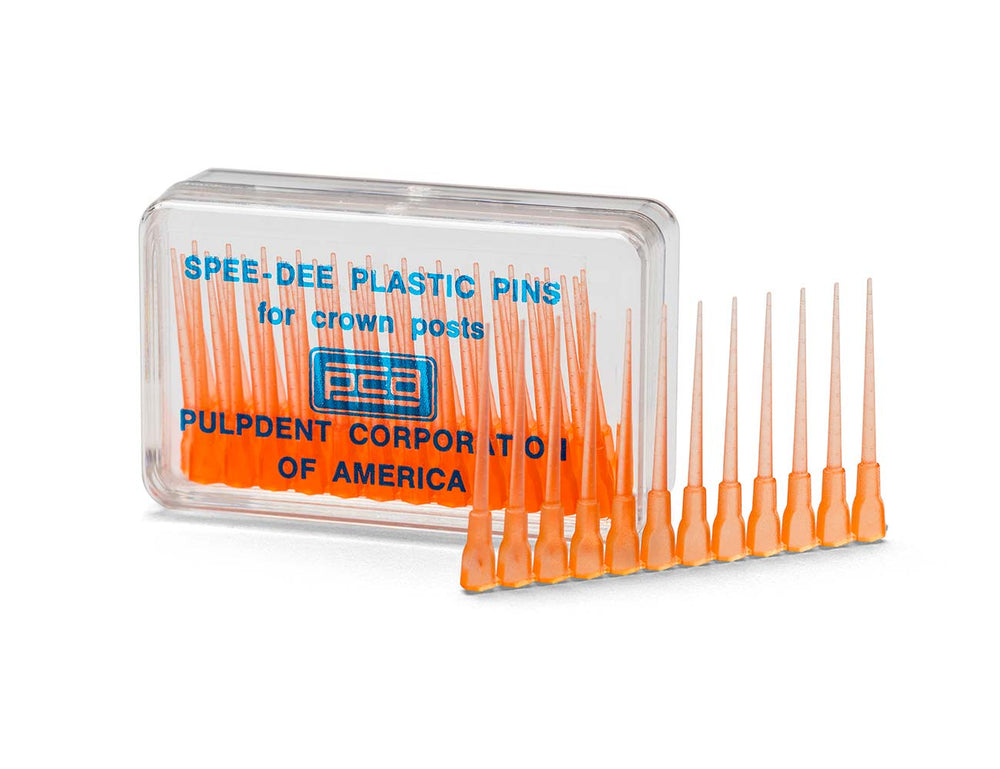
Pulpdent Spee-Dee Plastic Burn-Out Pins are components for restorative and cosmetic dental procedures. Specifically, these pins are utilized in core build-up and post applications, serving as an aid in the direct cast core technique.
This product is supplied in a box containing 60 plastic pins. Their burn-out characteristic ensures clean removal during the casting process, making them suitable for dental professionals performing direct cast core restorations where precise, void-free results are required.
Product
- Manufacturer
- Pulpdent
- Manufacturer #
- PIN
- Item code
- 106-1196
- UPC / Barcode
- PIN
Catalog path
- Marketplace
- Clinical
- Category
- Restorative & Cosmetic
- Subcategory
- Core Build-Up & Posts
Ordering
- Status
- In stock
- Weight
- 0.06 lb
More from Core Build-Up & Posts
Stocked in the same subcategory.


Veratiq Dental
Veratiq Etchera 37% Phosphoric Acid Etchant Gel
In stock
242 sold this monthfrom $5.69
Questions
What is Spee-Dee used for?
Pulpdent Spee-Dee Plastic Burn-Out Pins are components for restorative and cosmetic dental procedures.
How many come in a pack of Spee-Dee?
60 per pack; the price shown is per pack.
When does it ship?
In-stock orders placed before 3 PM ET ship the same day. An item we don't keep on the shelf shows its own ship-by date on its page, and you can cancel it for a full refund until it ships.Ground shipping is free over $49.
About posts and pins
Posts are prefabricated or custom made; with a prefabricated post the space can be prepared and the post bonded in a single appointment. Fiber posts have an elastic modulus much closer to that of dentin than metal posts do. Glass and quartz fiber posts are white or translucent. Retentive pins are small metal rods cemented, driven or screwed into dentin to add retention.
A core is the foundation restoration that rebuilds enough of the crown of a tooth to carry the final restoration. A post is a rod, usually of metal or fiber-reinforced composite resin, fitted into a prepared root canal; combined with a core it provides retention and resistance for a crown.
The main purpose of a post is to retain the core; a published review notes that posts do not reinforce the tooth.
How core materials, posts and pins differ
- Core materials — The material that rebuilds the missing part of the tooth and gives the final restoration its shape and hold.
- Posts and pins — A post goes into the root canal and holds the core; a pin goes into dentin to add retention. A narrative review found similar survival for fiber posts and for prefabricated and cast metal posts.
- Post and core accessories — The drills that shape the post space to a given post size.
What to look at when choosing
Post material: metal, or fibers of carbon, glass or quartz in a resin base. The first fiber posts were radiolucent; radiopaque fiber posts followed.
Post shape and size: posts are tapered and smooth or parallel-sided and serrated, and come in numbered sizes.
Curing of the core material: light-cured composite is placed in layers of about 2 mm, and dual-cure resins were developed for deeper applications where light penetration is limited.
FDA class: metal root canal posts and retentive pins are Class I devices (21 CFR 872.3810 and 872.3740). Tooth shade resin, the material of composite cores, is Class II (21 CFR 872.3690).
Sources: The Glossary of Prosthodontic Terms, 9th edition (J Prosthet Dent 2017) · Vârlan et al. 2009, Restoration of endodontically treated teeth: basic principles (J Med Life) · Panpisut et al. 2022, Dual-Cured Dental Composites for Core Build-Up Materials (PMC9181985) · Pereira et al. 2023, Current Insights on Fiber Posts: A Narrative Review (J Clin Med) · Ahmed et al. 2014, Dental fiber-post resin base material: a review (J Adv Prosthodont) · Role of post design and cement type in fiber post adaptation and retention, 2025 (PMC12905909) · ADA Oral Health Topics: Materials for Direct Restorations · FDA 21 CFR 872.3810, Root canal post · FDA 21 CFR 872.3690, Tooth shade resin material
