


Pac-DentShips in 3 business days
Pac-Dent Evacu-N-Irrigation Needle Tips, 3/4", 100/Pack · 19 Ga (Gray)
SKU 103-1751MFR# 234
Gauge
19 Ga (Gray)
The Pac-Dent 3/4 Evacu-N-Irrigation Needle Tips are 20 Ga. tips in yellow, supplied 100 per pack for endodontic irrigation. Catalog code 235.
Pac-Dent Evacu-N-Irrigation Needle Tips, 3/4", 100/Pack is an irrigation needle from Pac-Dent, part of the Evacu-N line. Each pack holds 100.
This page carries 5 gauge options: 18 Ga (Pink), 19 Ga (Gray), 20 Ga (Yellow), 22 Ga (Black), 25 Ga (Blue).
Find it on our Endodontics shelf, under Irrigation.
Orders placed before 3 PM ET ship the same day when the item is on our shelf (otherwise within 3 business days), and ground shipping is free over $10.
Product
- Manufacturer
- Pac-Dent
- Manufacturer #
- 234
- Item code
- 103-1751
Catalog path
- Marketplace
- Clinical
- Category
- Endodontics
- Subcategory
- Irrigation
Ordering
- Status
- Ships in 3 business days
More from Irrigation
Stocked in the same subcategory.




Questions
What is Evacu-N used for?
The Pac-Dent 3/4 Evacu-N-Irrigation Needle Tips are 20 Ga. tips in yellow, supplied 100 per pack for endodontic irrigation.
Which gauge options are on this page?
This page carries 5 gauge options: 18 Ga (Pink), 19 Ga (Gray), 20 Ga (Yellow), 22 Ga (Black), 25 Ga (Blue). Pick one to see its price, part number and stock.
How many come in a pack of Evacu-N?
100 per pack; the price shown is per pack.
When does it ship?
In-stock orders placed before 3 PM ET ship the same day; anything not on our shelf ships within 3 business days.Ground shipping is free over $10.
About irrigation needles
An irrigation needle carries the solution into the canal, and the tip design is one of the things that decides how the fluid moves: the designs compared in the literature are open-ended, side-vented and closed-ended. In computer models of flow, open-ended needles produced the highest wall shear stress and the highest pressure at the tip, while side-vented needles gave moderate shear stress at lower pressure. Double side-vented and multi-outlet designs reduced the peak stress and covered more of the wall. A side vent sends the solution sideways, which the review describes as effective in curved canals and isthmuses.
Irrigation is the chemical half of cleaning a canal: instruments cannot contact every part of the canal wall, so solutions are used to reach what they leave untouched. One review puts the share of canal wall left un-instrumented at 40 to 50 percent. Bacteria have been found inside the dentinal tubules as deep as 300 to 500 microns.
The FDA lists the endodontic irrigating syringe among dental hand instruments, a Class I device (21 CFR 872.4565). The solutions fall into proteolytic agents, demineralizing or chelating agents, antiseptics and topical antibiotics, with sodium hypochlorite, EDTA and chlorhexidine as the common examples.
How the parts of an irrigation set-up differ
- Irrigation Needles — The tip that goes down the canal; its opening decides where the fluid goes. A closed-ended needle keeps the pressure at the tip low, which reduces the risk of solution being pushed past the end of the root.
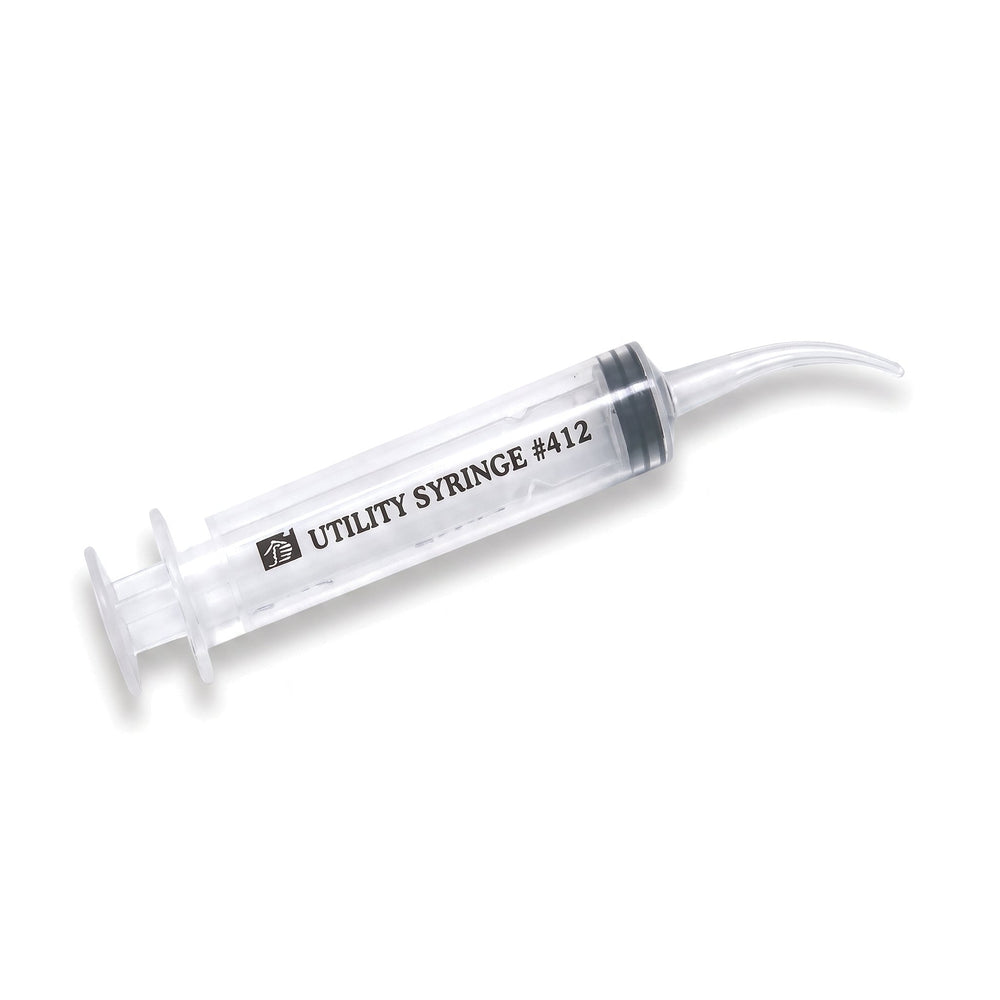
- Syringes & Tips — The barrel that holds the solution, not the tip that enters the canal.
- Irrigating Devices — Adds movement to the solution, where a syringe and needle only deliver it.
- Irrigation Solutions — The chemistry itself: one solution works on the organic tissue, the other on the inorganic part.
What to look at when choosing irrigation needles and syringes
Tip design: the review of flow models calls side-vented needles the most balanced of the configurations it compared, and says open-ended designs warrant cautious application.
Canal size: smaller apical preparations and narrow tapers went with higher wall shear stress, larger preparations with lower stress and smoother flow.
Strength of solution: one review reports that sequences using 5 percent hypochlorite with 17 percent EDTA took more calcium and phosphorus out of dentine than 3 percent hypochlorite with 8 percent EDTA. Every irrigation sequence studied had some damaging effect on dentine, including lower flexural strength and microhardness.
Sources: The effect of root canal irrigants on dentin: a focused review, 2020 (Restor Dent Endod) · Shear stress dynamics in root canal irrigation: a systematic review of computational fluid dynamics studies, 2026 (Front Dent Med) · FDA 21 CFR 872.4565, Dental hand instrument · Intracanal placement of calcium hydroxide: a comparison of a specially designed paste carrier technique with other techniques, 2013 (BMC Oral Health) · Comparative evaluation of irrigant activation devices for removal of calcium hydroxide, 2026 (BMC Oral Health)
