

Keystone IndustriesShips in 3 business days
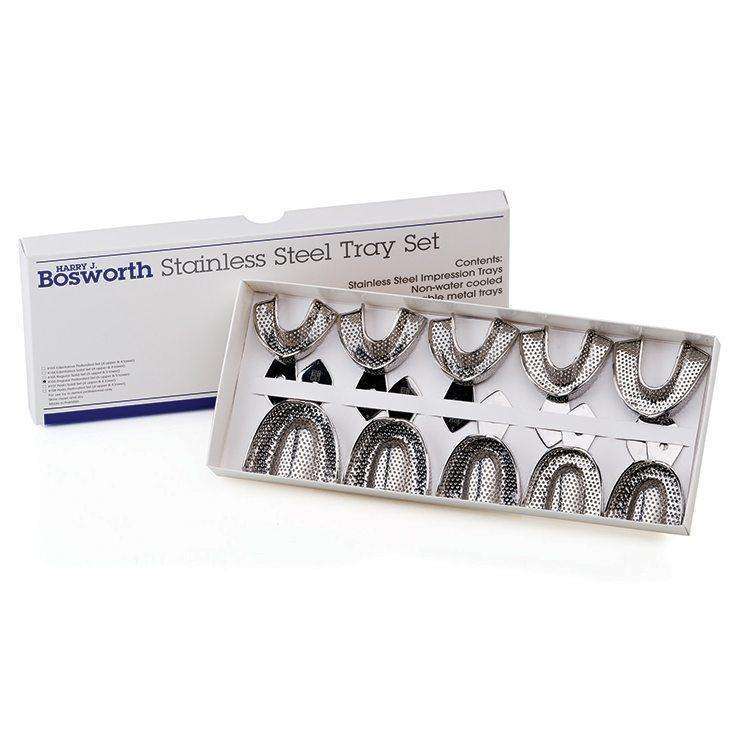
Keystone Stainless Steel Impression Trays, Perforated · #5 Lower
SKU 010-0225MFR# 0921666
Keystone Industries #1 Stainless Steel Perforated Upper Impression Tray. Reusable, autoclavable upper-arch impression tray with a perforated design to help retain impression material. Catalog code 0921654.
Product
- Manufacturer
- Keystone Industries
- Manufacturer #
- 0921666
- Item code
- 010-0225
Catalog path
- Marketplace
- Clinical
- Category
- Impression Materials
- Subcategory
- Impression Trays
Ordering
- Status
- Ships in 3 business days
More from Impression Trays
Stocked in the same subcategory.




MN Health
EcoPression VPS Bite Registration Material, 2 × 50 mL Cartridges
In stock
482 sold this monthfrom $9.20

MN Health
EcoPression VPS Impression Material, 4 × 50 mL Cartridges
In stock
277 sold this monthfrom $18.00


Questions
What is it used for?
Keystone Industries #1 Stainless Steel Perforated Upper Impression Tray.
Which tray options are on this page?
This page carries 15 tray options: #0 Upper (XL), #1 Lower, #1 Upper, #2 Lower, #2 Upper, #3 Lower, #3 Upper, #4 Lower and 7 more. Pick one to see its price, part number and stock.
When does it ship?
In-stock orders placed before 3 PM ET ship the same day; anything not on our shelf ships within 3 business days.Ground shipping is free over $10.
About metal trays
A review states that metal impression trays offer greater rigidity and accuracy than plastic trays. Metal trays with flanged, border-lock margins are described as offering torsional rigidity and inherent stability for final impressions.
An impression tray is the receptacle the impression material is placed in, and the device that carries, confines and controls that material while the impression is made. The FDA lists a preformed impression tray as a Class I device: a metal or plastic device intended to hold impression material to make an impression of the teeth or the bony tooth sockets (21 CFR 872.6880). A stock tray is prefabricated, comes in a range of sizes, and is used mainly for preliminary impressions. A custom tray is made individually from a cast recovered from a preliminary impression, and it is used for the final impression.
A review notes the convenience of a stock tray: an impression can be made in the same visit, with no preliminary impression and no study model first.
How the types of tray and tray material differ
- Disposable Trays — Thrown away after one patient, so there is nothing to clean or sterilise. Plastic flexes more, and that flexure risks the material pulling away from the adhesive and distorting the impression.
- Metal Trays — Rigid and reused, where a plastic tray flexes. An early review of tray selection reported that flexible plastic trays led to discrepancies of about 200 microns.
- Partial Trays — Covers a section of the arch, not the full arch.
- Tray Adhesives & Cleaners — Painted on the tray before the material goes in, not mixed with the material. Adhesives are not interchangeable between materials.
- Custom Tray Material — The material a tray is made from, not a finished tray.
What to look at when choosing a tray
Size: a review describes a tray that covers all the teeth, including the last ones, without touching the soft tissues, leaving at least 2 to 3 mm of material between tray and tissue. A tray that is too short can stop the material from capturing the tissue below the preparation; one that extends more than 2 to 3 mm past the gum margin can deform the material on removal.
Retention: perforations hold the material, and an adhesive can be used as well. Drying the adhesive in open air for 10 to 15 minutes lets the solvent evaporate; if the tray is then tried in the mouth, saliva can cut the bond strength to a fifth.
Fit at closure, for a dual-arch tray: any interference as the teeth close can flex the tray, and plastic dual-arch trays were the ones whose accuracy that flexure affected.
Sources: The Glossary of Prosthodontic Terms, 9th edition (J Prosthet Dent 2017) · FDA 21 CFR 872.6880, Preformed impression tray · Addition Silicone Impressions in Fixed Prosthodontics: Clinical Standpoints, 2023 (PMC10517288) · Rues et al. 2021, Disposable plastic trays and their effect on polyether and vinyl polysiloxane impression accuracy (Clin Oral Investig) · Effect of variation of impression material combinations, dual arch tray types, and sequence of pour on the accuracy of working dies, 2016 (PMC4837785) · Cervino et al. 2018, Alginate Materials and Dental Impression Technique: A Current State of the Art (Mar Drugs) · FDA 21 CFR 872.3670, Resin impression tray material
