


Keystone IndustriesShips in 3 business days
Keystone Mizzy Heatless Wheels · #6 · White · 50
SKU 010-2151MFR# 6150600
Size
#6
Color
White
Pack
50
50$35.65
Keystone #8 Red Mizzy Heatless Wheels are alpha aluminum oxide abrasive wheels designed for dental laboratory applications. These wheels are categorized as abrasive wheels within the broader abrasives, buffs, and brushes product range.
The heatless characteristic of these wheels is a distinguishing feature for laboratory work. They are supplied by Keystone Industries in packs of 50, a quantity suited for consistent use in dental laboratory environments.
Product
- Manufacturer
- Keystone Industries
- Manufacturer #
- 6150600
- Item code
- 010-2151
Catalog path
- Marketplace
- Laboratory
- Category
- Abrasives, Buffs & Brushes
- Subcategory
- Abrasive Wheels & Belts
Ordering
- Status
- Ships in 3 business days
More from Abrasive Wheels & Belts
Stocked in the same subcategory.



Keystone Industries
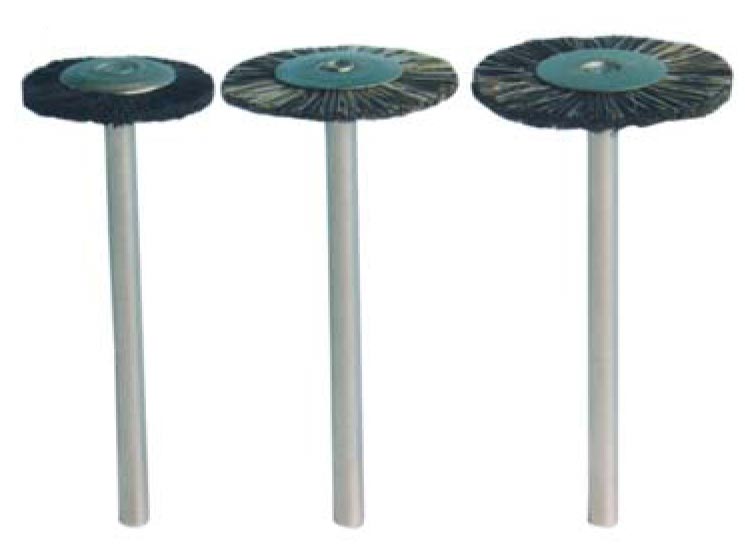
Keystone Scotch-Brite Miniature Brushes — 12/Pack
In stock
307 sold this monthfrom $18.82


Questions
What is Keystone Mizzy Heatless Wheels used for?
Keystone #8 Red Mizzy Heatless Wheels are alpha aluminum oxide abrasive wheels designed for dental laboratory applications.
Which size and color and pack options are on this page?
This page carries 15 size options: #1, #2, #3, #4, #5, #6, #7, #8 and 7 more. This page carries 3 color options: Regular Grit, White, Red. This page carries 1 pack option: 50. Pick one to see its price, part number and stock.
When does it ship?
In-stock orders placed before 3 PM ET ship the same day; anything not on our shelf ships within 3 business days.Ground shipping is free over $10.
About heatless wheels
Heatless wheels on this shelf are the abrasive wheels for the lab handpiece: heatless and grinding wheels, radial discs and rubber abrasive cones.
OSHA defines a grinding wheel as abrasive particles held together by a bond and used for grinding on its rim. OSHA defines an abrasive belt as a power-driven, flexible, coated band used for grinding, polishing or buffing.
How the types on this shelf differ
- Grinding Wheels — The coarse step: it shapes the work and removes excess material.
- Flexible Silicone Polishers — The abrasive is embedded in a flexible silicone body.
- Polishing Wheels — A wheel for the smoothing steps that follow grinding.
- Buffing Wheels — Carries the polishing agent to the work.
- Abrasive Discs — Grinds and smooths with its face.
- Mounted Rubber Points — A rubber-bonded point already fixed on its own shank.
- Polishing Discs — The finer steps of the same series.
- Separating & Cut-Off Discs — A thin wheel for cutting, where an abrasive disc works on its side.
- Mounted Stones — A rigid bonded abrasive, for grinding and shaping.
- Ceramic & Porcelain Polishers — Polishes the ceramic itself, in place of a glaze layer.
- Heatless Wheels — Heatless and grinding wheels, radial discs and rubber abrasive shapes, filed under the heatless wheels name.
Heatless wheels are also filed here; no source on our allowed list describes them, so this guide does not.
What to look at when choosing
Coarse tools shape the work and remove excess material; medium ones smooth out the grooves and scratches the coarse ones leave.
Surface: 0.2 micrometres of roughness is considered the threshold for a clinically acceptable restoration.
Speed: OSHA's abrasive-wheel rule has the spindle speed checked against the maximum operating speed marked on the wheel.
Reuse: the CDC states that burs, polishing points and rag wheels used on contaminated appliances or prostheses should be heat-sterilised, disinfected between patients, or discarded.
Dust: the CDC names grinding and polishing castings and porcelain among the laboratory steps that put dust in the air.
Sources: OSHA 29 CFR 1910.94, Ventilation (grinding, polishing and buffing operations) · OSHA 29 CFR 1910.211, Machinery and machine guarding: definitions · A Comprehensive Review of the Surface and Chromatic Properties of Monolithic Zirconia: Polishing and Finishing Methods (Cureus 2024) · Does Sterilization Affect the Performance of Single-Step Resin Composite Polishers? (Dent J 2023) · FDA 21 CFR 872.6010, Abrasive device and accessories · The Glossary of Prosthodontic Terms, 9th edition (J Prosthet Dent 2017) · Rao et al. 2015, Surface roughness of three heat-cured acrylic denture base resins with different conventional lathe polishing techniques (J Indian Prosthodont Soc) · ISO 21671:2006, Rotary polishers · OSHA 29 CFR 1910.215, Abrasive wheel machinery · CDC, Guidelines for Infection Control in Dental Health-Care Settings, 2003 (MMWR 52 RR-17) · CDC, Silicosis in Dental Laboratory Technicians, Five States, 1994-2000 (MMWR 53(09))
