


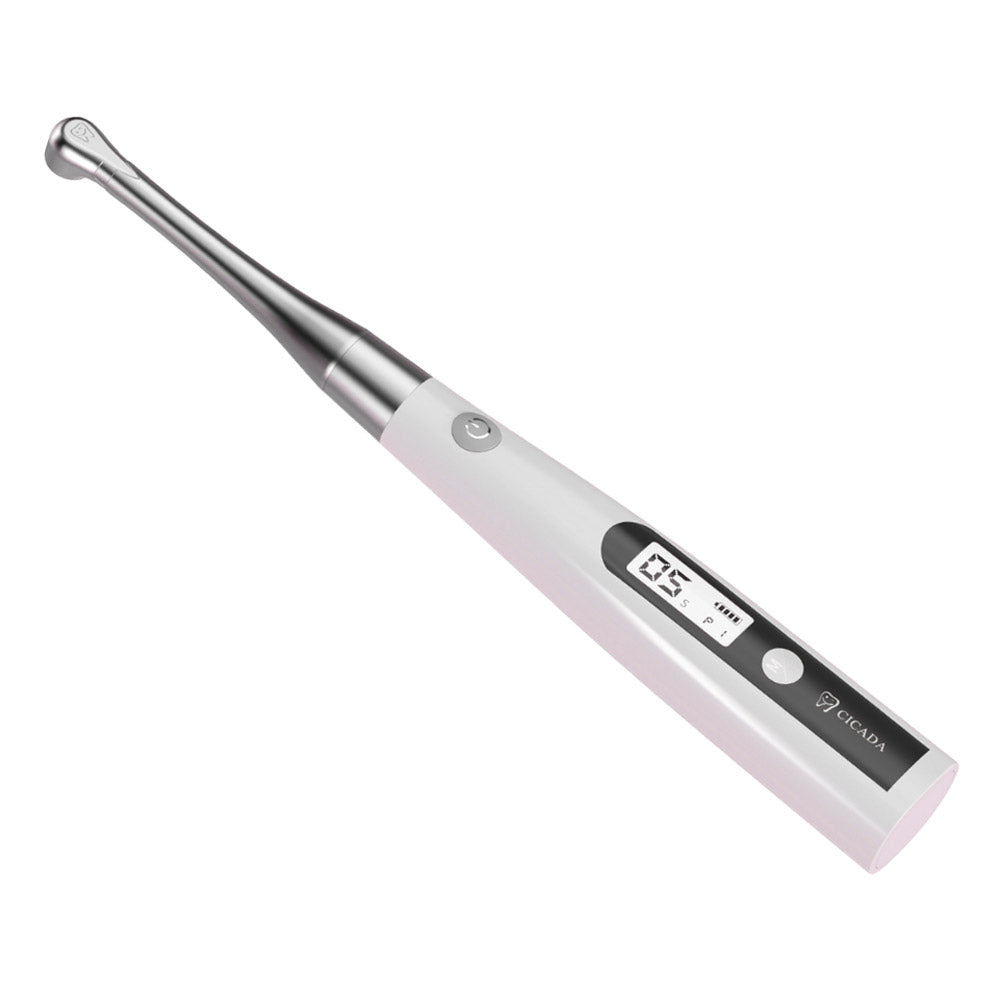
The Pac-Dent iVac™ LED Piezo Ultrasonic Scaler Unit, supplied by Pac-Dent for endodontic procedures. Catalog code 9542PS.
Pac-Dent iVac™ LED Piezo Ultrasonic Scaler Unit is a scaler unit from Pac-Dent. Manufacturer part number 9542PS.
Find it on our Equipment shelf, under Ultrasonic Scalers & Electrosurgery.
Orders placed before 3 PM ET ship the same day when the item is on our shelf (otherwise within 3 business days), and ground shipping is free over $10.
Product
- Manufacturer
- Pac-Dent
- Manufacturer #
- 9542PS
- Item code
- 103-1685
- UPC / Barcode
- 9542PS
Catalog path
- Marketplace
- Clinical
- Category
- Equipment
- Subcategory
- Ultrasonic Scalers & Electrosurgery
Ordering
- Status
- Special order
More from Ultrasonic Scalers & Electrosurgery
Stocked in the same subcategory.



Questions
What is it used for?
The Pac-Dent iVac™ LED Piezo Ultrasonic Scaler Unit, supplied by Pac-Dent for endodontic procedures.
When does it ship?
In-stock orders placed before 3 PM ET ship the same day. An item we don't keep on the shelf shows its own ship-by date on its page, and you can cancel it for a full refund until it ships.Ground shipping is free over $10.
About scaler units
An ultrasonic scaler unit is the powered unit and its handpiece, which drive the vibrating tip, as against the tips and accessories that fit it. A piezoelectric scaler has a negative feedback function that automatically adjusts the output power based on the resistance the working tip meets. There is no uniform method for quantifying the output power of a machine, which makes two machines of the same stated power hard to compare.
An ultrasonic scaler is used during dental cleaning and periodontal therapy to remove calculus deposits from teeth by applying an ultrasonic vibrating scaler tip, and the FDA classes it as Class II (21 CFR 872.4850). There are two categories: magnetostrictive scalers generate tip vibrations from 18 to 45 kHz, piezoelectric scalers from 25 to 50 kHz. ISO 18397 is the international standard for powered scalers, covering air-powered and electrical-powered handpieces and tips of both kinds.
A dental electrosurgical unit is the other machine on this shelf: a controlled power source with a set of cutting and coagulating electrodes, intended to cut or remove soft tissue or to control bleeding during surgical procedures in the mouth, classed as Class II (21 CFR 872.4920). The current passes through the tip of the electrode into the tissue and, depending on the operating mode selected, cuts through soft tissue or coagulates it. Published work describes electrosurgery as working by high-frequency current to cut and coagulate tissue, resulting in a bloodless surgical field.
How the machines and their parts differ
- Scaler Units — The unit that generates the vibration, as against the tips and accessories that fit it. A rotary scaler does the same job differently: it is an abrasive device attached to a powered handpiece to remove calculus deposits, also Class II (21 CFR 872.4840).
- Scaler Tips & Inserts — The part that is changed, matched to one of the two categories of ultrasonic scaler.
- Scaler Accessories — Carries water, air or the tip to the unit; it is not the working end itself.
- Electrosurgery Units — Cuts and coagulates soft tissue with current, where a scaler removes calculus from teeth with vibration.
- Electrosurgery Accessories — The electrode that carries the current into the tissue, not the generator behind it.
- Air Polishing Units — Cleans with a powder-and-water jet rather than with a vibrating tip. Powder jet handpieces sit outside the scope of ISO 14457, the standard for dental handpieces and motors, as do air-powered and electrical-powered scalers.
- General Repair & Replacement Parts — A worn part swapped for the same part, not a tip consumed in treatment.
- Handpiece Parts Accessories & Maintenance — Belongs to the handpiece that carries the tip, not to the generator or the tip itself.
- Filters — Treats the water going into the scaler rather than touching the tooth.
- Hoses Tubing & Fittings — Carries water and air to the handpiece; the filter in the same line treats what passes through it.
Two pages here also carry a hand-instrument scaler tag although the products are piezo tips; that type belongs to the periodontal instruments shelf.
What to look at when choosing
Scaler type: the tips are made for one category or the other, and the two differ in frequency as well as in tip movement. In a clinical study patients reported more pain, noise and vibration from magnetostrictive scalers than from piezoelectric ones, which the authors attribute to the different tip movements.
Power: low power is recommended in order to reduce discomfort and loss of hard tissue, and a narrative review found a positive correlation between power setting and surface alteration.
Implanted cardiac devices: the ADA reports that piezoelectric dental scalers may be safer than magnetostrictive models, and that electrosurgery devices have the highest potential for electromagnetic interference. In-vitro studies have consistently shown clinically significant interference from monopolar electrosurgery, including pacing interruptions.
Powder for an air polisher: sodium bicarbonate is effective on supragingival plaque and stains but is highly abrasive to root cementum, dentin and restoration surfaces. Glycine is approximately 80 percent less abrasive than sodium bicarbonate, and erythritol has a particle size similar to or smaller than glycine. A narrative review of periodontal instrumentation described air-polishing systems as less abrasive, particularly in biofilm management.
Polishing powder is its own FDA class: an oral cavity abrasive polishing agent, a paste or powder containing an abrasive material intended to remove debris from the teeth and applied by a handpiece attachment, Class I under 21 CFR 872.6030.
Sources: FDA 21 CFR 872.4850, Ultrasonic scaler · You et al. 2024, Effects of a new magnetostrictive ultrasonic scaler and a traditional piezoelectric ultrasonic scaler (Sci Rep) · ISO 18397:2025, Dentistry — Powered scalers · FDA 21 CFR 872.4920, Dental electrosurgical unit and accessories · Management of Chronic Inflammatory Gingival Enlargement Using Conventional and Electrosurgical Techniques (Clin Cosmet Investig Dent, PMC13367337) · FDA 21 CFR 872.4840, Rotary scaler · Influence of scaler tip design on root surface roughness, tooth substance loss and pain perception (BMC Oral Health, PMC8011415) · ADA Oral Health Topics: Dental Unit Waterlines · ADA Oral Health Topics: Cardiac Implantable Devices and Electronic Dental Instruments · Antimicrobial Efficacy and Soft-Tissue Safety of Air-Polishing Powders in Periodontal Therapy: A Narrative Review (J Funct Biomater, PMC12841966) · ISO 14457:2017, Dentistry — Handpieces and motors · ADA Oral Health Topics: Infection Control and Sterilization · The Impact of Periodontal Instrumentation on Enamel and Cementum: A Narrative Review (Dent J, PMC13205519) · FDA 21 CFR 872.6030, Oral cavity abrasive polishing agent
