

GingiPakIn stock
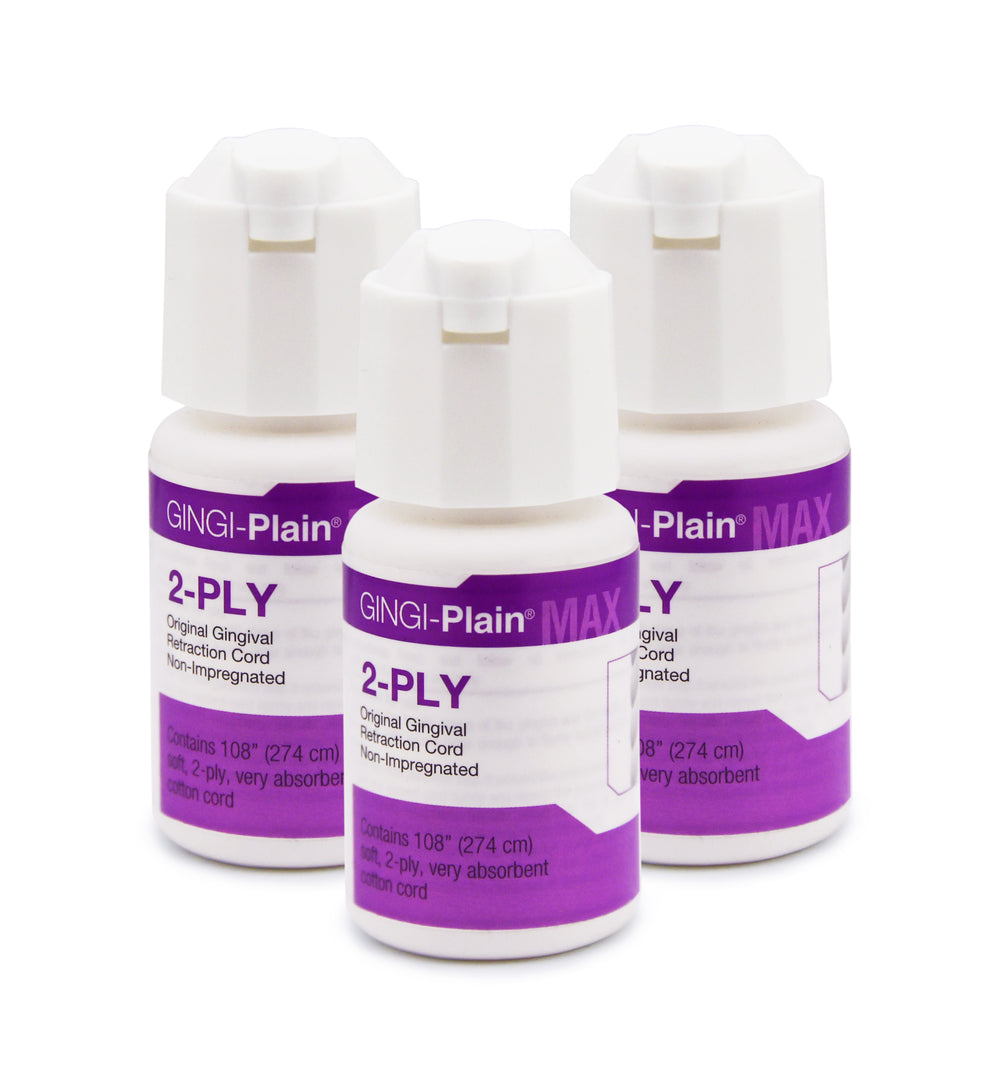
GingiPak Gingi-Pak MAX Retraction Cord, 108" · Epinephrine (Gingi-Pak) · 2-Ply
SKU 112-0046MFR# 10120M
Impregnation
Epinephrine (Gingi-Pak)
Epinephrine (Gingi-Pak)$15.40
Non-Impregnated (Gingi-Plain)$13.65
Ply
2-Ply
2-Ply$15.40
4-Ply (Crown-Pak)$26.43
Gingi-Pak MAX Cord 2-Ply is a retraction cord. It is used for gingival retraction during restorative and cosmetic dental procedures. Its application facilitates clear margins for impressions or direct restorations.
This cord features an original 2-ply design and contains epinephrine. Each bottle provides 108 inches of cord. This format is suitable for practices requiring a medicated, two-ply retraction cord for precise tissue management.
Product
- Manufacturer
- GingiPak
- Manufacturer #
- 10120M
- Item code
- 112-0046
Catalog path
- Marketplace
- Clinical
- Category
- Restorative & Cosmetic
- Subcategory
- Retraction & Hemostatics
Ordering
- Status
- In stock
More from Retraction & Hemostatics
Stocked in the same subcategory.


Vericom
DenFil Light-Cure Micro-Hybrid Composite Capsules, 0.25 g — 20/Pack
In stock
144 sold this month$30.40

RMH3 Dental
MiFlo Delivery Tips, Pre-Bent Needle Tip with Brush Padded End, 19G — 100/Box
In stock
55 sold this month$28.03

RMH3 Dental
Articulating Paper, Blue/Red — 12 Books × 12 Sheets
In stock
23 sold this monthfrom $3.80

Questions
Which impregnation and ply options are on this page?
This page carries 2 impregnation options: Epinephrine (Gingi-Pak), Non-Impregnated (Gingi-Plain). This page carries 2 ply options: 2-Ply, 4-Ply (Crown-Pak). Pick one to see its price, part number and stock.
When does it ship?
In-stock orders placed before 3 PM ET ship the same day; anything not on our shelf ships within 3 business days.Ground shipping is free over $10.
About retraction cord
Retraction cord comes knitted, twisted or braided, and either impregnated with a medicament or hemostatic agent or left plain. Cords are colour-coded and sold in diameters numbered from 000 to 3 for different sulcus depths, with no standardised sizing system behind the numbers. Braided cord is tightly woven, so it places without fraying and absorbs medicaments well, but pressing on one section can dislodge another from the sulcus. Knitted cord is made of interlocking loops that adapt as it goes in and stay put when the next section is inserted, and it compresses on insertion.
Gingival displacement is the deflection of the marginal gingiva away from a tooth, and gingival retraction is another name for the same thing. It opens space at the margin, so that a preparation below the gum line can be reached and enough impression material sits in the widened crevice. It also helps control bleeding, which matters for hydrophobic impression materials and for adhesive restorations. The techniques are grouped as mechanical, chemical, surgical, or a combination of those, and the mechanical one uses retraction cords.
How cords, agents and instruments differ
- Retraction Cord — The mechanical part: a thread packed into the sulcus to displace the tissue. It is used on its own or together with a hemostatic or vasoconstrictor agent.
- Hemostatic Agents & Paste — The chemical part: it stops the bleeding and dries the field rather than pushing the tissue aside. A retraction paste works without a cord: one widely used paste is kaolin with aluminium chloride, and it swells on contact with crevicular fluid.
- Retraction Instruments & Accessories — The tools that place the cord and carry the agent, rather than the materials themselves. A review notes that a periodontal probe is used for interproximal cords, and a flat plastic instrument where the gingival tissue is thin.
What to look at when choosing
Cord size: a review ties the numbers to the job, with 000 for anterior teeth and double packing, and 3 for areas of fairly thick gingival tissue where a significant amount of force is required. Cord construction: twisted cord frays and untwists more readily while being placed, so it is used less than braided and knitted cord.
Impression material: a review lists inhibition of the set of polyvinyl siloxane and polyether impressions among the disadvantages of both aluminium chloride and ferric sulfate. The same table lists tissue discoloration under ferric sulfate, and notes that ferric sulfate is compatible with aluminium chloride but not with epinephrine.
Bonding afterwards: studies have found that contamination with an aluminium chloride hemostatic agent can significantly decrease bond strength, one reason being that these acidic substances remove the smear layer and alter the dentine surface. Strength of the agent: a narrative review reports that ferric sulfate solutions above 15 percent are highly acidic and may cause considerable tissue irritation and postoperative root sensitivity.
Cord or no cord: a survey of 188 dentists found the cordless technique believed to be easier, faster and less traumatic to the gingival tissues, while the impression was believed to be more predictable with conventional cords and hemostatic medicaments. A paste depends on expanding in the sulcus, and a review notes it may not displace enough where the sulcus is deep.
Sources: The Glossary of Prosthodontic Terms, 9th edition (J Prosthet Dent 2017) · Dentists’ knowledge and preference regarding gingival displacement methods (BMC Oral Health 2023) · Present status and future directions: Soft tissue management in prosthodontics (World J Methodol 2025) · Effect of an aluminum chloride hemostatic agent on the dentin shear bond strength of a universal adhesive (Restor Dent Endod 2023) · Clinical applications of ferric sulfate in dentistry: A narrative review (J Conserv Dent 2017)
