

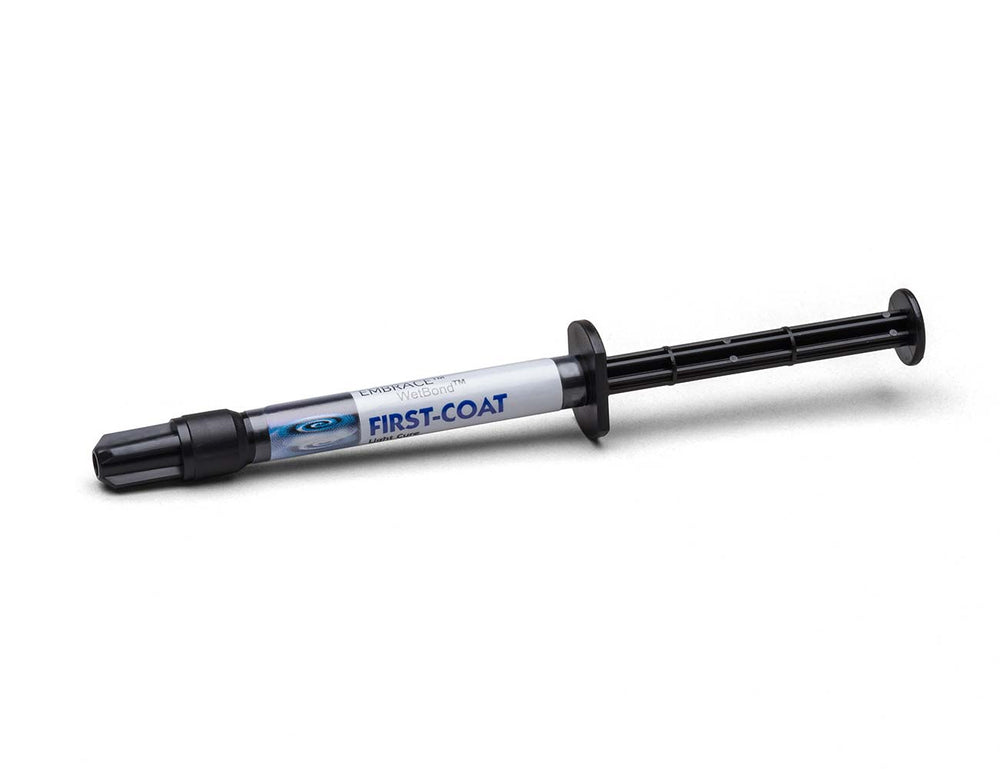
A one-step, resin-based primer that bonds chemically and mechanically to etched ceramic and abraded metal surfaces. 1.2 mL syringe.
• One step – takes the place of silane and metal primers • Contains no solvents • Pulpdent calls it stronger than silane • Light cure
How it's used: Apply to etched porcelain and abraded metal, light cure, then opaque or restore with composite.
For use by a dental professional. Made in USA by Pulpdent Corporation.
Product
- Manufacturer
- Pulpdent
- Manufacturer #
- EMFC
- Item code
- 106-1112
- UPC / Barcode
- EMFC
Catalog path
- Marketplace
- Clinical
- Category
- Restorative & Cosmetic
- Subcategory
- Bonding & Etch
Ordering
- Status
- Ships in 3 business days
More from Bonding & Etch
Stocked in the same subcategory.


Veratiq Dental
Veratiq Etchera 37% Phosphoric Acid Etchant Gel
In stock
168 sold this monthfrom $5.69
Questions
What is Embrace used for?
A one-step, resin-based primer that bonds chemically and mechanically to etched ceramic and abraded metal surfaces.
When does it ship?
In-stock orders placed before 3 PM ET ship the same day; anything not on our shelf ships within 3 business days.Ground shipping is free over $10.
About ceramic primers and silane
Silane is a coupling agent: it improves the chemical bond between an inorganic surface, such as a dental ceramic, and resin. On glass-based ceramics it is applied after hydrofluoric acid etching; for zirconia-based ceramics a systematic review describes it as optional or not required.
A bonding agent is a resin painted onto the inside of a prepared tooth to improve the retention of a restoration such as a filling. The FDA regulates it as a resin tooth bonding agent, a Class II device (21 CFR 872.3200). An etchant is a chemical agent that selectively dissolves a surface, leaving it retentive.
Bonding to teeth follows an etch-and-rinse or a self-etch strategy; resin-modified glass ionomer, which adheres on its own, is counted as a third. Retention comes from a hybrid layer and resin tags formed when the adhesive hardens inside the etched surface.
How the types of adhesive and etchant differ
- Universal adhesives — One adhesive for any of the three etching approaches. The makers of some still call for a separate activator or a dedicated primer on porcelain and zirconia.
- Self-etch adhesives — No separate acid and no rinsing. It does not etch enamel to the depth phosphoric acid does.
- Total-etch adhesives — Applied after phosphoric acid that is rinsed away. A review calls the three-step systems the most versatile, usable with self-cure, dual-cure and light-cure protocols.
- Etching agents — The acid itself: phosphoric acid for enamel and dentin, hydrofluoric acid for glass-based ceramics.
- Ceramic primers and silane — Prepares the ceramic restoration, not the tooth, for bonding.
- Adhesive accessories — The applicators that carry the adhesive to the tooth.
What to look at when choosing a bonding agent
Bottles and steps: systems run from three bottles to one. A review reports the highest bond strengths for the three-step systems, which are also the most complicated to use.
Compatibility: not all one-bottle etch-and-rinse adhesives are compatible with self-cured or dual-cured materials or with core materials.
Delivery: self-etch adhesives come in bottles or unit doses, and two-part ones are mixed immediately before use.
For ceramics: a systematic review found better bonding when silane was applied separately than when it was only contained in a universal adhesive.
Testing: ISO 29022 describes the shear test used to measure the bond strength between restorative materials and tooth structure.
Sources: FDA 21 CFR 872.3200, Resin tooth bonding agent · The Glossary of Prosthodontic Terms, 9th edition (J Prosthet Dent 2017) · Sofan et al. 2017, Classification review of dental adhesive systems (Ann Stomatol) · Chmielewska et al. 2022, Material Connections in Restorative Dentistry: A Comprehensive Review (Int J Mol Sci) · Dapieve et al. 2018, Silane incorporated to universal adhesives or applied separately: A systematic review (J Indian Prosthodont Soc) · FDA 21 CFR 872.3140, Resin applicator · ISO 29022:2013, Notched-edge shear bond strength test
