

DreveSpecial order
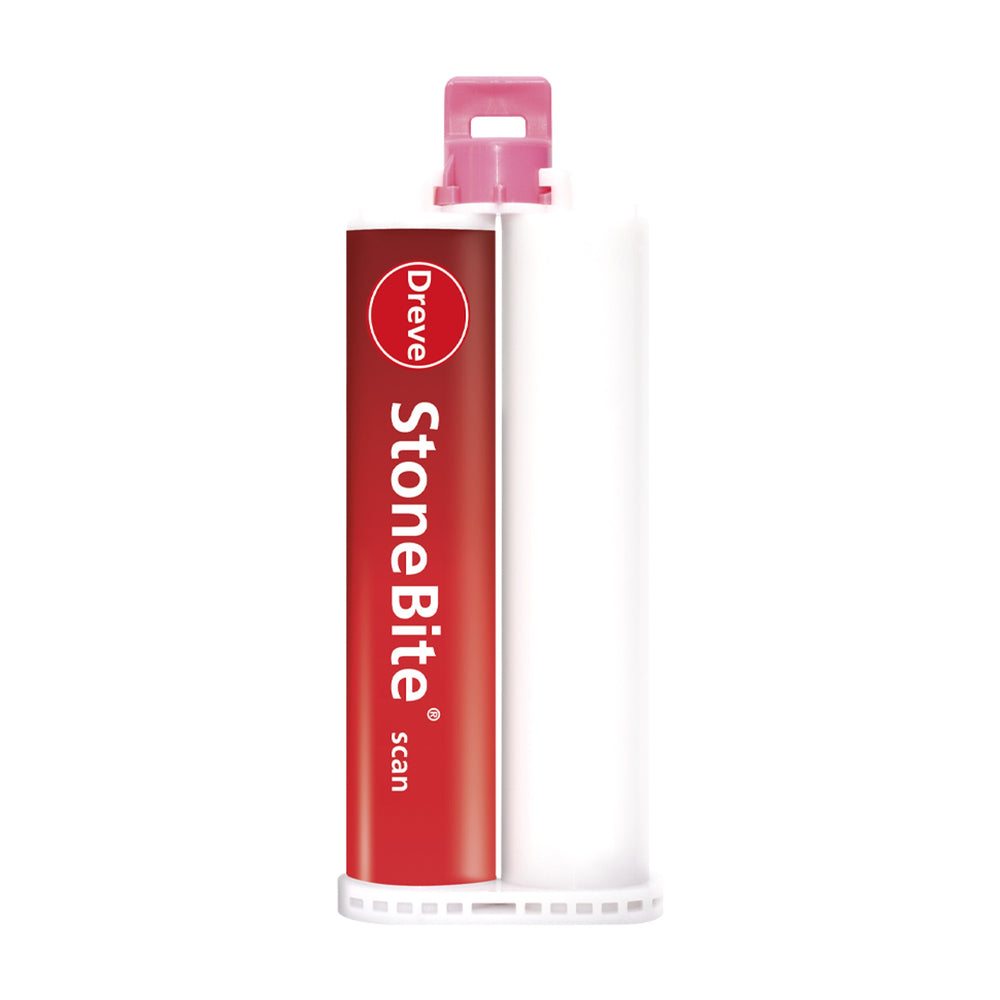
Dreve StoneBite scan Bite Registration Material · 2 x 50 ml Cartridges
SKU 120-0250MFR# D504870
Pack Size
2 x 50 ml Cartridges
2 x 50 ml Cartridges$121.85
Scannable addition-curing silicone (VPS) bite registration material for CAD/CAM work, easy to cut and mill. In 50 ml double cartridges.
For use by a dental professional.
Product
- Manufacturer
- Dreve
- Manufacturer #
- D504870
- Item code
- 120-0250
Catalog path
- Marketplace
- Clinical
- Category
- Impression Materials
- Subcategory
- Bite Registration
Ordering
- Status
- Special order
More from Bite Registration
Stocked in the same subcategory.


MN Health
EcoPression VPS Bite Registration Material, 2 × 50 mL Cartridges
In stock
1,022 sold this monthfrom $9.20


MN Health
EcoPression VPS Impression Material, 4 × 50 mL Cartridges
In stock
522 sold this monthfrom $18.00


Keystone Industries
Keystone Tray-Aways Disposable Impression Trays — 12/Pack
In stock
64 sold this monthfrom $8.44
About VPS bite registration
VPS bite registration materials are vinyl polysiloxane: a base and a catalyst pressed from a cartridge and mixed as they come out, to record the bite. A survey reports that vinyl polysiloxane improved both horizontal and vertical stability of the mounted casts, because of its own rigidity and dimensional stability. Setting times differ widely between products: one study measured 30 to 180 seconds against a regular setting standard material at 60 seconds. A few practitioners in one survey syringed the material directly onto the occlusal surfaces with a mixing dispenser.
A bite registration is the everyday word for a maxillomandibular relationship record. That record is a registration of any positional relationship of the lower jaw against the upper, and it can be made at any vertical, horizontal or lateral orientation. An interocclusal record is a registration of the positional relationship of the opposing teeth or arches. A published survey describes it as an accurate and dimensionally stable representation of the interocclusal space, which is then transferred to an articulator.
The materials in clinical use for it are plaster, wax, zinc oxide-eugenol paste, autopolymerising acrylic resin, polyether and polyvinyl siloxane. Polyether and polyvinyl siloxane were developed as impression materials and are now sold as interocclusal registration materials as well. ISO 4823 is the international standard for elastomeric impression and bite registration materials.
How the two kinds of bite registration material differ
- VPS Bite Registration — A two-paste silicone that sets in the mouth in seconds to a few minutes. A set record of this kind is named for articulation within 24 hours.
- Bite Registration Materials — A paste that is mixed, or a wax that is warmed, instead of a silicone pressed from a cartridge. Wax and zinc oxide eugenol records are named for articulation within one hour, where a silicone record is named for 24.
What to look at when choosing a bite registration material
What these materials are judged on: little resistance before setting so the jaw can close freely, little dimensional change after setting, accurate recording of the incisal and occlusal surfaces, simple handling, biocompatibility and easy checking.
Setting time: the patient has to hold the jaw in one position while the material sets, and a study names uncontrolled jaw movement as a cause of records that have to be repeated. Older patients with poor neuromuscular control find it difficult to hold the jaw in one position while the material sets.
Rigidity: the set record has to resist distortion from the weight of the casts and the parts of the articulator used to hold them while the casts are mounted.
Dimensional stability over days: one study of silicone bite materials found the most stable ones changed by less than a tenth of a millimetre from the original die at 24, 72 and 168 hours, while the least stable changed much more.
After it is out of the mouth, only minor changes such as trimming are permitted, and about half the practitioners in one survey trimmed the record before it went to the laboratory.
Sources: The Glossary of Prosthodontic Terms, 9th edition (J Prosthet Dent 2017) · Trends in Selection, Usage, and Techniques of Interocclusal Record Materials among Private Dental Practitioners, 2018 (PMC6006868) · ISO 4823:2025, Dentistry — Elastomeric impression and bite registration materials · Digital Accuracy of Closed-Tray Implant Impressions: Influence of Polyvinyl Siloxane Viscosity, 2025 (PMC12468653) · Variations in linear dimensional accuracy and stability of vinylpolysiloxane-based bite registration materials, 2025 (PMC12836952) · Dimensional Stability and Compressive Resistance of Three Interocclusal Record Materials, 2024 (PMC11568839) · FDA 21 CFR 872.6890, Intraoral dental wax
