


DirectaShips in 3 business days
Directa ContacEZ Subgingival Strip System · Assorted · Small Pack
SKU 107-0685MFR# 33108
Strip
Assorted
Pack
Small Pack
The Directa Subgingival Strip System GOLD Small Pk is a finishing and polishing product. It is designed for application in subgingival areas, facilitating the creation of refined surface contours and smooth margins.
This system features a GOLD designation, indicating a specific material or coating, and is supplied in a small pack format. It is intended for dental professionals who require a specialized finishing solution for precise subgingival applications.
Product
- Manufacturer
- Directa
- Manufacturer #
- 33108
- Item code
- 107-0685
Catalog path
- Marketplace
- Clinical
- Category
- Finishing & Polishing
- Subcategory
- Strips
Ordering
- Status
- Ships in 3 business days
More from Strips
Stocked in the same subcategory.
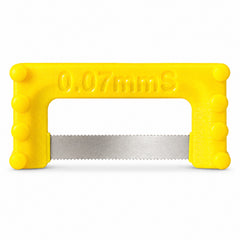


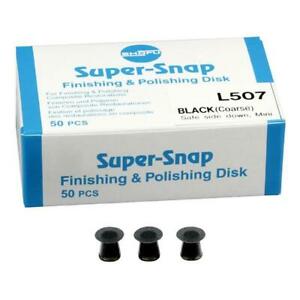


Questions
What is it used for?
The Directa Subgingival Strip System GOLD Small Pk is a finishing and polishing product.
Which strip and pack options are on this page?
This page carries 4 strip options: Gold, Blue, Assorted, Copper. This page carries 3 pack options: Small Pack, Large Pack, Medium Pack. Pick one to see its price, part number and stock.
When does it ship?
In-stock orders placed before 3 PM ET ship the same day; anything not on our shelf ships within 3 business days.Ground shipping is free over $10.
About polishing strips
A polishing strip is the finer grade, used to smooth and gloss a surface between teeth after it has been shaped. Published work on reducing enamel between teeth describes polishing as an indispensable step afterwards, to smooth the surface and clear away residual debris and abrasive particles. Many strips carry more than one grade on the same band, so the coarse-to-fine sequence runs on one instrument.
A strip is a thin flexible band coated with abrasive, pulled through by hand between two teeth where no rotary instrument fits. The FDA names the polishing agent strip in its Class I list of abrasive devices and accessories (21 CFR 872.6010). Published work on reducing enamel between teeth lists the available systems as hand-held abrasive strips, tungsten carbide or diamond burs, and powered systems such as mechanical oscillating disks or strips. One kind used in that work is described as a double-sided metallic electroplated abrasive strip 6 mm wide.
A strip is also used to adjust a restoration already in place: published work describes a diamond strip adjusting the tightness of a proximal contact by sawing a constant amount of material between the new restoration and the neighbouring tooth. The same work notes a strip can be used once the prosthesis is seated, so a contact can be adjusted even after cementation. It also gives the thickness of the diamond strips tested as roughly 65 to 75 microns, more than the 13 to 30 microns of shim stock.
How the types of strip differ
- Polishing strips — The finishing and gloss grades, used after the shape is set.
- Interproximal strips — Removes material from a contact; published work puts it alongside burs and discs as a stripping instrument, with polishing to follow.
- Polishers — Named for what it does rather than for the band it comes on.
What to look at when choosing a strip
Grit and backing: published work describes metallic electroplated abrasive strips and names the type and grit size of the abrasive coating as a factor in the surface produced.
Thickness: published work gives the diamond strips tested as roughly 65 to 75 microns thick, and notes that this makes them hard to insert between a restoration and the neighbouring tooth depending on periodontal health and tooth mobility.
One side or two: published work describes both single-sided diamond-coated discs and double-sided manual metallic strips in the same comparison.
Hand or handpiece: the same work ran the diamond-coated discs and the oscillating strips at 5,000 rpm with continuous water, while the manual strips were pulled by hand.
What follows: published work found polishing produced smoother surfaces in every group, and describes it as an indispensable step after reduction.
Sources: Omar et al. 2026, Evaluation of enamel surface after interproximal reduction using different methods, with and without polishing (Sci Rep) · FDA 21 CFR 872.6010, Abrasive device and accessories · Kim et al. 2025, A comparison of stone-based and diamond strip approaches for adjusting proximal contact tightness (BMC Oral Health) · Polishing systems for modern aesthetic dental materials: a narrative review, 2024 (Br Dent J) · Büyükpolat et al. 2025, The effect of polishing pastes on the surface roughness, microhardness, gloss, and color change of resin composites (BMC Oral Health) · ISO 6360-6:2004, Number coding system for rotary instruments — Abrasive instruments · ISO 8325:2023, Dentistry — Test methods for rotary instruments
