

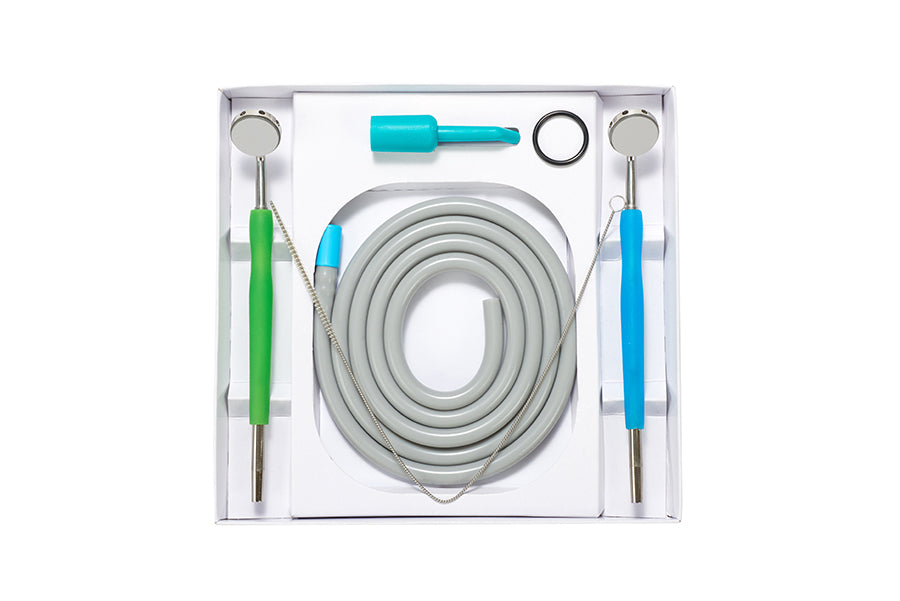
Kit
Mini Kit
Full Kit$270.00
Mini Kit$155.00
The DiaDent Miracle Suction Full Kit is a evacuation product supplied by DiaDent for dental evacuation. Catalog code 901-001.
DiaDent Miracle Suction Kits is an isolation & starter kit from DiaDent.
This page carries 2 kit options: Full Kit, Mini Kit.
Find it on our Evacuation shelf, under Isolation Systems.
Orders placed before 3 PM ET ship the same day when the item is on our shelf (otherwise within 3 business days), and ground shipping is free over $10.
Product
- Manufacturer
- DiaDent
- Manufacturer #
- 901-002
- Item code
- 110-0129
Catalog path
- Marketplace
- Clinical
- Category
- Evacuation
- Subcategory
- Isolation Systems
Ordering
- Status
- Ships in 3 business days
More from Isolation Systems
Stocked in the same subcategory.


Questions
What is DiaDent Miracle Suction Kits used for?
The DiaDent Miracle Suction Full Kit is a evacuation product supplied by DiaDent for dental evacuation.
Which kit options are on this page?
This page carries 2 kit options: Full Kit, Mini Kit. Pick one to see its price, part number and stock.
When does it ship?
In-stock orders placed before 3 PM ET ship the same day; anything not on our shelf ships within 3 business days.Ground shipping is free over $10.
About isolation systems and starter kits
One kind of isolation system functions as a combined device for suction, retraction, illumination and isolation. Another integrates fluid evacuation, tongue and cheek retraction and a bite block, is autoclavable, has no illumination feature, and isolates and evacuates half of the oral cavity at a time. A starter kit is the control unit together with the mouthpieces and parts needed to begin.
Controlling moisture and microbes are likely the two most crucial variables for a successful restoration. Moisture control is critical to the efficacy and success of various dental procedures, resin sealants especially, because the surface to be treated must be clean and dry. The most used isolation techniques for moisture control are cotton rolls with saliva ejectors, and dental clamps with a rubber dam.
The FDA’s rubber dam is a thin sheet with a hole in the centre, intended to isolate a tooth from fluids in the mouth, and the device includes the dam, the clamp, the frame and the forceps for the clamp (21 CFR 872.6300, Class I). There is no rubber dam shelf here; what this shelf holds are the suction-based alternatives, their mouthpieces and absorbent pads.
Although the rubber dam is regarded as the ideal tool for isolation, several comparative studies of rubber dam isolation against alternative isolation techniques have reported no statistically significant differences in clinical outcomes. A two-year randomised trial in primary molars found cotton roll isolation non-inferior to rubber dam for the longevity of composite restorations. A systematic review of isolation in oral and maxillofacial surgery reports that several newly developed alternative isolation techniques outperformed the rubber barrier in terms of acceptability and operability.
How the types of isolation system differ
- Isolation & Starter Kits — One unit does the suction, the retraction and the bite block together.
- Mouthpieces — The consumable part of an isolation system, changed between patients, not the control unit.
- Cotton Roll Substitutes — An absorbent pad for the sublingual or parotid area, in place of a roll that has to be swapped out.
What to look at when choosing an isolation system
Hands: the vacuum a high-volume evacuator generates is strong enough that a dental assistant is needed to stabilise it in the mouth. A study of a self-holding suction device reported that it prevented the tongue and cheeks from interfering with the operation area and did not require a dental assistant.
Reprocessing: whether the mouthpiece is single use or autoclavable decides how it is handled between patients.
What the evidence says: a systematic review found that the application of rubber dams may result in a successful outcome compared to cotton rolls on some low-certainty evidence, and that additional high-quality studies are necessary.
Sources: Tiwari et al. 2023, Isolation Systems and its Effectiveness in Oral and Maxillofacial Surgery: A Systematic Review (J Pharm Bioallied Sci) · Safety and effectiveness of an innovative SS-suction device to control moisture in dental procedures, 2023 (PMC10366434) · Use of rubber dam versus cotton roll isolation on composite resin restorations’ survival in primary molars: 2-year results from a non-inferiority clinical trial (PMC9552420) · FDA 21 CFR 872.6300, Rubber dam and accessories · Optimizing Pediatric Patient Comfort: A Study of Moisture Isolation Techniques During Dental Treatments, 2026 (PMC12939983) · CDC, Guidelines for Infection Control in Dental Health-Care Settings — 2003 (MMWR 52(RR-17)) · FDA 21 CFR 872.6050, Saliva absorber · Droplet Distribution in a University Dental Clinic Setting: The Importance of High-Volume Evacuation, 2022 (PMC9499005)
